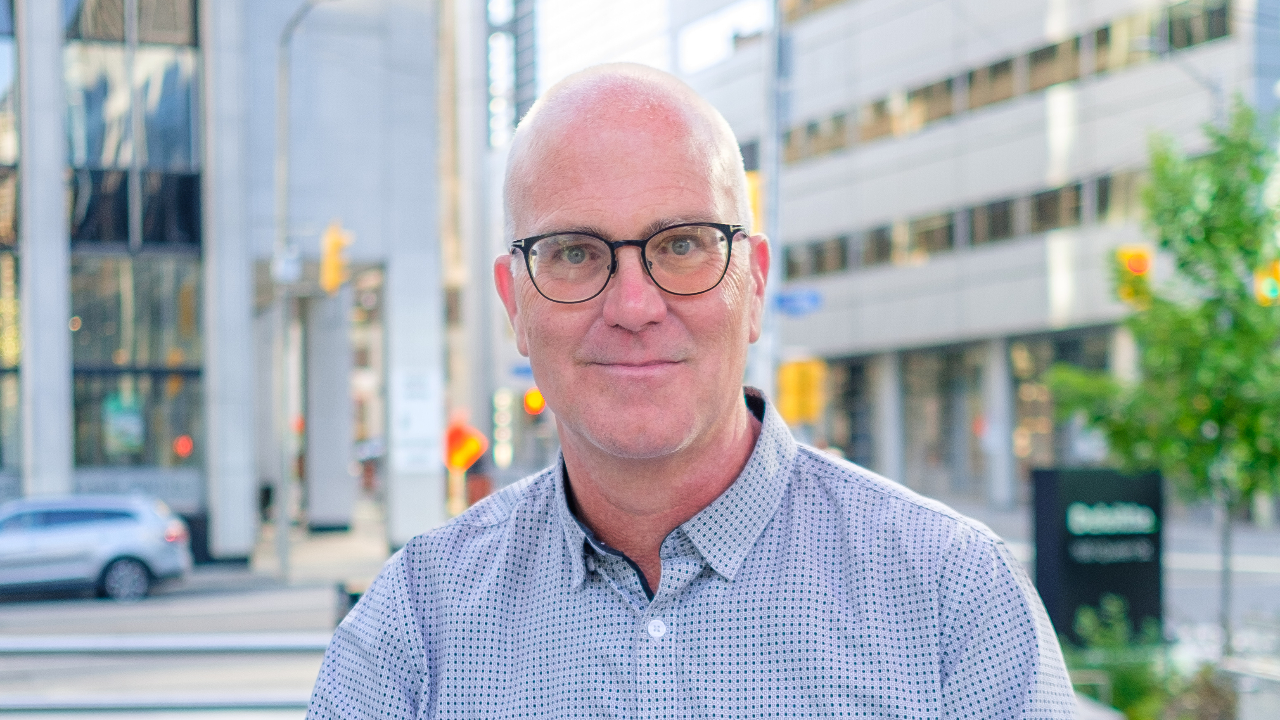
Jeff Leiper is no stranger to City Hall, having been the councillor for Kitchissippi Ward since 2014.
In those 12 years, Leiper said he’s seen economic issues from a number of perspectives. When asked to name a business that reminds him why the local economy matters, Leiper was quick to reply.
“There is no better business in my mind than The Record Centre on Wellington Street as an example of that,” Leiper told OBJ Tuesday. “Businesses succeed best when they develop a relationship with their customers. They become community contributors, and particularly in Hintonburg and with businesses like The Record Centre. What we see is a very virtuous circle of businesses who support the community and the community supports those businesses in return.”
Now, Leiper is on the campaign trail to become mayor when Ottawans go to the polls Oct. 26.
Outside of Hintonburg, Leiper said he’s conversed with business owners across the city to understand what matters to them. He shared more details on his platform with OBJ, including his positions on issues relevant to the business community. The following transcript has been edited for length and clarity.
What are the main pain points for the local economy as we head into this election?
“I’ve been talking a lot with local businesses right across the city and there’s a number of things that they raise with me when we have those conversations. I hear a lot about city construction, particularly for our retail businesses and the businesses that have offices that are storefront or above-storefront. The impact of city construction projects is often a pain point. I hear about parking. That is an issue that is evergreen. I hear a lot about engagement with City Hall. The ability to take advantage of programs at City Hall can be difficult for local businesses to navigate the bureaucracy and find the right door. That’s particularly true of businesses that are not part of a BIA, which obviously is a very substantial number of the businesses in Ottawa.”
What would you do in the ByWard Market?
“The ByWard Market is experiencing challenges. One of the considerations is around attracting customers by increasing or enhancing people’s feelings of safety and I think one of the things that I would really like to do is to put more outreach, including overnight outreach, on the streets in the ByWard Market. To put a more visible presence by the city on the streets to help customers, businesses and residents all feel safer and more secure. There are questions around whether we’re getting the right level of programming in the ByWard Market. Is there more that we could be doing on programs to make it a regional or city-wide attraction? I would increase bylaw staffing to make sure that when people have bylaw complaints about things like derelict properties they are being responded to quickly. And I would focus on cleanup. Just trying to keep the ByWard Market tidy-looking. I think the city could be doing more on that. There is a question as to whether the right infrastructure is in place in the ByWard Market. Is the right public realm infrastructure in place? We have what looks to be an attractive long-term plan for the ByWard Market and the public infrastructure, but I think there is a question as to whether it is the best we can do. Whatever plan we wind up finally developing, we need to make sure that we follow through on that.”
What would be your next steps in downtown revitalization?
“I’m not sure that we have done enough real listening at this point. So when I am mayor, I intend my very first thing to say is, ‘Here’s what we’ve heard and we have a number of plans and we have a number of strategies.’ So I really want to talk to all of the stakeholders involved to make sure that we’ve got the right plans in place and that I’m understanding what businesses have been telling the city. Certainly the cleanup in terms of physically cleaning the streets, making sure that they are tidy, is something that I want to get to work on right away. Then it’s about ensuring that we have outreach ambassadors, some of that non-police response, on the streets. It’s something that I can begin working on right away as well.”
What plans do you have for nightlife/vibrancy and tourism in Ottawa?
“I will have more to say about that in the coming weeks, but this is very, very important to me. First off, we need to move a portion of arts and culture funding into our economic development branch. So we need to treat funding for arts and culture as part of how Ottawa is going to support jobs or support tourism and increase local business activity. That restructuring is going to be critical. I think that there will still be some arts and culture funding that is off to the side, such as when we commission art, for example. But a lot of the funding that is going into the performing arts, for example, I think that we need to move it into the economic development branch and that’s something that I’ve heard directly from business owners in Ottawa.”
What do you propose doing for the housing sector?
“On housing, we have two crises. The first of them is with respect to affordable market housing. For a little bit, we’re going to have to see how the new comprehensive zoning bylaw that I shepherded through our council process ends up working. We’ve added new permissions to build a lot more housing through our Official Plan and our new zoning bylaw and I want to keep a close eye on how that evolves. There is also a real crisis for people who struggle to afford market housing at all and my plan is to build 1,500 not-for-profit housing units on city-owned land every year.
“So one of my frustrations is that city-owned land that’s suitable for residential development has been slow to get into the hands of our not-for-profit partners and that’s something that I want to start doing right away. The acquisition of housing needs to be accelerated as well. So the best way to preserve housing as affordable is to preserve the affordable housing that we already have. An acquisition fund to help either the city’s not-for-profit arm under Ottawa Community Housing or third-party not-for-profit players to acquire not-for-profit rental housing and keep it affordable in perpetuity is very, very important to me as well. We also need to ensure strong enforcement of property standards bylaws, which has been a frustration of mine as a city councillor, to ensure that we are using every tool at our disposal so that bad landlords who are letting their residential properties fall into disrepair are required to bring it back into repair.”
What type of support might you offer the tech sector?
“Invest Ottawa is something of which I’ve been supportive for a long time. I’m going to be in the hands of those experts with respect to how the city can help foster that sector. What we’ve seen is that on things like zoning that are squarely within the city’s purview, we can be of help and we’ve been responsive. But with respect to some of the issues that they face, for example, talent retention. Talent retention is a strategy that’s being led out of Invest Ottawa and Invest Ottawa has a significant city contribution to it. They’re the ones who can best help us understand. I think from a city perspective, ensuring that we have a supply of affordable housing, ensuring that we have transit that works, ensuring that we have parks and recreational infrastructure that are compelling and attractive and well-maintained. That’s going to be the most important contribution that we can make to the tech sector. But where the experts like Invest Ottawa and the Ottawa Board of Trade tell us there are things the city can do to continue to help foster that sector, I will be all ears.”
How would you help to grow defence and security in Ottawa?
“I think this comes down to a conversation with Invest Ottawa. At the City of Ottawa, our job is to ensure that whatever sector is being fostered in the city, that we have a quality of life that will help them with talent attraction and retention. If there are things that I can do for any of the sectors in Ottawa, working with our members of Parliament, working with our members of provincial parliament, who are doing things like making the policy that they need to make to foster economic development, I’m happy to play my role as mayor.”
Anything else to add?
“I think one of the important things that you’ll see me talking more about in the coming weeks, with respect to a vibrant tourism sector, with respect to a vibrant artistic and cultural sector, is that, for understandable reasons, a lot of that is in the downtown core and is central right now. It is going to be important to me that I never lose sight of ensuring that there is a vibrancy right across the city. You know, we’ve seen that centres or hubs or nodes, like Shankman Centre in Orleans, have the potential to become really interesting places in and of themselves. There are similar places in Barhaven, Kanata and within the inner suburbs. I think one of the things that I want to make sure I’m doing is fostering the same kind of vibrancy with just as much urgency for those centres as we are in the more central areas.”
Other candidates running for mayor include: Queen Divine Priya Amber Bakshi; Zed Chebib; Bernard Couchman; Suraj Harish; Geoff Nicholas; Josh Rachlis; Ali Shayvard; Jacob Solomon; Amjed Syed; and Peter Westaway.