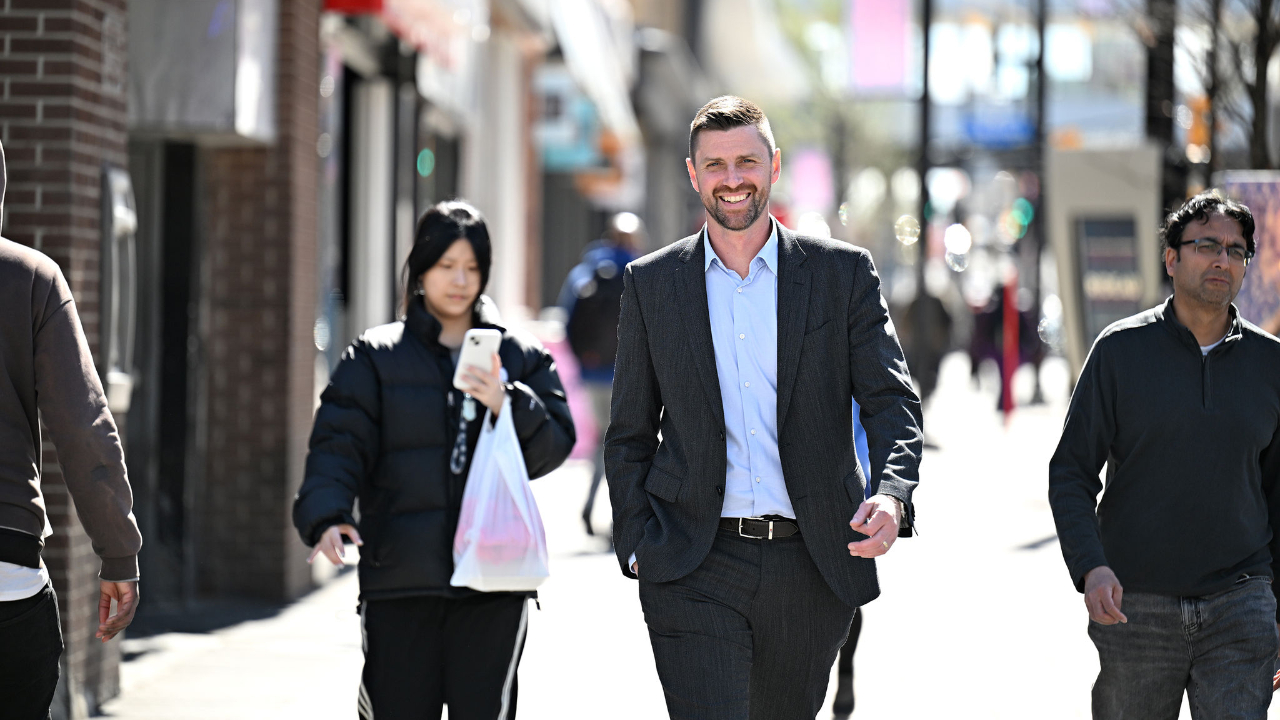
Alex Lawson knows what it’s like to be a small business owner in the city of Ottawa.
The 38-year-old has operated his own construction management company, Capital Framing, since 2017. A dyed-in-the-wool Ottawan, Lawson grew up in Heron Gate and later lived in Lowertown, Centretown, the east end and Kanata North before settling in Dunrobin with his wife and three daughters a few years ago.
The longtime entrepreneur is now wearing a new hat: mayoral candidate. He says he believes his background in business and his experiences living in a variety of neighbourhoods give him “a better understanding for what the priorities (are) of different people in different parts of the city and different demographics.”
Lawson recently sat down with OBJ to share his views on a range of issues relevant to the business community. The following transcript has been edited for length and clarity.
How do you think your experience as an entrepreneur affects your perspective as a candidate?
It’s having the opportunity to fail, and having that be a real and potential outcome when you actually have to make the numbers work … where if this goes the wrong way, if I make the wrong decision, if I don’t correct something soon, it’s going to carry on the wrong path. There’s budgeting to actually make payroll and make sure you have enough crews for a job. And there’s the leadership role of being an entrepreneur. It’s a people game as much as it is a numbers game. A lot of people have compared me to (former mayor) Larry O’Brien. It’s, ‘Oh, the business owner thinks he’s going to run the city like a business.’ You’re not going to run the city like a business. There will be some parallels — budgets need to get balanced and things like that. But that’s not the approach that I’m taking. The fact that I am a business owner is not everything. I am a resident of Ottawa. I am a taxpayer … I’m here to focus on the basics — crime, transit, traffic, affordable living.
What are the main pain points for the local economy as we head into this election?
It’s being able to get around. It’s being able to get your customers to your business, it’s being able to get your employees to your business. It’s people being able to afford to spend money at your business. It’s your employees being able to afford to live in their place. It depends on what kind of business you’re talking about as well. You’re talking about a business on Wellington (Street) that called me and said their business is down 40 per cent since they put in parking meters. A few other businesses around there have said the same thing. I got a call from a business two days ago down here at Somerset and Bay. (The property owner) was saying she’s had 15 instances of illegal dumping on her property in the last three months … There are a lot of stories like this when we talk about the business community. Housing (construction) in Ottawa has slowed down. It’s picked up again, but believe me, as somebody who’s been in this industry in this city for 20 years, it’s never been as slow as it was over the last three (years). One large factor was development charges are up 30 per cent in the last four years. It’s hard to point to a business that’s doing better. All of these businesses are saying, ‘Is it worth it anymore?’
What’s your plan for the ByWard Market?
It’s not as simple as turning a key and everything’s fixed. We have a lot of issues there. There is the public safety issue — the fact that people just don’t feel safe down there anymore. I was down there a few days ago and I counted 15 security guards for the event in (the ByWard Square pop-up performance area), and we need it. We need to deal with that before anything else is going to work. It’s not kicking 17 businesses out of the ByWard Market Building and turning it into just two. That’s not going to fix things until you clean things up. Pulling up the pavement and painting it and changing it to interlock or cobblestone isn’t going to make a difference while we still have this element of crime and people not feeling safe to go down there. The BIA that used to exist lost its say in things. The ByWard Market District Authority operates without input from businesses — multiple (restaurants and retailers) have told me this. The residents don’t have a say, the councillor doesn’t have a say, the businesses don’t have a say. The ByWard Market is not doing well. Look at the vendor village — that was a complete flop. It’s a mess. We need to do something else there. We need to get input from the businesses that have been there all the time. They’ll know where things can actually improve. There have been conversations about … maybe we should bring the farmers (market) back. Let’s talk to (farmers) about where to actually set it up, and let’s make it a market again. I think we either need to get rid of the ByWard Market District Authority, because that didn’t work, or we just need to integrate the businesses into it better and have a collaborative approach with the businesses that have been there for so long, the people that have known the Market for 20, 30, 40 years.
What would be your next steps to help revitalize downtown?
It’s nice to see that we are taking a creative approach with these “Uncommon Spaces” (on Bank Street). We need places to get the community out. The federal government forcing everybody back to work, I don’t agree with that. But if somebody has to now commute an hour and a half to two hours to get (to work) from the suburbs and two hours to get back, how long are they going to stay (downtown) and how much money are they going to spend? They’re probably going to bring lunch. I don’t think they’re going to be (patronizing downtown) businesses if they’re upset that they have to be there. Make it an easier place and a more welcoming place to get to. We’ve got a transit system that still doesn’t work. How do we revitalize downtown? Make it somewhere that people want to go.
What plans do you have for nightlife/vibrancy in Ottawa?
It is a real priority. Let’s talk to the businesses. Let’s see what the problems actually are. For instance, trying to get home from the Market with a transit system that’s unreliable. Maybe we need to look at extending (the hours of) buses in the area. Most (businesses) will say, ‘What night mayor? I haven’t talked to him.’ Some will say, ‘I’ve never seen or heard of this person.’ It’s an easier point of interface with the city for businesses down there. Having a department that handles this? Great. Saying, ‘We need a night mayor and everything’s going to be perfect’? That’s ridiculous. I was talking with Deek (Labelle, the general manager of the Chateau Lafayette) a couple of months ago, and she was talking about predatory parking enforcement. If somebody gets a parking ticket, you don’t want to go back to that place for a little while. She was telling me (a bylaw officer) came into the Laff, I think it was at 11:30, to give them a ticket for a noise complaint. This doesn’t make any sense. Employees, after they finish their shift, do they feel safe going home? Is there a bus available to them? The transit system is not working. We’ve got parking restrictions hurting businesses. Let’s make it a safe place that people want to be, and let’s talk to the private sector, be like, ‘Where else could we help here?’ There’s an affordability crisis and there’s less disposable (income). Costs have risen. We can only bring down costs so much, but what can we do to make sure that people have more (money) that they’re willing to spend? We’re almost a one-industry town when you look at the federal government, and that employer is contracting. Whether or not you agree that the federal government should be contracting, the fact is that Ottawa is overexposed (to federal layoffs). There are a lot of people who are nervous about that, who aren’t going to be going out for dinner as much because they’re wondering if they’re going to lose their jobs.
What type of support might you offer the tech sector, especially defence and security?
Our tech sector is huge. We’ve got a lot of innovation, great companies, great products. If we can bring more of the defence sector into the tech industry, there’s a lot of opportunity to expand that as well. Let’s be looking at these defence contractors and saying, ‘What’s it going to take to get you here?’ We might lose a bit (of revenue) on giving them a better (tax) rate, but we’ll get that money back. It’s going to be collaborating with Gatineau and doing what we can to advertise that Ottawa is open for business, Ottawa is a good place for your employees to raise a family.
What do you propose doing for the housing sector?
They are in the process of lowering development charges, and that’s something that we put in our plan as well — chop it by 50 per cent. Bloomberg did a report that examines the profit margin that’s possible on different types of development. They (looked at) 30 different types — whether it’s midrise, suburban, downtown core or whatever it is — and how feasible it is for lenders. Lenders are looking for 20 per cent profit margin — they’re in. Ten to 20 per cent, it’s like, all right, maybe — we’ll get in depending on other factors. Below 10 per cent, forget about it. The only thing that’s close to pencilling out right now (in Ottawa) is midrise downtown core, and even that was only because of the potential for (landlords) to charge a lot of money for rent, so that’s not helping affordability. Cutting development charges in half will help a lot. The housing task force has done a good job of listening to the industry and there are things that have moved in the right direction. Approval times are getting better. But some (developments), it’s been three and a half years from site plan approval to registration because the legal department at the city is so understaffed. Within the planning department, there needs to be a lot more collaboration there. Within the city, there should be one point of contact. There’s a lot of ideas for innovative ways that we can improve things. Other jurisdictions are using AI for approvals on applications.
Anything else you wanted to mention?
People want a city that they can get around. We should take a look at every (candidate’s) transit plans. We should get into the management of it. There are ways to make our buses actually run on time (that don’t just involve) throwing more money at (transit). You don’t pour more water into a leaking bucket — it’s just going to leak out. You want to know how to make a bus show up on time, you talk to a bus driver. I’ve talked to bus drivers, I’ve talked to the transit heads. With everything we’re approaching, it’s really from a (standpoint) of where policy meets reality — getting down into the weeds and talking to the people who actually understand it. Our transit plan is comprehensive. It’s not just, ‘We’re going to spend more here.’ It’s, ‘Here’s how we make the bus show up on time.’ People want to get around, they want to feel safe, they want their garbage to be picked up.
Other candidates running for mayor include: Queen Divine Priya Amber Bakshi; Zed Chebib; Bernard Couchman; Suraj Harish; Geoff Nicholas; Josh Rachlis; Ali Shayvard; Jacob Solomon; Amjed Syed; and Peter Westaway.