The Bright Side of Business: LiveWorkPlay partners with Ottawa mask manufacturer, creating inclusive work opportunities

0

Amid the bleak backdrop of job losses caused by the pandemic, an Ottawa manufacturer is working with a local non-profit to create inclusive employment opportunities as it helps to safeguard Canadians from COVID-19.

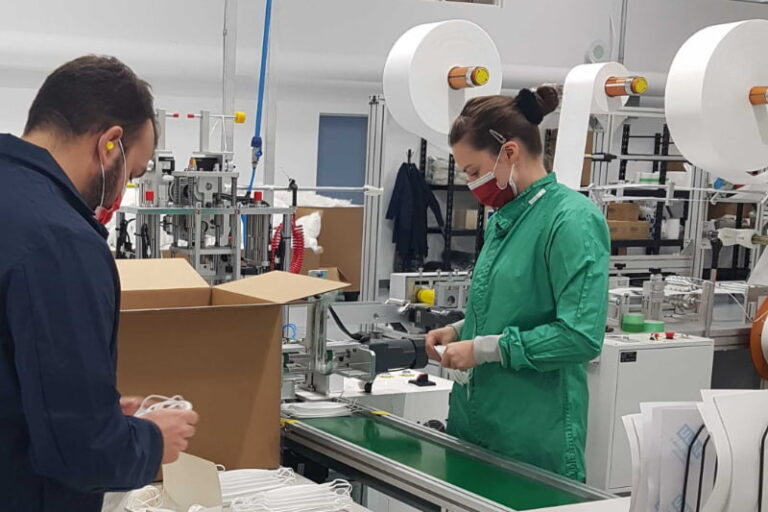
Viral Clean operates a 25,000-square-foot manufacturing facility in Nepean. Currently creating 50,000 masks daily, the company is ramping up its capacity with an eye towards producing more than 800,000 units each day.

When the pandemic first hit, Viral Clean started importing masks for the federal government. Quickly realizing they could make their own masks instead, Viral Clean pivoted, setting up shop within the month.

As it scaled up its operations, Viral Clean reached out to Ottawa-based non-profit LiveWorkPlay to ask if they needed any donated masks. A past recipient of the Best Ottawa Business Awards, the organization’s mission is in its name: ensuring individuals live, work and play as valued citizens. Founded in 1995, LiveWorkPlay partners with private-sector businesses, providing employment support to its clients, which include individuals with intellectual disabilities and autism.

But the offer of donated masks quickly led to an even deeper, more meaningful engagement.

“We learned more about the organization, and asked them to help us place two people here,” says Viral Clean CEO Alex Dugal. “We wanted to make sure that we were diverse and inclusive right from the start.”

Building strong bonds 

When initiating a new employer partnership, LiveWorkPlay starts with a workplace assessment.

“We make sure that we can make the best match for the employer, and also for our candidate,” explains Alastair McAlastair Ghartey, LiveWorkPlay’s inclusion specialist.

Viral Clean needed support with its mask assembly line as well as custodian duties. After looking through their clients, Ghartey and his team suggested Stephan Groulx and Andrew Urie.

By January 2021, Groulx had started his new role on the assembly line, doing quality control.
LiveWorkPlay client at Viral Clean

“It’s a machine that pumps (masks) out – it’s pretty spectacular to see,” says Ghartey. “You have to be very quick, but you have to be thorough, because they’re packaging them.” 

Urie was hired as a custodian at Viral Clean.

“Obviously, it’s a very sanitary facility,” says Ghartey. “They’re both very important roles.” 

Diving in together

Usually, at the start of a work placement, LiveWorkPlay will provide employers with detailed information about how best to work with their client. However, because Viral Clean was so busy – producing masks 12 hours a day, six days a week – LiveWorkPlay made an exception, with Ghartey training beside Groulx and Urie on their first day. 

“As a company that was doing a hundred thousand things at once, LiveWorkPlay supported us fully through it,” Dugal says. “It was easier to onboard Stephan and Andrew than it is for us to hire an employee not through their organization.”

“They’ve both gained a tremendous amount of confidence.”

Ghartey occasionally checks in with Groulx and Urie.

“They’ve both gained a tremendous amount of confidence,” he says. “Stephan – it’s almost like he’s a different person now. Like anybody, he’s employed, he’s earning his own money. The people that he works with are really good, so he’s not as isolated anymore, particularly during the pandemic.”

Viral Clean was recently awarded a Health Canada contract to produce 10 million masks. Dugal hopes that, as the company grows, so will its partnership with LiveWorkPlay.

“As we need to bring more people on, we’ll be reaching back out to them,” he says.

The Bright Side of Business is an editorial feature focused on sharing positive stories of business success.

This column is presented by Star Motors, Ottawa’s original Mercedes-Benz, Mercedes-AMG and Mercedes Van dealer.

Since 1957, Star Motors has provided its customers with the Mercedes-Benz “The Best or Nothing” standard in vehicle selection, service, genuine parts and certified collision repair.

For your convenience, you may shop, research, chat and compare vehicles online at starmotors.ca, and visit the 400 West Hunt Club location or call (613) 737-7827 for the very best in personal service.

Chef Joe Thottungal rallies support for Food For Thought Café, tackling food insecurity during COVID-19

0

Award-winning chef Joe Thottungal is celebrated not only for his culinary skills, but also for his consistent philanthropy – especially during COVID-19.

When the pandemic first hit, Thottungal was travelling through India for a culinary tour. Hearing the news, he immediately returned home, sleeves rolled up and ready to help. 

Thottungal rallied his team around Food For Thought Net Café. Founded by chef Sylvain de Margerie in 2018, the non-profit is on a mission to reduce food insecurity for low-income households, focusing on vulnerable individuals in lodgings with no kitchen, or for whom cooking is a challenge.

“It is really scary to see the food insecurity,” Thottungal says. “A lot of people are falling through the cracks.” 

At first, Thottungal supported Food For Thought from his downtown restaurant, Thali, making 300 to 400 meals per day. But before long, demand rose beyond the facility’s capacity. By December 2020, representatives from the Chateau Laurier hotel had invited Thottungal and his team to use their kitchens, underutilized this winter amid the pandemic. 

Broadened horizons 

At the hotel, volunteer chefs use state-of-the-art facilities, cooking up to 1,000 meals per day.

“It’s like a marriage happened in heaven,” Thottungal says of the partnership. The meals are then distributed through local resource centres, food banks and more. 

Fully volunteer-run, Food For Thought is supported by sponsors, including Ajay Bisaria, India’s high commissioner to Canada. Throughout 2020, Bisaria partnered with Thottungal, sponsoring meals during India’s Independence Day and Diwali.

Last week, Bisaria joined forces with Thottungal for a third time and helped mark India’s 72nd Republic Day.

“In normal years, we would have had a grand reception,” Bisaria says. “We would have invited a large number of Indian community members, friends of India and Canadian dignitaries.” 

Instead, the High Commissioner sponsored 1,500 hot meals, 300 of which were donated to the Shepherds of Good Hope. On the menu was a vegetable curry, butter chicken and dal makhani – a dish made with black lentils, tomato, onions and cream, simmered for hours.

Food for Thought volunteer chefs working at the Chateau Laurier

Recalling his favourite moment from last week’s event, Bisaria says, “I got an opportunity to wear an apron, be an honorary chef for the afternoon, and get a picture with all these celebrity chefs!”

A community effort 

Since April 2020, almost 10 per cent of Food For Thought’s meals have been sponsored by the Indian, German, South African and European Union embassies.

“The diplomatic community is really happy, because they are giving back to Canada,” Thottungal says. “I’m very honoured to be an Indian, and to be a blessed Canadian too, to support the community.”

Last week, Food for Thought also celebrated serving 150,000 meals since the pandemic – a grand total reached with support from the City of Ottawa, Canadian Red Cross, local restaurants, schools and more.

When Thottungal opened his first Ottawa restaurant, Coconut Lagoon – also the name of his award-winning cookbook – he received a huge outpouring of community support. Through his work with Food For Thought Cafe, Thottungal aims to pay it forward.

His next step? Securing a permanent kitchen for the non-profit, so it can continue growing beyond COVID-19.

“The idea is that, if anybody knocks on our door to ask for a meal, no questions asked, we will give them a warm meal,” Thottungal explains. “(It) should be everybody’s right.”

The Bright Side of Business: Matriarch apparel combines purpose and fashion with support for young mothers

0

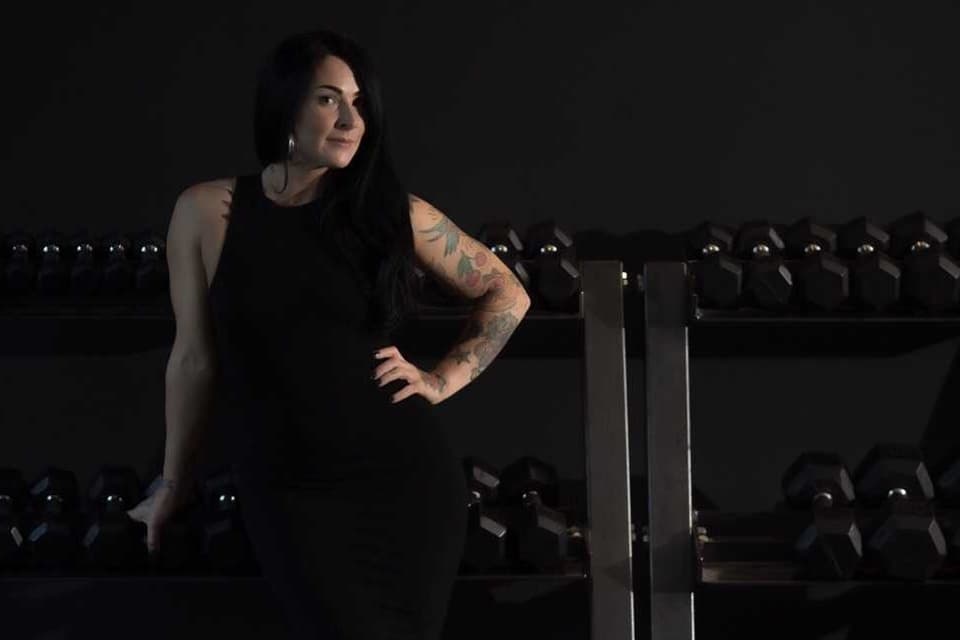
A professional trainer of 13 years, Meghann Nevada isn’t afraid of a little hard work. After closing her downtown Ottawa gym, Grit + Glory SC, she launched her first-ever fashion business – right in the middle of a pandemic. 

Meghann Nevada

Nevada ran Grit + Glory for two successful years. When her building’s leasing manager decided to renovate the space into something new, Nevada decided to launch Matriarch, selling bold, statement-making apparel with a social mission. 

Proceeds from Matriarch’s sales go towards scholarships that help young and teen mothers through post-secondary education. Nevada, once a teen mother herself, looks to provide young moms with what would have helped her after high school.

“You’re really out on your own,” Nevada says. “You’re still a teenager yourself, or you’re a young mom trying to raise another child.”

Challenge accepted

With the closure of Grit + Glory, and her daughter soon turning 21, Nevada dug into her passion for apparel and fashion, mapping out a vision for Matriarch.

But – as was the case for so many entrepreneurs in 2020 – things didn’t quite go as planned.

“I’d actually been accepted to (Parsons School of Design) in New York – then the pandemic hit,” she says.

Grounded in Canada by lockdown, Nevada set aside the prestigious art school, instead teaching herself to use Photoshop and e-commerce platforms.

“I don’t need-need to go to school for fashion,” she says. “It kind of all synced together for me.”

By September 2020, Nevada had opened Matriarch online, selling clothing and accessories such as hats, tote bags and mugs.

Aside from the Basics line that Nevada designs herself, all of Matriarch’s artwork is commissioned from female artists around the world, and then printed locally in Ottawa. The current Matriarch collection is inspired by ‘The Empress’ Tarot card.

Matriarch t-shirts

“She’s the matriarch of the Tarot deck,” Nevada explains. “She’s about birthing new ideas and creativity.”

The first scholarships will launch in the fall of 2022, helping young mothers cover everything from rent to childcare to tuition. 

“Not only are (young mothers) dealing with the stress of school and generating the funds to go, you’re also trying to raise a child, maintain a relationship with your partner, your peers, and maybe have a job,” Nevada says. 

The scholarships will offer $2,500, $5,000 and more.

“Whatever the number is, if it pays for a semester, or it pays for fees and books – that’s a huge thing,” she says.

Building strong foundations 

When Nevada was launching her gym several years ago, less than a month passed between her decision to start the venture and the facility’s soft launch – a head-on, crash-course into the business, she recalls.

Meghann Nevada

Things are different this time.

“This pandemic has really put the brakes on in a good way,” Nevada says. “It’s slow growth and baby steps.” 

That model has allowed Nevada to build an engaged online community. Looking to a post-COVID world, she says she’d love to host a fashion show, partnering with local businesses. Longer term, Nevada wants to offer teen and young mothers additional resources, such as financial education, entrepreneurship mentoring and classes on relationship psychology. 

“I want to really, really stay true to what I feel would have benefited me and the girls that I went to school with, and what I can do to help create that for somebody else,” she says.

The Bright Side of Business is an editorial feature focused on sharing positive stories of business success.

This column is presented by Star Motors, Ottawa’s original Mercedes-Benz, Mercedes-AMG and Mercedes Van dealer.

Since 1957, Star Motors has provided its customers with the Mercedes-Benz “The Best or Nothing” standard in vehicle selection, service, genuine parts and certified collision repair.

For your convenience, you may shop, research, chat and compare vehicles online at starmotors.ca, and visit the 400 West Hunt Club location or call (613) 737-7827 for the very best in personal service.

The Bright Side of Business: PranaShanti Yoga Centre opens two new locations during pandemic

0

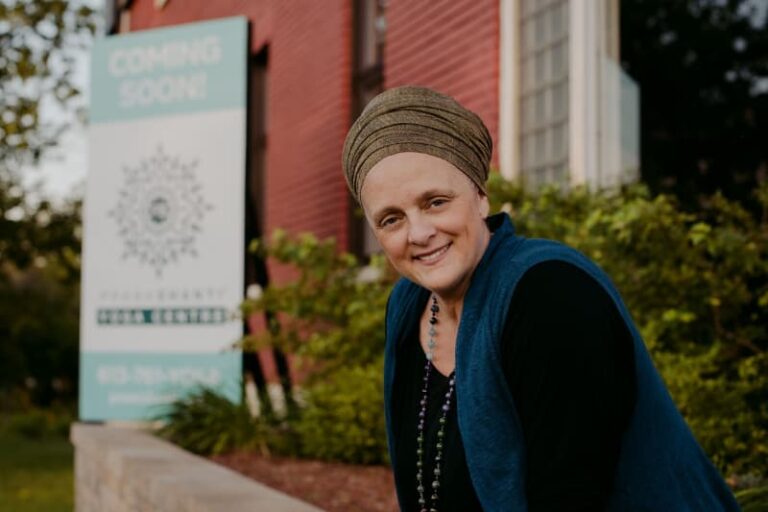
Finding flexibility in both her yoga practice and business, Devinder Kaur turned 2020’s challenges into a year of growth.

Before founding PranaShanti Yoga Centre – the largest training centre east of Toronto – Kaur was an IT consultant. Some 20 years ago, she started doing yoga at the recommendation of a colleague. Falling in love with it, she became a teacher and initially started PranaShanti as an e-newsletter for her students.

“2020 has become this full-circle moment,” Kaur says. “It started off online, and I’m online again!” 

By 2008, Kaur opened her first studio, renting a 6,000-square foot warehouse.

“Everybody thought I was totally crazy,” Kaur laughs. “(People said) ‘It’s way too much space, and (Hintonburg)? Nobody’s going to go there.’”

But Kaur stuck with it, eventually adding another 2,000 square feet to make room for her 10 staff, 55 teachers and 80 weekly classes.

The successful launch in the midst of the financial crisis gave Kaur confidence that she could navigate virtually any business challenge that came her way. But last year taught her that a global pandemic was a completely different ball game.

Rolling with the punches

In March 2020, Kaur shut down her studio due to COVID-19.

“I had to lay off staff – horrible, horrible, horrible,” she says. However, the pause didn’t last for long – within three days, Kaur and her husband, also an IT consultant, had moved the whole business online.

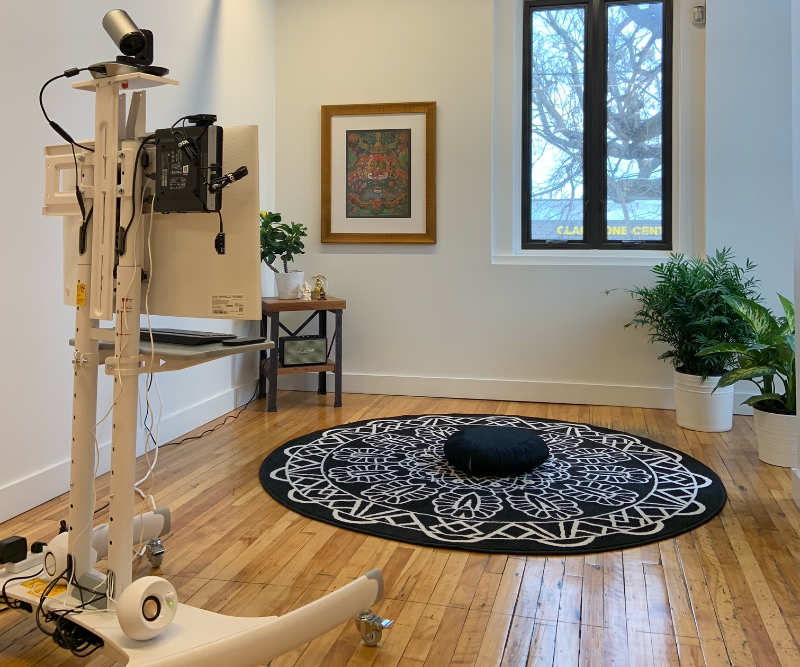
Virtual yoga class

“25 years in IT paid off yet again,” she says.

By going virtual, PranaShanti was able to continue its teacher training courses, as well as offer free yoga classes for five weeks. Upwards of 300 people joined each free session, tuning in from North America, Iceland, the U.K., Egypt, India and more.

“It was so uplifting (during) such a dire sense of disaster,” Kaur says. Even now, with a charge for online classes, PranaShanti continues to draw clients from around the world.

Despite the success online, the lack of in-person sessions meant Kaur had to give up the Hintonburg lease – PranaShanti’s Armstrong Street home for the past 12 years.

“Unfortunately our landlord was not interested in doing any rent relief, so it kind of forced my hand,” she says.

But when one door closes, two more open. Kaur moved her yoga studio to a new location on Gladstone Avenue, as well as opening an education centre on Eccles Street.

Devinder Kaur

Using a hybrid model of in-person and online classes, PranaShanti now offers international teacher training, as well as other courses for stress management, healthy living and more.

“I went into COVID with one space, and I’m coming out of COVID with two!” Kaur says. 

New horizons 

Surviving the pandemic is a feat for any business, let alone doubling locations. While she used some government assistance, Kaur explains that it was her personal finances covering the bulk of expenses.

“Typically they say you should have a reserve of x number of months to cover rent, salary, things like that. Well, I tripled that,” she says. “I was hoping I would be able to use it for other advancements of our business, but here’s where we are.” 

Kaur is considering franchising the new business model. Until then, PranaShanti will continue to support the Ottawa yoga community while catering to global audiences.

“People are able to come for courses throughout the week (while) working from home,” she says. “It gives us a tremendous opportunity for flexibility in the way that we can serve people.”

The Bright Side of Business is an editorial feature focused on sharing positive stories of business success.

This column is presented by Star Motors, Ottawa’s original Mercedes-Benz, Mercedes-AMG and Mercedes Van dealer.

Since 1957, Star Motors has provided its customers with the Mercedes-Benz “The Best or Nothing” standard in vehicle selection, service, genuine parts and certified collision repair.

For your convenience, you may shop, research, chat and compare vehicles online at starmotors.ca, and visit the 400 West Hunt Club location or call (613) 737-7827 for the very best in personal service.

The Bright Side of Business: Ottawa Firehouse Subs franchisee brings Christmas joy through support of front-line workers

0

When it comes to running a business and supporting his community, Pradip Patel has one simple motto: “The answer is yes – what’s the question?”

After getting a taste of Firehouse Subs while in Atlanta, Patel brought the U.S.-based restaurant chain to Ottawa. With a successful opening in Gloucester in 2017, Patel and his team expanded to Nepean in 2019. Both locations quickly generated more than $1 million in sales. Leveraging the momentum, the team opened a third location in Orléans this month.

While Patel wasn’t the first to bring Firehouse Subs to Canada, he was the first Canadian to sign a franchisee agreement.

“I was head over heels,” he explains. But it wasn’t just the food or the business opportunity. His excitement also came from the restaurant’s charitable foundation, which raises money for first responder equipment.

“I can go to work and support my community at the same time,” he says. “It’s a win-win situation for me.”

In less than two weeks, the Orléans restaurant has raised more than $4,000 in donations. Patel estimates that the three locations have collectively raised more than $216,000 in donations through customers rounding up the price of their subs. The funds then go towards buying equipment, gas generators, ATVs and more.

In recognition of his leadership and contributions, Patel won the 2019 Firehouse Subs Franchisee of the Year, receiving the coveted Axe Award.

“It’s amazing to let our team and our guests know what we’ve done thanks to their support,” he says.

All hands on deck 

No stranger to franchising, Patel ran an Esso gas station for 14 years before venturing into the food industry. At Esso, he raised some $983,000 for CHEO, with a focus on burn victims.

“(Firehouse Subs) really spoke to me, because I’ve always had great friends in the fire department,” he says.

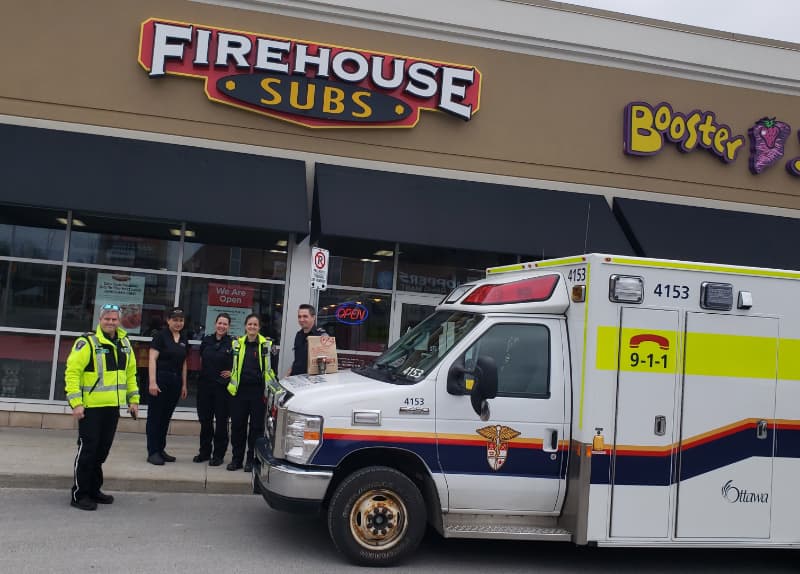
That same community spirit saw Patel and his Firehouse Subs team donate more than 600 meals to healthcare workers at the start of the COVID-19 pandemic. And as testing sites popped up, they drove to every location, handing out free drinks. Additionally, the team donated food to charities such as Ronald McDonald House.

Firehouse Subs donation to paramedics

“We sent in all our firefighter friends with minibikes and fire trucks, to put a smile on the kids’ faces,” Patel says.

Bringing Christmas cheer 

With Christmas around the corner, Patel and his team are working hard to keep spirits high. For the past two years, they took part in Help Santa Toy parades, which is run by the Ottawa Professional Firefighters Association.

“This year, there’s no parade, so we’re working with the Ottawa firefighters to get our restaurants to collect toys,” Patel says. At all three locations, toys are placed underneath a Christmas tree to be distributed through the Salvation Army.

Firehouse Subs toy donations

Additionally, Patel and his team plan to deliver cookies to first responders on Christmas Eve.

“We’re like little elves,” he jokes, crediting his grandmother for instilling in him the importance of giving back.

“(She) always told me, ‘Never stop giving. Because the day you stop, that’s the day you stop growing,’” he recalls.

The Bright Side of Business is an editorial feature focused on sharing positive stories of business success.

This column is presented by Star Motors, Ottawa’s original Mercedes-Benz, Mercedes-AMG and Mercedes Van dealer.

Since 1957, Star Motors has provided its customers with the Mercedes-Benz “The Best or Nothing” standard in vehicle selection, service, genuine parts and certified collision repair.

For your convenience, you may shop, research, chat and compare vehicles online at starmotors.ca, and visit the 400 West Hunt Club location or call (613) 737-7827 for the very best in personal service.

The Bright Side of Business: Indigenous tourism operators ready to ride economic recovery

0

A cohort of local Indigenous tourism operators is hoping that a specialized training program will position them to be at the forefront of their industry’s expected rebound in 2021.

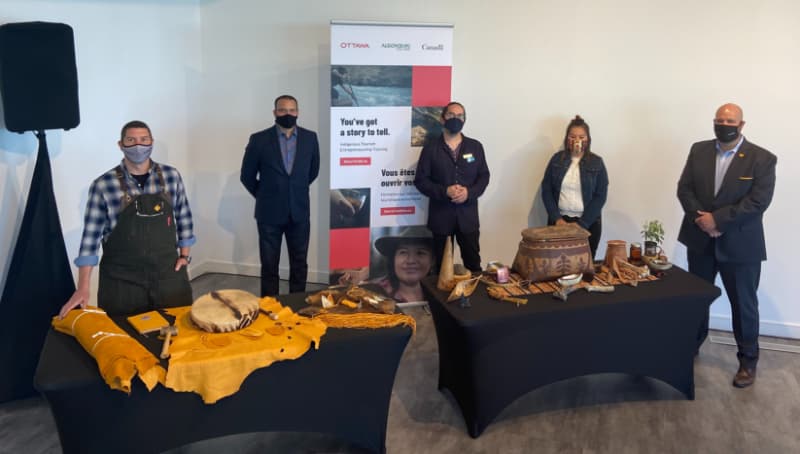
For the past 10 weeks, Algonquin College and Ottawa Tourism have been running the federally funded Indigenous Tourism Entrepreneurship Training program. Created for Indigenous learners by Indigenous entrepreneurs and subject-matter experts, this free program shares the fundamentals of business planning and development.

Launch of the Indigenous Tourism Entrepreneurship Training

One of the program participants was Marc Forgette, founder of Makatew Workshops, which offers Indigenous crafts workshops to corporate and not-for-profit organizations. He says his business is likely to benefit from the expected rise in domestic tourism over the coming year.

“There’s a lot of great Indigenous tourism ideas out there,” Forgette says. “I think we’re going to see more Canadians staying within our borders, which will be amazing.”

Taking the plunge

Forgette, who is of French and Algonquin descent, founded Makatew in June 2019 after spending a dozen years working in business development and sales.

In those roles, he regularly attended trade shows and noticed a lack of locally-sourced items, and Indigenous products in particular. It’s a gap he says goes back decades.

“Growing up in the ’70s and ’80s, there was not very not much shared about our culture,” he says. “About three, four years ago, I decided to really start exploring my culture and where we came from.”

The name Makatew was inspired by his great-grandmother’s last name, loosely translating to “Black” in Anishinaabemowin. All of Forgette’s products are made of locally-sourced leather, with one of the most popular being Makatew bookmarks.

Leather bookmarks

“They sell over and over because they’re easy to produce, they’re a sustainable product, and you can brand them with your logo,” he says.

Within two weeks of leaving his corporate job, Forgette secured his first gig: running a booth at an event for 300 international travel writers.

“I had to teach myself how to use the sewing machine, sew 150 medicine bags, and treat (them) within five weeks,” Forgette recalls. “Sometimes I was wondering, ‘what the heck did I get myself into?’” 

Forgette’s workshop invited participants to sew beads onto the medicine bags. In the end, it was a huge success, with his table being among the event’s most popular booths.

“From that point on, I knew that I was onto something,” Forgette says. 

Making new connections

Like many businesses, Forgette took Makatew virtual during the COVID-19 pandemic. While he says his online workshops have been well-received, Forgette says the Indigenous Tourism Entrepreneurship Training program “couldn’t have come at a better time” and helped him shore up some of his business fundamentals, such as creating a mission statement.

“The course really helped me to get to things that I’ve been thinking about, but putting on the back burner because I felt like I didn’t have time,” Forgette says. “It is absolutely important in the life of an entrepreneur to establish some things early in your business.”

Two program moderators walked participants through each module, which also included topics such as branding and accounting. Each week, an Indigenous entrepreneur would also speak and share their own experiences.

“All the teachings in this course are Indigenized teaching – that’s very important to me, because everything I’m doing, I want to make sure I’m doing correctly,” Forgette says. 

As well as this, the program connected Forgette to a network of Indigenous entrepreneurs, including two new business collaborators.

“We’ve already started working together because I feel I can help them in their journey, and they can help me in my journey as well,” he says.

The Bright Side of Business is an editorial feature focused on sharing positive stories of business success.

This column is presented by Star Motors, Ottawa’s original Mercedes-Benz, Mercedes-AMG and Mercedes Van dealer.

Since 1957, Star Motors has provided its customers with the Mercedes-Benz “The Best or Nothing” standard in vehicle selection, service, genuine parts and certified collision repair.

For your convenience, you may shop, research, chat and compare vehicles online at starmotors.ca, and visit the 400 West Hunt Club location or call (613) 737-7827 for the very best in personal service.
The Bright Side of Business: Award-winning hairdresser elevates Ottawa at international fashion competitions

0

When it comes to hairdressing, few represent Ottawa like Silas Tsang, an internationally-recognized, award-winning master stylist.

Tsang and his wife – fellow hairdresser Dorothy Tsang – are the co-owners of Blushes, a Kanata-based luxury hair salon. This month, the couple added to their business’ many accolades, each taking home awards from the 2020 Contessas. Now in its 32nd year, this photo-based competition attracts top Canadian hairdressing talent.

Tsang’s photo collection won him the most coveted prize as the Canadian Hairstylist of the Year.

“I worked with an amazing photographer, an amazing make-up artist, and an amazing stylist,” Tsang says. “I learn from them a lot.” 

Silas Tsang

This is far from Tsang’s first award. Just this fall, that same photo collection got him shortlisted for the prestigious 2020 HJ’s British Hairdressing Awards.

“To be able to show the world that you have that (recognition) – it’s a hairdresser’s dream,” he says.

Growing up in Hong Kong, Tsang says knew he wanted to be a hairdresser even as his family encouraged him to explore other career paths.

“My mom said, ‘Hairdressing is not really professional, maybe you can do something else.’ But I said ‘I love it.’”

“My mom said, ‘Hairdressing is not really professional, maybe you can do something else’ – but I said ‘I love it,’” he recalls. 

Tsang stuck to his guns – or in this case, his scissors. After a teacher told him he must repeat grade 11 to prepare for higher education, Tsang – who didn’t want to go to university – took a leap of faith by moving schools entirely.

“I ended up serendipitously meeting Dorothy at this new high school,” he says.

After graduating, Tsang moved to London, UK to study hair design and kickstart his career before moving to Ottawa with Dorothy in 1992. 

Recognition builds

Nine years later, the couple set up shop with Blushes and quickly grew a local client base. Tsang’s wide-reaching renown would come later, thanks to a tip from his mentor at L’Oreal Professionnel, Jennifer Scott.

“She told me that the only way to get recognized in this field is to enter competitions,” Tsang says. “I am so grateful that I listened to her advice.”

Blushes

In 2007, Tsang entered his first-ever competition: the international L’Oreal Colour Trophy Awards.

“I didn’t place even in the semi-finals,” Tsang says. “It was a little bit discouraging, but I didn’t give up.”

And it was a good thing, too – just one year later, Tsang would take home the competition’s Newcomer of the Year and People’s Choice awards.

During this time, Blushes kept growing from strength to strength.

“Working with my wife, who is also a talented hairdresser, brings great comfort, as we share the same goals and values,” Tsang says. “We’re able to use each other’s strength to get through challenging times, and also to celebrate our successes.”

Blushes Salon

COVID-19 fell into the former category, as Blushes closed for the first three months of the pandemic.

“During the first wave, we decided to start selling and delivering hair products once a week,” Tsang says. “We also asked our landlord for some rent relief, to mitigate the challenges of having to shut down our services.”

Building back together

As Blushes re-opened, Tsang and Dorothy prepared new safety policies, purchasing disposable masks, shoe covers, single-use hair capes and more.

“Our clients were very happy to be back,” Tsang says. But despite a busy few months, the couple estimates that business is still down 30 to 40 per cent.

The pandemic might have slowed down business, but it hasn’t stopped Tsang sweeping up awards. And next summer, he will be hosting a show with the North American Hairstyling Awards, scheduled for Las Vegas.

“I’m focusing on that now – I want to show the world what I’m going to do,” Tsang says.

While Ottawa might not have the biggest fashion industry, Tsang believes that “the more people we have, the more creativity will flourish. My wife and I couldn’t imagine starting a family and owning our salon anywhere else. This city has given us the opportunity to share our craft with the world.”

The Bright Side of Business is an editorial feature focused on sharing positive stories of business success.

This column is presented by Star Motors, Ottawa’s original Mercedes-Benz, Mercedes-AMG and Mercedes Van dealer.

Since 1957, Star Motors has provided its customers with the Mercedes-Benz “The Best or Nothing” standard in vehicle selection, service, genuine parts and certified collision repair.

For your convenience, you may shop, research, chat and compare vehicles online at starmotors.ca, and visit the 400 West Hunt Club location or call (613) 737-7827 for the very best in personal service.
Li-Cycle charges ahead with Kingston ramp-up

0

With the number of electric vehicles on the road skyrocketing, a Canadian recycler of the lithium-ion batteries found under the hoods of these cars and trucks is turning to its growing Kingston R&D centre to help it expand its operations.

Mississauga-based Li-Cycle recently added a third shift at its Kingston facility, which also hosts many of the company’s R&D initiatives. The plant will operate 24/7 by the end of the year, processing up to 5,000 tonnes per year of lithium batteries into what Li-Cycle calls “intermediate products,” says Li-Cycle co-founder Tim Johnston.

Those intermediate products from Kingston and other “spoke” facilities will then be sent to a new US$170-million “hub” facility in Rochester, N.Y., which is set to process up to 60,000 tonnes of lithium-ion battery feed annually into battery-grade chemicals and returned to the battery industry.

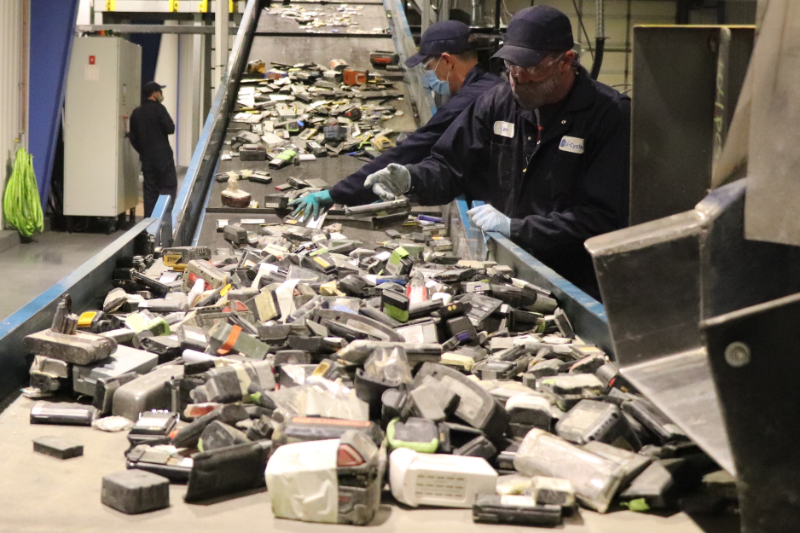
Battery processing

The company says its hydro-metallurgic process means it extracts about 95 per of recoverable materials from each lithium-ion battery it processes. 

Johnston said Li-Cycle continues to be inundated with companies wanting to offload spent lithium-ion batteries, a trend set to rise as electric vehicles grow in popularity. About 40 per cent of Li-Cycle’s battery feed currently consists of electric vehicle and high-voltage batteries, but Johnston says he projects it to make up the bulk of its recycling business in the coming years.

Its Kingston workforce – which currently stands at approximately 30 employees and is expected to grow by another 10 in the coming months – will also be kept busy building 14 additional “spoke” facilities that Li-Cycle plans as part of its global expansion. Each facility is constructed and tested in Kingston before being broken down into six modules and transported to their new locations.

Li-Cycle facility

“The benefit of that is we know that by the time a facility is delivered to site that it’s ready to go, that there shouldn’t be any surprises on the commissioning side,” Johnston said.

“We have all the know-how and understanding of how to construct these facilities locally and by being able to do it here locally we’re able to generate a relatively efficient engineering and construction process, which also brings down the cost of implementation, as well as the risk.”

Other pilot programs for Li-Cycle’s R&D program are also set to be run out of Kingston over the next one to two years, Johnston said. 

Johnston said Li-Cycle is not yet ready to announce further international expansions, but is at different levels of commercial negotiations with multiple countries in Europe and Asia as it eyes off opening additional facilities.

Farm Boy deal just the beginning for indoor farming startup

0

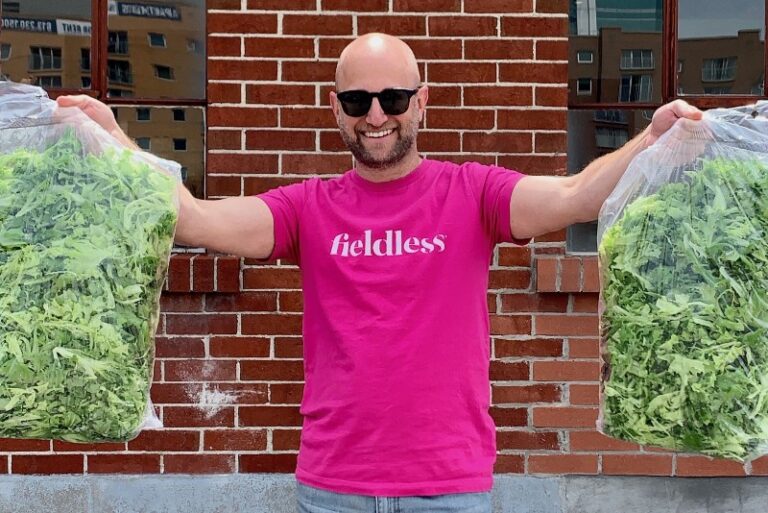
Within six months of completing construction on its Cornwall growing facility, Fieldless Farms’ produce could already be found on the shelves of more than 20 Farm Boy stores across Ontario.

But armed with an aggressive expansion plan to bring more hydroponically grown vegetables to Canadians, CEO Jon Lomow says his company is just getting started. 

Fieldless currently supplies two types of lettuce mixes – Northern Crunch and Ontario Sweets – grown in its Cornwall indoor farming facility. Lomow wants to rapidly expand both the types of crops the startup grows as well as its physical footprint.

Fieldless uses just 20,000 square feet at its Cornwall facility for its current operations, but Lomow insists that will increase quickly, with the CEO also harbouring ambitions of building new growing facilities in Toronto, Montreal and even the country’s west coast by 2025.

“We want to scale this very large – we want to be a national success story. We want to play a major role in shortening supply chains for Canadians using controlled environment agriculture,” Lomow says.

He says Fieldless will significantly increase its capacity to grow leafy greens in the next one to three years, increasing the yield of both its current lettuce mixes and other crops such as romaine lettuce, spinaches and basil. From there, there are plans to expand to smaller vegetable crops, including baby tomatoes, cucumbers and peppers, which the company is just on the cusp of being able to grow economically, Lomow says. 

Agricultural evolution

That kind of aggressive growth may seem overly optimistic to some, but Lomow says rapid change is all the company has known since its inception. Fieldless, which secured its first round of private capital funding in June last year, has gone from finishing construction on its Cornwall facility to providing almost 2,000 packs of lettuce mixes to customers each week inside six months. 

Initially just selling products through Burrow Shop, the Ottawa-based online retailer Lomow co-founded, as well as Ottawa’s Massine’s Your Independent Grocer, Fieldless achieved one of its early goals in August when it signed a deal with supermarket chain Farm Boy to supply its lettuce mixes to 16 stores spanning from Cornwall to Kingston. That number quickly jumped when Farm Boy asked weeks later if Fieldless could supply seven stores in the Toronto area, a number that is set to grow again in coming weeks. 

Farm Boy’s origin in Cornwall and its “obsessive focus” on reducing the amount of fresh produce wastage made it the perfect first retailer to partner with, Lomow says.

That early growth gives confidence to Lomow, who notes that Canada – reliant on $48 billion of food imports each year – needs to significantly increase its food production in future years.

Lomow is also buoyed by what he predicts will be a “trillion-dollar evolution in the agriculture industry,” powered by falling automation costs and efficiency improvements in lighting technologies.

Fieldless Farms corridor

The thing that sets Fieldless apart is that it’s not trying to do it all, Lomow says. Before launching, it signed a deal with an unnamed Canadian partner that handles the hydroponic technology side of the equation, leaving Lomow and his team to focus on the supply chain as well as perfecting the taste of its products and getting the products into stores.

“We’ll deploy core technologies for our growing platforms and then we’ll innovate inside the gaps, because there are tons of gaps still in indoor farming,” Lomow says. “We just won’t be developing the core technology.”

“We decided we were way better off to focus our efforts on evaluating that technology, in making sure that we had the right technology as opposed to starting from scratch. If you go down the wrong road you’re kind of stuck there.”

The current technology platform sees lettuce crops grow from seedlings inside a 20-day cycle in a way that Lomow says strikes “the right balance between automation and manual labour,” but Fieldless’ technology agnostic approach means it will partner with other technology companies to build other facilities and grow other crops in the future.

The bright side of business: Fullscript empowers employees with carbon-neutral push

0

Ottawa-based health-tech firm Fullscript believes in taking a holistic approach to wellness – first for patients, and now for the planet.

Fullscript develops an online platform that helps health professionals across North America prescribe natural supplements. Last month, the company announced its carbon neutral certification: balancing the carbon it emits with the carbon it absorbs back from the atmosphere. 

“As we grow, emissions grow, so we need to find ways to become more efficient,” says Dylan Trebels, Fullscript’s senior product manager. Trebels is spearheading the initiative alongside his colleagues. “It wasn’t leadership saying, ‘this is something we’re going to do. It was myself and a couple of other people who are passionate about this.”

Going carbon neutral

In addition to its Ottawa office and a Toronto distribution partner, Fullscript has warehouses in Arizona and Pennsylvania. In late 2019, Fullscript hired Toronto-based Carbonzero to create a corporate carbon reduction strategy. To get the ball rolling, Fullscript shared data on everything from its utility bills to company travel and shipping destinations. From there, Carbonzero estimated the company’s 2020 emissions, which are to be compared with a year-end audit.

Fullscript

Three different scopes of emissions were assessed across all of Fullscript’s facilities, starting with the direct burning of fossil fuels through natural gas heating. That’s followed by indirect emissions, which are typically related to electricity use.

Trebels says many companies limit their efforts at reducing emissions to these first two “scopes.” But for Trebels, scope three – all other indirect emissions from sources that a company doesn’t own or control, such as transportation and distribution –  represents “the meat.”

Fullscript’s scope three assessments also included its server electricity and shipping methods.

“Eighty per cent of our footprint comes from something we have no control over if we still want to get goods to our customers.”

“Eighty per cent of our footprint comes from something we have no control over if we still want to get goods to our customers,” Trebels says. “I would love to see a future where we can ship every single package in an electric or zero-emissions vehicle.”

For emissions that can’t be reduced, businesses can compensate by paying for activities that absorb emissions, called carbon offsetting.

“We decided we’re going to offset everything right off the bat,” Trebels says.

Fullscript purchased offsets from the Ontario Biodiversity Afforestation Project, planting trees along a northern Ontario highway. Since the start of the year, Fullscript has offset an estimated 3,400 tonnes of carbon.

“It’s about 222 years of emissions for an individual Canadian,” Trebels says. “Another equivalent measure is about 22,000-23,000 miles (covered by) driving a passenger sedan every single day for a year.”

Fullscript won’t know the exact cost of going carbon neutral until its end-of-year audit with Carbonzero.

“Offsets can vary wildly in cost,” Trebels says. Some industry estimates range from under $1 to over $50 per tonne of carbon, depending on the offset’s quality and location. “We tend to aim higher on that scale, just because there’s better social benefits to keeping it closer to home. You want to keep the money within the local economy.” 

Empowering employees

Both Trebels and Fullscript president Kyle Braatz say the key to the project’s success was securing the buy-in of the company’s employees. This also meant that the sense of accomplishment rippled throughout the entire company, Braatz adds.

Kyle Braatz

“I remember when Dylan actually announced that we’d gone carbon neutral. You could see individuals in our team tearing up. It was that important to them,” he says. “As a company, to invest in what’s right, but also what’s right for our people – it’s a no-brainer.”

Braatz recommends that other companies considering a carbon-neutral strategy ensure they have an internal advocate who’s going to drive and educate the organization, as well as a leadership team that’s bought into the vision.

For his part, Trebels has both a challenge and a warning for other businesses: Initiatives such as these might not be an optional nice-to-have measure in the coming years.

“This will become table stakes. Businesses who aren’t focused on social good and where they can have positive impacts on the environment may not be around,” he says. “We’re not a gigantic tech company, and we’re still doing this. It is possible for smaller and mid-market companies to do this.”

The Bright Side of Business is an editorial feature focused on sharing positive stories of business success.

This column is presented by Star Motors, Ottawa-Gatineau’s original Mercedes-Benz, Mercedes-AMG and Mercedes Van dealer.

Since 1957, Star Motors has provided its customers with the Mercedes-Benz “The Best or Nothing” standard in vehicle selection, service, genuine parts and certified collision repair.

For your convenience, you may shop, research, chat and compare vehicles online at starmotors.ca, and visit the 400 West Hunt Club location or call (613) 737-7827 for the very best in personal service.