Kickstarter campaign for new indoor facility pumps fresh air into Ottawa’s skating and cycling scene

0

When Epic Indoor Bike Park opened in Ottawa, Anthony Bereznai was excited. The seasoned management consultant and passionate mountain biker had been paying close attention to similar businesses popping up in cities such as Toronto and Cleveland, and was rooting for the first such effort in his own city.

And when Epic closed its doors in 2015 after running for less than a year, it didn’t sour Bereznai’s enthusiasm.

“I knew it could be done,” he says. He felt poised to learn from Epic’s mistakes.

“I went through and did a full business case, figured out why it wasn’t working, and what could be changed. I felt that I knew how to make it viable. So I spent the next couple of years working on it.”

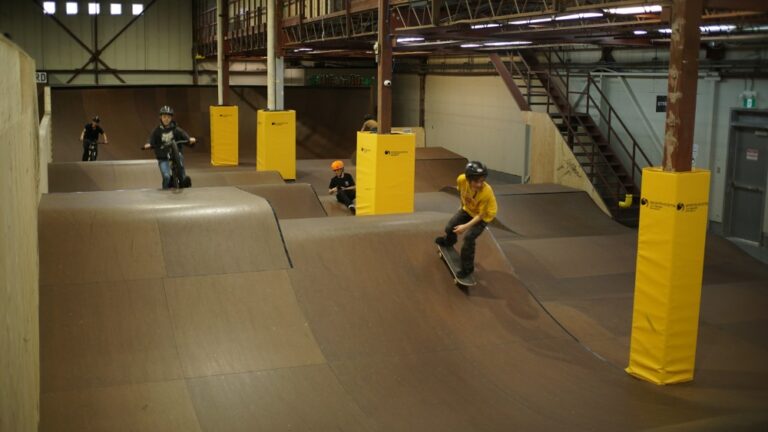
Today, Bereznai owns and manages The Yard, which has been open for only six weeks but is already getting plenty of traffic and is generally filled to capacity on weekends. The indoor bike-and-skate park at 265 City Centre Ave. draws a diverse crowd, from BMX and skateboard pros, to high school rollers with scuffed helmets, to parents looking to spend some quality time with their kids.

Full-speed ahead

So, how do you go about successfully starting a business for a niche audience in a city like Ottawa, and especially after others had already failed? Bereznai knew he’d have to take risks, but wanted to be as prepared as possible.

He started by putting out feelers.

“After working out the initial design budgeting, the first public step I took was sending out a survey to my personal network,” he explains. The word spread, and within a couple of weeks he had received 900 responses, and not only from people in the biking community, which is where he had started. The idea had drawn a lot of attention.

“It’s easy for people to say, ‘Yeah, I’ll come, and yeah, I’ll pay,’ but I needed to see that people would actually put money behind it,” says Bereznai.

The next step was a crowdfunding campaign.

“The purpose of the Kickstarter was never to fund the entire project,” Bereznai explains. He used the campaign to get a more grounded idea of Ottawa’s appetite for the business. The hunger was clearly out there, because the campaign cleared its $100,000 goal on schedule.

Having proven that his project had legs – or at the very least, wheels – Bereznai pushed forward by getting some additional funding from the Business Development Bank of Canada and financing the rest personally.

“I leveraged my house. … It was one of the hardest decisions, but I did the numbers and I believed in them, so I took on the risk.”

“I leveraged my house,” he says. “It was one of the hardest decisions, but I did the numbers and I believed in them, so I took on the risk.”

With the budget for The Yard secured, Bereznai set off to realize his vision for the indoor park and immediately ran into the first unexpected problem: all five buildings he had looked at were rented.

“As soon as the Kickstarter was done, all those spaces disappeared,” he says. “This never happens. Landlords changed their minds; it’s like the market had gotten hot all of a sudden.”

Bereznai

Luckily, Bereznai happened to see a perfect building in his own neighbourhood, which had until then gone under his radar. But the real estate market was not quite finished with him yet.

“People don’t realize this, but commercial real estate in Ottawa is a lot more expensive than (Toronto and Montreal),” he says. “We are probably paying 30 to 40 per cent more than those cities for the same space.”

“If you want to have a place in Ottawa, you’ve got to be on the ball – there’s just no margin for error.”

Going the distance

To make sure he played it safe with his investment, Bereznai also needed to establish in advance if The Yard would be profitable. To achieve that, he had designed the Kickstarter campaign as a sort of dry-run version of his revenue model for the park, which is based around selling day passes.

“There are no subscriptions, not yet. Having a membership option for a flat fee is challenging,” Bereznai explains, adding that from what he had learned talking to similar businesses in the United States, a membership system could “kill a park.”

The venture has a few additional revenue streams aside from the day passes. In the spring and summer months, when The Yard competes with open spaces and the nearby McNabb skatepark, it offers summer camps for kids. Bereznai says the camps have been a hit so far, with the March Break one selling out completely, and more being booked in advance already.

The park’s day-to-day operation is steadily growing too. More than 2,400 unique visitors have signed in at The Yard since it opened its doors, and Bereznai is hard at work putting every square inch of the building to use. He has already introduced a bike and skate shop – by purchasing nearby Airborne Action Sports and relocating it to The Yard’s lobby – as well as a bike rental service.

Bereznai is not done expanding the park’s amenities and is currently building an indoor café on the building’s second floor. The café is designed as a lounge for parents and young kids, and is complete with a party room and a safe area for skateboarders under four to practise with their parents.

“I always wanted this, and it has exactly the feeling we want,” he explains. “There are always parents who come to spend the day with their kids, and they need somewhere comfortable to lounge.”

He added that the café introduces another revenue stream for the business as well.

“It’s not easy to convince people to give money for something that doesn’t exist,” Bereznai says, reflecting on the Kickstarter campaign that made it all happen. “So it’s nice to see it become real and keep growing, to see all these new people every day. We’ve had a really solid start.”


Retiring Algonquin College president Jensen hopes to leave legacy of entrepreneurship

0

Algonquin College president Cheryl Jensen announced Tuesday she will step down when her five-year term expires at the end of this year.

The longtime college executive and Algonquin’s first female president told OBJ she hopes her legacy of promoting entrepreneurship and strong collaboration with Ottawa businesses will carry on with her successor.

“I believe the college … is a huge economic driver for the city,” Jensen said. “I’ve spent a lot of my time and will continue to do so until I’m finished here, working with business, making sure that partnerships are strong.”

Jensen’s tenure at Algonquin has been marked by a strong focus on instilling entrepreneurial principles into programs offered by the college. During her term she oversaw a number of operations dedicated to that goal, the most recent one being the construction of the DARE District learning centre.

“Entrepreneurship doesn’t mean that you necessarily have to start your own company,” she said. “It means that even if you work at a large organization, you have that entrepreneurial spirit – that what you do every day is important to everyone else who works for the company.”

“I believe the college … is a huge economic driver for the city.”

One point of pride from Jensen’s work with the college is the recent establishment of the Education City initiative, a partnership in principle among Ottawa’s four main post-secondary institutions: the University of Ottawa, Carleton University, La Cité collégiale and Algonquin.

“We are in the early days,” said Jensen, “but it should start accelerating in the next months and years into something we can be very proud of as a city, drawing more people here.”

The initiative’s primary goal is making co-op placement opportunities for students more flexible and rewarding, and in effect making Ottawa a more attractive landscape for companies looking for skilled employees.

To that end, Algonquin’s planned switch to a three-semester academic year will “absolutely help co-op programs,” Jensen said.

“It opens up a flexibility for how we structure program delivery and gives employers opportunities to hire students for co-op in all three terms – fall, winter and summer – which is something we haven’t done in the past.”

Jensen said the best way to ensure the initiative bears fruit is for the next person who fills her position to remain committed to it.

“Leadership of big initiatives like Education City starts at the top,” said Jensen. “I am proud to say all four school presidents are totally committed. That’s something I certainly hope the board will consider when they’re looking for my successor.”

Jensen earned a bachelor of science degree in chemistry at McMaster University before beginning her teaching career at Hamilton’s Mohawk College in 1983. After earning a master’s degree in education from Brock University, she served in various senior administrative roles at Mohawk before becoming president of Algonquin in 2014.

As for what’s next on the horizon after she steps down, Jensen said she’s not sure yet, adding whatever it is, it won’t be “full-time.” In the near future, she said, she is looking forward to vacationing and spending time with her grandchildren.

“I’ll be watching Algonquin from afar for sure,” she said.

Update: Watson unfazed by SNC-Lavalin concerns as Ford delivers $1.2B funding on stage 2 LRT

0

Ontario premier Doug Ford confirmed a $1.21-billion commitment from the province to help fund the second phase of Ottawa’s light-rail transit line during an announcement Friday morning, despite fresh concerns over the choice of SNC-Lavalin to develop a portion of the project.

The Ontario government’s commitment mirrors a $1.2-billion contribution from the federal government towards the $4.66-billion contract approved by council earlier this month to extend Ottawa’s LRT east, west and south by 2025.

A consortium comprised of Nebraska-based Kiewit and French contractor Vinci will extend the light-rail line west to Moodie Drive and east to Orléans, while a subsidiary of Montreal-based SNC-Lavalin will build out the extension to Riverside South. SNC-Lavalin, which is currently embroiled in a federal political scandal over charges of fraud, is also a member of the Rideau Transit Group consortium building the first phase of the LRT’s Confederation Line.

Ford was asked by reporters whether his government feels comfortable releasing the funds originally promised by the previous Liberal regime, citing concerns raised in a CBC News article published Friday morning that alleged bid-winner SNC-Lavalin failed to meet baseline technical standards for the project.

The premier passed the question on to Ottawa Mayor Jim Watson, who said that the selection had been “approved by the fairness commissioner (and) unanimously by the selection committee,” adding that the decision had ultimately been made by “staff, not by politicians.”

While city staff declined to provide answers to city councillors on whether SNC-Lavalin met the technical qualifications before the March 6 vote to approve the phase two contracts, director of O-Train planning Chris Swail said then that the Montreal firm’s proposal came with the lowest cost of any other bid.

Watson stressed Friday that the SNC-Lavalin decision is “the best deal for taxpayers.”

“Without stage two, we could never even dream of stage three, which will bring us to Kanata, Stittsville and Barrhaven,” Mayor Jim Watson said of the project, which he described as the biggest infrastructural undertaking in the history of Ottawa.

“Stage two will also (eliminate) more than 900,000 annual bus trips into our city’s downtown core and remove 14,000 cars on our highways and roads during rush hour. This project is also the city’s biggest investment in a green and sustainable future,” Watson said.

At the mention of stage three, Ford declined to confirm provincial funding for the third leg of the project, saying he’d wait until the first two phases are complete before making commitments.

Previously pegged at a price tag of $3.6 billion, the cost of stage two LRT has since ballooned to $4.7 billion and has been delayed by two years. The project is now expected to be completed in 2025.

Many city councillors were upset with what they perceived as a lack of transparency in the LRT procurement process and tight timeline to approve the massive contracts. Nonetheless, city council voted 19-3 in favour of moving forward with city staff’s choices of preferred proponents in the project.

– With files from Craig Lord

New greenspace, art installations proposed for ‘pedestrian oasis’ on Sparks Street

0

The City of Ottawa unveiled a loose plan for the future of Sparks Street Thursday, one that would see the pedestrian thoroughfare remain closed off to vehicles but gain a few leafy elements.

Mayor Jim Watson addressed members of the public and media at 79 Sparks St. Thursday afternoon, where the city has been hosting a public storefront since last year in order to engage with the public on the future of the street.

“We’ve received a lot of good ideas. Some of them very strange, but some of them very good,” Watson said of feedback from local residents collected in the past year.

The proposed plan has a few specific features. Under the proposal, the stretch between Elgin Street and Lyon Street would indeed remain pedestrian-only – public feedback was firm on that front. New greenspaces, including 50 canopy trees, would be added to brighten the promenade and encourage passersby to linger.

Sparks Street would also host additional events, art installations and public entertainment. Businesses along the street are also encouraged to contribute to the street’s vision as a “pedestrian oasis and cultural celebration street,” according to the city’s press release.

National Capital Commission CEO Tobi Nussbaum highlighted that the plan aligns with the Crown corporation’s priorities for the street, such as preserving its heritage and character while moving forward with sustainable improvements. He also expressed the NCC’s desire to get Sparks Street property owners involved in the process.

Watson extended an invitation to the public to review the preliminary plan and provide feedback. The plan can be seen at 79 Sparks St. on Thursday, March 21 between 3 and 7 p.m., and on Friday, March 22 between 10 a.m. and 3 p.m. Criticisms, suggestions and other feedback can be sent to mysparksstreet@ottawa.ca before May 1.

The plan – and any additions to it inspired by the public’s feedback – will be up for approval in the fall.

Ottawa software startups take centre stage at L-Spark’s SaaS Showcase

0

Entrepreneurs seeking to tap new markets in fields ranging from boating safety to blockchain-integrated data management pitched their ideas to a packed ballroom Wednesday in L-Spark’s annual SaaS Showcase at the Brookstreet Hotel.

The event put a spotlight on many of L-Spark’s software-as-a-service accelerator companies, and for the first time ever it also featured players from outside of the Kanata-based company’s portfolio. They included startups supported by Invest Ottawa, Algonquin College, the University of Ottawa, Queen’s University and Montreal’s Holt Accelerator.

Trebble CEO and founder Armel Beaudry presented his vision for “the future of media consumption.”

Trebble FM, which is the product of Beaudry’s partnership with Algonquin College, is a platform aimed at businesses, media and content creators looking to create, distribute and listen to shortcasts. Shortcasts are “snackable” one- to two-minute audio bites that content providers would usually produce daily.

“With the platform, we are allowing people to catch up with what they care about, without having their screen in front of them,” Beaudry said. “You can do it while you’re driving or in the shower. It’s an eyes-free, hands-free experience.”

The platform uses “capsules” – think of it like a tweet, but in audio. Trebble creators can include capsules with their content giving listeners access to interactive options such as more information or direct purchasing.

“We are allowing people to interact with the content. For example, if you were listening this morning and you heard about the L-Spark showcase, you could say, ‘Hey, can you send me ticket information?’ and Trebble will send that information right to your phone,” Beaudry explained.

These interactions are done hands-free by speaking to your device. Trebble content is integrated with Amazon Alexa and Google Home smart speakers, but the app’s built-in voice assistant supports vocal interaction without any smart speakers.

The Trebble FM mobile app launched Wednesday. The platform’s revenue model is based around subscriptions and advertising partnerships, and its creators aim to have 10,000 daily listeners by the end of summer 2019.

Welbi

Some featured presenters at the event, such as Mero Technologies, already have a foothold in their industry and are seeking investment towards their future growth. The showcase crowd heard that Mero is looking to raise $500,000 to cover development costs in hopes of “scaling (its) solution across North America.”

Mero is an intelligent labour and supply management tool, and is already used by clients such as Toronto’s Pearson Airport and Hilton Hotels & Resorts.  

“We are looking into revolutionizing how property management works,” said co-founder Nathan Mah at the top of his presentation. The app closes in on that goal by monitoring janitorial staff traffic and cleaning supplies in corporate buildings and cutting out redundancies and waste.

Mah said the issues Mero addresses currently cost North American businesses billions of dollars each year in unnecessary expenses. Mero’s revenue stream is based around subscriptions, and the app has so far shown to save an average of $500,000 annually to Mero’s Canadian corporate clients, its creators say.

This year’s showcase once again supported the Ottawa chapter of Technovation, a global technology entrepreneurship program supporting and encouraging young girls in the tech sector. The 2018 Technovation winners in the high school category presented their smart grocery app, Doof.

Doof – which is “food” spelled backwards – aims to “provide an easy-to-use platform to help manage groceries,” according to presenters Rica Qiu, Cherish Zhang, Divya Menon, Grace Gao and Shannon Cui, who currently attend Colonel By Secondary School.

Their presentation said 2.2 million tonnes of usable food are wasted each year around the world, and Doof is targeted at users who want to reduce their household’s food waste. The startup plans to generate revenue through advertising on its platform and partnerships with local grocers in the hope of introducing points-based rewards systems and coupons.

The app is currently under development, and the founders hope to find local partners by mid-July, followed by a full launch in December.

Technovation ambassador Jennifer Francis told Techopia the program has already had tangible impacts, noting many of its alumni have gone on to participate in the Dev Degree program, a joint venture of Carleton University and Ottawa’s Shopify.

“It’s been a good pipeline into the industry from a proven success perspective,” Francis said.

Ottawa co-op raises $336K for green building fit-ups

0

Local community finance co-op CoEnergy raised $336,000 in a recent share offering to help install green energy technology in several Ottawa buildings, the organization said this week.

The funds will be used to install energy-saving infrastructure such as LED lighting at Ottawa’s RA Centre as well as at two local housing units and a condominium in a drive to cut the buildings’ greenhouse gas emissions.

“Each of these facilities is taking meaningful strives to reduce their carbon footprint, while saving money and creating better environments for their tenants and customers,” CoEnergy general manager Janice Ashworth said in a statement.

More than three dozen members of CoEnergy purchased the shares and will be paid back over the next decade from savings generated by the co-op’s retrofits. The participating facilities expect to save money on energy costs thanks to CoEnergy’s improvements, and a portion of those savings will then be repaid to the co-op.

“From there, we are able to issue an annual dividend and return the original investment at the end of the 10-year team,” explained CoEnergy communications manager Aaron Thornell in an email.

CoEnergy was established last year by members of the Ottawa Renewable Energy Co-operative, which has been in business since 2010. The two co-ops share resources and staff and operate under a single board of directors.

While OREC is restricted to the generation and sale of renewable energy tied to the power grid and the group’s membership is limited to Eastern Ontario, CoEnergy has a broader focus on sustainability and energy-efficiency goals and also operates in west Quebec.

OREC is incubating CoEnergy for its first year of operation, Thornell said, adding the new group plans to elect its own board of directors next year.

He said CoEnergy is also aiming to develop community-owned solar energy programs that will have a similar revenue model to the retrofits announced this week and will also be financed through member investments. OREC has previously developed 20 solar projects across Eastern Ontario.

The two co-ops will hold a second investing round in April and May, Thornell said, adding its financing goal might differ based on “the scope of work that project partners are looking to take on.”

Cord-cutting DVR maker Nuvyyo receives $1M funding from BDC Capital

0

The Business Development Bank of Canada has given a $1-million loan to Ottawa-based tech company Nuvyyo.

“Nuvyyo’s deep and well-rounded management team has kept the company ahead of the curve in the fast-growing international cord-cutting market,” BDC director of growth and transition capital Robert Shaw said in a recent news release.

Cord-cutting refers to the practice of ditching traditional cable subscriptions in favour of free or paid alternatives such as online streaming platforms. Nuvyyo – one of OBJ’s fastest-growing companies in 2017 – develops an over-the-air option called the Tablo.

Nuvyyo had previously raised a $4-million series-A round from Celtic House Venture Partners. Marketing manager Laura Slater told OBJ the initial funding has given the firm a solid foundation with customers, largely in the United States.

“The concept of cutting cable in favour of alternatives has really skyrocketed,” Slater said in an email to OBJ. “Many consumers still don’t realize that they can access live, local television for free simply by putting up a TV antenna. Once they understand that concept, and that they can still enjoy the benefits of a DVR, there really is a lightbulb moment.”

The fresh money will go towards a couple of projects, including fulfilling product orders with Nuvyyo’s clients in the U.S.

“In recent months we’ve significantly expanded our retail channel, and this cash will allow us to meet surging consumer demand for cord-cutting solutions,” Slater said. “Approximately 98 per cent of our current customer base is in the United States. … We believe the demand for our products will continue to strengthen in that market over the coming years so that will remain our focus for the short term.”

Funding will also go towards research and development of Nuvyyo’s next generation of products, according to company CEO Grant Hall. The new model will be available at the end of the month under the name Tablo QUAD DVR.

Reality vs the Hollywood version of one Ottawa founder’s story

0

XPR founder Joelle Parenteau recently took up blogging. In a pair of recent posts, she contrasted the glamorous, “Hollywood version” of her startup story with the more honest but far less romantic story of feeling lost after a personal crisis and having to rediscover which way was up.

With her permission, Techopia shares her two stories below. You can find more of Parenteau’s blogs here.

The Hollywood version

I needed a change of scenery. So I had a brilliant idea: move to Los Angeles. Why not right? I bought a one-way plane ticket, booked an Airbnb, and was ready for a new adventure.

Every morning I would wake up, go to Runyon Canyon, and run in the Hollywood Hills. I always stopped at the top to gaze across at the Hollywood sign and out over the massive expanse that is the city of Los Angeles all the way out to the ocean — with my iPod blasting City of Angels by Thirty Seconds to Mars. So surreal. It gave me goosebumps every time.

I was determined to learn to surf, this had long been high up on my bucket list. But I definitely didn’t want to settle for the lame commercialized lessons. I was in LA after all — surrounded by surfer dudes — surely one of them could show me? I wanted the real deal. But it wasn’t so simple.

Fortunately I had nothing but time, so I resorted to wandering the streets until one day I met a surfer dude happy to share his favourite hobby. I had the most incredible experience — he knew all the best spots, was a super cool dude, and had great tips and stories to share.

“People I hadn’t heard from in years sent messages asking how the hell I was doing all this. They were jealous. I felt guilty. I believe everyone should have access to this. I found my mission.

And not only was the surfing amazing, but this led to many other unique experiences: riding a motorcycle down the 101 into Malibu, shooting at the LA gun club (after almost accidentally walking through Skid Row), and much more. You couldn’t ask for more authentic experiences — with the coolest, realest, people in LALAland.

When I shared this on Facebook (proof of life for my mother not to worry) the response shocked me: people I hadn’t heard from in years sent messages asking how the hell I was doing all this. They were jealous. I felt guilty. I believe everyone should have access to this. I found my mission.

I was in LA for about five months — during which it rained for a grand total of about 30 minutes (aka drought) and was pretty much 95 F and sunny every single day. I loved it. But I knew I could only stay in the US for one more month before getting in serious trouble so I started thinking about Visas.

I decided to fly home for a quick visit to see friends and family and ended up crashing at my buddy Craig’s place (PageCloud Founder & CEO). He kept bugging me to tell him what I was up to — I mentioned I had this crazy idea but I didn’t want to tell him because I knew he was a tough critic and I assumed he would crush my startup dreams.

Finally I caved and told him, bracing for the worst. His response caught me completely off guard: ‘You have to build this’. Wait. What? He told me I could stay as long as I needed as long as I worked on this — and mentored me every evening after working at PageCloud all day. Which makes for a funny story when people ask me how I found my advisors…

Then I met Daniel (Shopify Co-Founder) for the first time. He generously agreed to a 30 minute coffee. We talked for 3 hours. When he asked what I do I told him my idea. He asked if I was fundraising. Uh ya…? I mean, yes, totally fundraising. As of now. He said he was interested in investing on one condition: I build this in Ottawa — not run away to LA again. Ok fine.

So I just left my stuff in LA and raised a quarter million dollars with nothing but a dream. XPR was born.

Kinda sounds like a movie screenplay doesn’t it? I go to LA and magically figure out what to do with my life (so cliche). I have a startup idea that gets funded. Wow, how inspiring. At least that’s what I tell people — cause everyone wants a blockbuster origin story.

Thing is, there’s two sides to every story. That’s the Hollywood version—ironically literally straight from Hollywood.

Next time I’ll tell you the real story.

Based on a true story

This is the other side of the Hollywood Version of my story. And though all true — it simply wasn’t the whole story. So now I’ll add a few of the key details I left out.

After just two years my marriage was falling apart. We weren’t right for each other and never would be. I asked for a divorce. It was by far the hardest, most gut wrenching, and heart breaking decision I’ve ever had to make. I needed to get away. So I ran away — to Los Angeles.

Arriving in the so called City of Angels I had nothing and knew no one. I wasalone and felt utterly lost. This was way outside my comfort zone. I’d read this quote somewhere: “Outside your comfort zone is where the magic happens.” Kinda corny I know. Yet here I was putting that theory to the test.

I woke up every morning wondering the same thing: what the hell am I doing? Before I could psych myself out too bad I’d throw on my running shoes and head out into the Hollywood Hills to distract myself.

The very first time I got to the top of Runyon Canyon and looked out at the view I was more awestruck then I’d ever been before. How in the world did I end up here? I realized just how hopelessly lost I’d become — and somehow simultaneously felt a strange sense of hope.

It’s a fairly steep climb up Runyon Canyon which on the flip side makes for a pretty precarious descent. Most people hike it. Few people run it. Especially the way down. I knew it was risky. People warned me, told me I was crazy. I did it anyway. It gave me goosebumps every time I felt my shoes skid and almost lose traction — it made me feel alive. Somehow I always made it down in one piece. It was a very effective mind clearing exercise.

JoelleParenteau2

I was desperate to try surfing. I needed the challenge; to prove something to myself. The typical tame lessons with big boards on little waves wouldn’t cut it; I stubbornly insisted on the shorter board and taller (up to 10ft) waves.

Mother nature kicked my ass. It was wonderfully humbling. At one point I remember being under water long enough to wonder which way is up?, should I panic?, and how long can I actually hold my breath? Yet I always came out of the water with the biggest stupidest smile plastered on my face. Ha! I didn’t drown — go me!

After days and days of hopelessly wandering Hollywood Blvd and the Venive Boardwalk I was lucky enough to find and get to know a guy who would show me unreal experiences you would typically never have access to. I was so grateful for these opportunities, but also I felt guilty. Why just me? Why not you too? Finally my life re-found some sense of purpose.

I lived out of a suitcase for 5 months. When I flew back to visit home I realized I no longer had a home in Ottawa: my ex got the house and condo in the divorce — as long as he didn’t touch my first business (which I may talk about in a future post if anyone’s interested). Fortunately my awesome buddy Craig (PageCloud Founder) said I could crash at his place.

Craig was the best mentor I could ask for. Daniel (Shopify Co-Founder) wanted to invest. So I prepped a pitch deck and met more investors. Everyone I shared with loved the idea. It was going so well!

One guy loved it so much he suggested he help me by rounding up a bunch of investor buddies of his. Sure, why not? I met each of them and they all loved the idea. This was so easy — life is so good! Or not.

At one point I remember being under water long enough to wonder which way is up?, should I panic?, and how long can I actually hold my breath?

One of the ‘buddies’ started to question my ability to lead: I was young and only had so much experience. At the last moment before the round was set to close, he demanded we change the terms — to give them more equity and control. And if I didn’t accept he, and all the buddies, would pull out.

Another big scary decision. Walk away from a quarter million dollars and hope like hell I can raise it again or get into a business marriage with men I couldn’t trust. Luckily I’d learned something from my failed marriage. And I wasn’t going to make that mistake again. Also, I don’t do take well to bullies. So in more ‘professional’ terms I told them to fuck off — admittedly with tears in my eyes cause at the end of the day I’m still human.

For the next week or so I woke up every morning feeling like I was going to throw up — and no, I wasn’t pregnant. I was thinking of how I’d wasted months of valuable time that might just ruin my chances at bringing this startup (different kind of baby) to life.

Thank god I still had Daniel. He promised he’d still invest — even offered to put in more if needed. But I still needed more. Then a true friend and very special human being named Jeff stepped in to help me find a couple more investors. And with one more guy I met at a poker home game I finally managed to close our first round: I had to raise a quarter million not once — but twice. Stressful as hell.

So yes, from the outside looking in I was living the dream — and in many ways I did. But it wasn’t all rainbows and butterflies. And it sure as hell wasn’t comfortable or easy.

If there’s one thing I truly believe it’s that everything happens for a reason. And it’s making the hard decisions that have led me to exactly where I am today. And there’s nowhere in the world I’d rather be.

Will legal marijuana be one of history’s most disruptive technologies?

The market potential for legalized marijuana is enormous.  One market in particular that could be significantly impacted is alcohol beverages – a trillion dollar market.  Another is the “wellness” market – selling of a natural product with significant health benefits, from pain management to Alzheimer’s and insomnia

The potential to offer an alternative to the alcohol market also rests on the many well-known health and social hazards of alcohol consumption, from excessive sugar and hangovers to cancer.  If the alternative has none of the negatives but also can claim health benefits, then it has the potential to be a significant disrupter.

On November 8th nine (9) U.S. states voted on legalizing marijuana, with only one (Arizona) rejecting legalization.

Those other eight (8) states – including California, Florida and Massachusetts – have a combined population greater than Canada.  Governments around the world are also considering legalization

The march toward full recreational legalization continues apace.  The world is now looking to Canada as the potential model on how a country can legalize cannabis for responsible adult consumption.

The problem with the U.S. market is a legal one: marijuana remains illegal at the federal level.  Although simple possession is not federally prosecuted in those states that have legalized marijuana, because it remains illegal, it causes a host of issues for investors and financial institutions.  Under the Obama administration, “guidelines” were issued to federal prosecutors not to allocate resources to possession charges.  Additional guidelines were issued to federal institutions.  These guidelines have allowed the marijuana industry to operate but with considerable legal issues which can only be resolved by an act of Congress.  Until that problem is solved, the U.S. marijuana industry will be stunted in its potential growth.  Even the present environment could be upended if the new Trump administration changes the existing guideline.  That problem however could benefit Canadian marijuana companies.

The issue for Canada is what will the legislative framework look like?

The Trudeau Government provided several ministers with the mandate to develop a legislative scheme for recreational marijuana.  Those Ministers in turn established the Task Force on Marijuana Legalization and Regulations, which is to report by November 2016.  That report is to provide advice on what a legalization framework will look like.  Certain key issues will be considered, most of which have been the subject of debate and legislation for medical marijuana:

  1. Keeping it out of the hands of minors.
  2. Keep profits out of the hands of criminals.
  3. Public health and safety of the product.

Those issues were of course front and center when the existing regulations were drafted and the system now in place appears to be working well with the exception of at least two (2) significant issues:

  1. Distribution – the proliferation of store-front retail distributors; and
  2. Derivative products – cookies, drinks and other potential derivative products.

Firstly, with respect to distribution, the good news is that Canada has a well-established government controlled (except Alberta) distribution network for alcohol products.  These distribution networks were established after prohibition precisely for the same reasons that are being debated for marijuana, including restricting sales to minors.  In order to defuse the profusions of retail store-front operations, the legalization scheme will need to ensure better distribution than that which exists today.  The provincial alcohol distribution networks are the logical and simple solution.

“The provincial alcohol distribution networks are the logical and simple solution.”

With respect to derivatives, this will be an important consideration when designing the legislative scheme.  This government will have the benefit of an opinion from the Supreme Court of Canada.  In R v. Smith whereby a prohibition of derivatives under previous legislation was struck down as being in contravention of Section 7 of the Charter of Rights and Freedoms.  The previous government expanded the exemption by including cannabis oil to fresh and dry cannabis.  The bigger question is whether a broader set of derivatives will be allowed for commercial distributors.  It is that issue which opens up the potential attack by marijuana on the alcohol industry.  The rationale behind R v. Smith would appear to provide the grounds for the government to allow for the commercial distribution of derivatives.

These issues will be addressed and the answers provided when the government introduces its legislation in the spring of 2017. 

An experienced Ottawa lawyer with over 30 years of experience, Tim McCunn is member of the Business Law Group at Perley-Robertson, Hill & McDougall. Tim’s practice is focused on corporate/commercial and securities law with particular emphasis on mergers and acquisitions and corporate finance for the technology and life science sectors. He can be reached at 613.566.2831 or tmccunn@perlaw.ca.