
The bright side of business: CommuniCare entrepreneurs expand to support children with autism

0

As the co-founder of CommuniCare Therapy, Cindy Harrison is both an entrepreneur and a speech language pathologist – and for Harrison, the two roles are deeply linked.

CommuniCare has been offering services such as occupational therapy, rehabilitation and social work to people of all ages since 1992. Located in south Ottawa, the business was co-founded by Harrison and fellow speech language pathologist Yvonne Bateman. The two met around 1990, working in schools as part of CHEO’s community contract. At the time, Harrison was supervising Bateman.

“A very talented clinician,” she recalls of her then-student, now-business partner. 

As CHEO began to shift towards highly specialized medical care, it let go of its community contract, which the government subsequently put out for tender.

“Yvonne and I decided we may as well do it,” Harrison says. “We were faced with writing an RFP. I didn’t even know what an RFP was, what a tender was, what a balance sheet was,” she adds, recalling how the pair tapped into their network for business expertise.

But they soon ran into new challenges. When they approached a bank looking for a loan, all the questions were directed to their husbands, rather than the two female entrepreneurs.

“As a person of colour, I also think that there are a lot of systemic barriers that, in a very fiscally cautious world, makes it difficult to become an entrepreneur.”

The experience stayed with the two co-founders.

“It’s really instilled in us the importance of building women entrepreneurs,” Harrison says. “As a person of colour, I also think that there are a lot of systemic barriers that, in a very fiscally cautious world, makes it difficult to become an entrepreneur. It will always be important to me to support businesses that are owned by female entrepreneurs, by people of colour.”

From strength to strength 

Harrison and Bateman launched CommuniCare with six people. Today, almost 30 years later, it’s grown to 225 staff, serving more than 12,000 people in the Ottawa region last year alone.

The organization currently has a contract with CHEO, which underscores the hospital’s community focus.

“It’s so interesting how that has come full circle,” Harrison says. “They are absolutely fantastic partners.”

In November 2019, Harrison and Bateman opened CommuniCare’s sister company in Nepean: ACT Learning Centre. While CommuniCare offers a range of services, ACT focuses solely on providing support and intervention for children and youth with autism spectrum disorder. 

Harrison had always been invested in the field; in the early 1990s, her son was diagnosed with autism. But even before then, Harrison says she had been interested in autism.

“I found this group of people really challenged me to be creative,” she says.

In Ontario, children with autism are typically diagnosed at four-and-a-half years old. ACT can identify signs in children as young as six months, and help parents to intervene.

Harrison shares the example of two parents who came to her, concerned because their six-month-old baby wasn’t looking or smiling at them. While the baby didn’t respond to visuals, Harrison found that he was “very attuned to auditory sounds.” She gave the parents a bell to shake near their face.

“He’d fixate on their faces, and they would get a social smile. Just by looking at individual differences, we were able to change the developmental trajectory of this little boy,” she says.

It’s in moments like this that Harrison sees the connection between being an entrepreneur and a medical professional.

“It’s being tenacious, harnessing hope, and being ready to pivot every minute of the day,” she says.

Building back from COVID-19

Despite supporting more than 100 families in under a year, ACT was hit hard at the start of the pandemic.

“I remember feeling just despondent because we had to lay off all of our staff,” Harrison says. However, with the wage subsidy, ACT was able to hire back its staff and provide free virtual services for families and children all over Ontario.

Looking ahead, Harrison and her business partners are planning to expand ACT into Orléans within a year and continue making a meaningful impact on families across the region.

“I hope that we can help to be pioneers of sorts, to change the developmental trajectory for a lot of little kiddos in our community,” she says.

The Bright Side of Business is a new editorial feature focused on sharing positive stories of business success.

This column is presented by Star Motors, Ottawa-Gatineau’s original Mercedes-Benz, Mercedes-AMG and Mercedes Van dealer.

Since 1957, Star Motors has provided its customers with the Mercedes-Benz “The Best or Nothing” standard in vehicle selection, service, genuine parts and certified collision repair.

For your convenience, you may shop, research, chat and compare vehicles online at starmotors.ca, and visit the 400 West Hunt Club location or call (613) 737-7827 for the very best in personal service.

The bright side of business: Prezdential Basketball gives Ottawa youth training, life-changing skills

0

Can you transform a professional basketball career into a social enterprise? For Manock Lual, founder and CEO of Prezdential Basketball, the answer is yes. Now in its third year, the business provides basketball lessons and foundational life skills to Ottawa youth.

Lual and his family came to Ottawa from South Sudan as refugees. He grew up in Overbrook from the age of 12.

Lual says that, at the time, there was a huge influx of first-generation immigrants from around the world.

“It was such a diversity of culture and artistic expression,” he recalls. “The thing that wasn’t around was resources.” 

At 16, Lual witnessed some of his friends be arrested and others deported. He chose to channel his energy into basketball and use it as a springboard.

“I said, ‘I can change my circumstances, I can even provide financial freedom for my family,’” he says. “I put everything into the game.”

After graduating university on a full scholarship, Lual began to play professionally, starting off in England.

“It was 10 years of business experience within one year,” he says, noting this wasn’t always a positive side of the game he loved. “These coaches were trying to make (basketball) something that it wasn’t. I understood that when you involve money in something, it always drives it into a different area.”

Lual returned to Canada and played for the Ottawa SkyHawks before being released.

“I went through my own depression,” Lual says. “To see that no matter how hard you work, or how talented you are, when it comes to the business world – if you’re not meeting the criteria, you could lose all of it. I went through a very tough time, but I picked myself up and said, ‘I’m going to give this back to the kids.’”

Prezdential Basketball

And so, after five years of playing professionally, Lual started Prezdential Basketball, partnering with community resource centres across Ottawa to provide basketball training for youth. Under Lual’s leadership, Prezdential quickly expanded its offerings to include entrepreneurship classes, coding workshops, financial literacy programming – even family counselling and cooking classes.

“We really, really try to stress how important vegetables and minerals are for your body, your brain, your thinking, your overall attitudes,” he says.

Prezdential also held a Know Your Rights session, inviting a non-uniformed officer as well as a lawyer and a judge to field questions from youth about their rights if they ever found themselves detained or arrested.

New initiatives 

“I’m somebody that experiences racial discrimination, prejudice. I’ve experienced it my whole life,” Lual says. “I’ve fought so hard to break through and for the amount of work that I’ve put in  – even the amount that I feel a lot of people have put in – we’ve barely scratched the surface until now,” he adds, referring to this year’s Black Lives Matter protests. 

Lual’s youth speak to him about their own experiences with racism and harassment.

“I’m fighting for these kids to understand that it’s not something that we’re going to get rid of until we change the system,” he says. “It will continue to happen, but equip yourself so you can handle it when it’s happening.”

“I’ve been in a dream state these last couple of weeks, just reflecting on how far I’ve come.”

To keep supporting youth during the height of physical distancing, Lual launched Quarantine Care (now the Overbrook Show).

“The first episode was showing Black, Indigenous and People of Colour how to take care of their hair naturally, the history and the culture behind dreads and braids, to be proud of your look,” Lual says. 

He also launched a back-to-school fundraiser in July, providing backpacks containing masks, T-shirts and supplies to more than 300 Overbrook youth. He’s also working to create a youth entrepreneurship program with a Dragon’s Den element as well as find a permanent home for Prezdential Basketball so it can offer all its programs from a dedicated location.

“We’re in a great state where we have a lot of support, and the programs are packed,” Lual says. “I’ve been in a dream state these last couple of weeks, just reflecting on how far I’ve come with the game (and) how amazing it is to find what you love at such a young age, and to carry it with you to adulthood.”

The Bright Side of Business is a new editorial feature focused on sharing positive stories of business success.

This column is presented by Star Motors, Ottawa-Gatineau’s original Mercedes-Benz, Mercedes-AMG and Mercedes Van dealer.

Since 1957, Star Motors has provided its customers with the Mercedes-Benz “The Best or Nothing” standard in vehicle selection, service, genuine parts and certified collision repair.

For your convenience, you may shop, research, chat and compare vehicles online at starmotors.ca, and visit the 400 West Hunt Club location or call (613) 737-7827 for the very best in personal service.

County Road 43 upgrade unlocks expansion plans for Kemptville businesses

0

Several Kemptville businesses and property owners are reviving expansion plans after the federal and provincial governments committed to funding an upgrade to a problematic 1.15-kilometre stretch of County Road 43.

Ron Theriault, Kemptville Retirement Living’s land and business development director, said a 75-bed expansion was always part of the company’s plan when it purchased its property west of the Highway 416 interchange. However, the economic impacts of COVID-19 and uncertainty around the road upgrade meant it had been placed on the backburner. 

“I don’t think we would have moved unless we had that commitment – it would have been just too dangerous. I think it would have been a big factor in the final decision.”

The current state of County Road 43 means residents can “forget about” turning left out of the retirement facility and requires drivers to be extremely vigilant to turn right onto the road, Theriault said.

“No one will ever tell you if that’s what scares them off (from deciding not to stay at the facility), but it is scary to try and drive and pull out,” Theriault said. 

“You have to be really alert and I think sometimes it could be scary and maybe some of them don’t go out because of that.”

Work on doubling the number of lanes to four as well as adding roundabouts, crosswalks, bike lanes and streetlights is set to begin next year after the federal and provincial governments committed nearly $10 million in funding.

The bridge over Kemptville Creek will also be rehabilitated as part of the project, which received $5 million from the federal government and $3.33 million from the provincial government, with the balance to be funded by the United Counties of Leeds and Grenville as well as the Municipality of North Grenville.

For Theriault, who said another site would have been chosen for the retirement community without assurances from the municipality that upgrading County Road 43 was a priority, securing the funding will usher in “the next boom for Kemptville” and allow KRL’s expansion plans to commence.

The road upgrade, which will include a turning circle near the facility, will also trigger the creation of another entry to KRL’s existing 150-suite facility, which opened last July.

“Obviously with the COVID and not knowing what is happening with the four lanes we kind of put it (the upgrade) on hold until we could figure it out,” Theriault said.

Retail attraction

Commercial and residential property developer Kevlar Developments, which owns the Giant Tiger and KFC retail sites on County Road 43, says the upgrade will help the company develop and find tenants for some of its vacant commercial retail land.

“Once (Highway) 43 is expanded to the four lanes and the traffic flows better, it certainly is going to help finish off the retail component up front,” CEO Kevin Mulligan said. 

“It’s certainly going to attract more quality tenants for our commercial retail space.”

“The tenants we’ve attracted – Starbucks, Mucho Burrito, some of the national food franchises – they look at traffic count and how well the traffic flows. The better the traffic count, the better the flow, it’s certainly going to attract more quality tenants for our commercial retail space.”

Kevlar Developments is currently planning an 84-unit development across four buildings on the rear of the vacant land it owns spanning from Giant Tiger to KRL, with Mulligan hopeful the upgrade will convince more people to move to the area. 

North Grenville Mayor Nancy Peckford said securing the funding was a “game changer” for Kemptville. She said the condition of County Road 43, used by more than 18,000 vehicles each day, was “deplorable” from both a safety and traffic flow perspective.

As well as KRL and Kevlar’s retail spaces, County Road 43 is home to North Grenville’s largest daycare and high school, as well as the Colonnade retail centre.

“It’s such an obvious example of infrastructure that didn’t grow with the community, so we were just putting more and more traffic on the road and it was just stressing everyone out quite frankly. So it is a big deal, it’s a game changer for our community and we’ve been waiting a very very long time,” Peckford said.

It is expected that construction will begin in 2021. The upgrade is set to take between two and three years, with Peckford saying she was “realistic enough” to expect construction to extend into a third year. 

The County of Leeds and Grenville has also committed to securing funding to expand a further three-kilometre patch of County Road 43 between Colonnade and Somerville roads, with the total cost of all upgrades on the regional highway tipped to exceed $30 million.

The bright side of business: Gatineau beekeeping firm Apiverte expands sustainable honey harvesting initiative

0

Canada loves its honey, and it shows: the number of Canadian bee colonies has been steadily rising over the last decade. Locally, Wakefield-based Apiverte is helping the National Capital Region be a part of that trend with an innovative and sustainable hive design that’s increasing pollination in the area around highways 5 and 105 between Chelsea and Low.

In a traditional farmer’s honey house, frames of honey are stacked one on top of the other, explains Sandra Bornn, who co-founded Apiverte with her husband, Michael Smith. The higher you go, the more honey you get. When it’s time to harvest, each full frame can weigh up to 80 pounds.

“There’s a lot of backbreaking work in beekeeping,” she says.

But there is another way.

“Bees will live anywhere. It’s only humans that have decided that we should put them in square boxes and stack them up,” Bornn says. “Why not make beekeeping in a fashion that won’t break the people doing the beekeeping?”

That’s exactly what Bornn and Smith did after coming across a vertical system in Slovenia.

“You basically open up a door, like a kitchen cupboard,” Bornn explains. “Everything is accessible. You’re never lifting anything heavier than a single frame of honey, which is maybe two-and-a-half kilos when it’s full.”

Bee house

This inspired Bornn and Smith’s EZ Hive design. After creating their prototype, they partnered with Gatineau farmers and businesses to build honey houses (“EZ Houses”) – each with five to 10 EZ Hives inside. The businesses host the EZ Houses and sell the majority of the honey.

“We’re in our second year and it’s very, very successful,” Bornn says. 

Grants help harvesting project take flight

Since launching in 2019, Apiverte has brought more than five million honey bees to the National Capital Region. In July 2020, the company received two grants totalling $35,000 to launch another project: the EZ Harvester, making remote honey harvesting accessible to small-scale producers. Instead of having to pay up to $10,000 for harvesting equipment, beekeepers can simply rent the EZ Harvester for a day.

“It’s a fully self-contained 24-foot concession trailer that we had custom-designed to fit all of our honey-processing equipment,” says Bornn. “It’s got windows so people can see how we get honey from the hive and into the bottle. Even little kids can come up and see what’s happening.”

Apiverte is researching how to use clean energy for the EZ Harvester’s honey-production equipment.

“We want to be able to operate off the grid,” Bornn says. “People generally have their hives in a farmer’s field way off the beaten path – they’re likely not going to have an extension cord (for honey extraction). If we can go there and be able to be self-powered for a day, that’s a real benefit, both for the environment and for our customers.”

Bees at work sign

For its feasibility study, Apiverte partnered with eco-solutions company Ahimsa. Bornn says the collaboration sparked the interest of the municipality of La Pêche, which awarded Apiverte $10,000 in grants through its Fonds Vert program. Quebec’s Ministry of Agriculture, Fisheries and Food awarded an additional $25,000.

“The first step is carbon-neutral honey harvesting – then we’re going to work towards making the rest of our honey production carbon-neutral as well,” Bornn says.

Looking ahead, Apiverte has several more expansion plans in the works. They’re looking to sell shares of honey, roll out a line of skin-care products made from honey byproducts as well as host workshops focused on bees, pollinators and the environment.

All this comes on top of their other professional commitments – Bornn is a marketing and design consultant, and Smith is a technician at the City of Ottawa – but is helping the couple indulge in a longtime dream.

“Farming is something we’ve always wanted to do,” Bornn says. “I don’t think either of us ever anticipated that we were going to farm five million tiny livestock.”

The Bright Side of Business is a new editorial feature focused on sharing positive stories of business success.

This column is presented by Star Motors, Ottawa-Gatineau’s original Mercedes-Benz, Mercedes-AMG and Mercedes Van dealer.

Since 1957, Star Motors has provided its customers with the Mercedes-Benz “The Best or Nothing” standard in vehicle selection, service, genuine parts and certified collision repair.

For your convenience, you may shop, research, chat and compare vehicles online at starmotors.ca, and visit the 400 West Hunt Club location or call (613) 737-7827 for the very best in personal service.

Four marathons, 24 hours: IMI’s Rudi Asseer raises $25K for Boys and Girls Club of Ottawa

0

When his community needs him, Rudi Asseer goes the extra mile – and then some. 

Asseer, president and CEO of IMI Global People Company, has supported the Boys and Girls Club of Ottawa since 2017. Like many local charities, BGCO’s fundraising efforts were disrupted by COVID-19.

“A lot of our core funding comes from that, and it pays for the basics of what we do – our daily operations, getting kids in the door,” says Adam Joiner, CEO of the Boys and Girls Club of Ottawa, which serves 4,500 children and youth every year. With schools closed, many are experiencing significant isolation, Joiner says.

“Our in-person, safe and supportive programming is what’s most important for some of these kids,” he says.

Asseer, a self-described “start-up philanthropist,” raced onto the scene with a special – and gruelling – charity run.

Personal connection

Sponsored by IMI and held on Saturday, July 11, Asseer brought the Quarantine Backyard Ultra to Ottawa: a global event held in more than 50 countries, with athletes each covering 100 miles in 24 hours. 

“I’ve always been an individual who likes to push the limits, whether in work or physically,” Asseer explained. Two weeks before the big day, he had already raised $20,000 for BGCO from online donors and corporate sponsors including Arbique & Ahde Law Firm, Francis Pomerleau and Lockton Insurance, which offered a very motivating $75 for every mile Asseer passed.

Alongside teammates from K2J Fitness, Asseer was slated to run four miles every hour at Kilbirnie Park in Barrhaven.

BGCO run

“I’ve never done anything like this before,” Asseer said the day before the run. “I’m very nervous. The furthest I’ve run is just over a marathon. We’ll be completing over four marathons consecutively.”

Despite any nerves, Asseer was in it for the long haul, not least because of his personal connection to BGCO. When he was eight, Asseer and his family moved to Canada from Belgium.

“My mom came from a separation and arrived in this country with four kids,” he said. “She was working a couple jobs, trying to go through school to become an addiction counselor.”

Asseer found community at the clubhouse.

“Providing a safe environment for inner city children is key,” he says. “Having that structure was so impactful at such a young age.”

On the day of the Quarantine Backyard Ultra, Asseer started running at 9 a.m. on Saturday, and finished close to the same time the next day. As well as raising an additional $5,000, he hit his personal goal: 100 miles completed in 23 hours and 39 minutes.

BGCO run

“It was getting a little bit tight, but I dug deep and got it done,” he says. “The Boys and Girls Club was always on my mind.” 

Kyla Martin, Asseer’s wife, joined in the run, marking the event by completing her first-ever marathon. IMI crew chief Andrew Rosil was also present, keeping the athletes motivated and staying with Asseer over-hours.

“It was a big challenge, with a lot of people behind the scenes making it happen,” Asseer says. “The support was just fantastic.”

BGCO is set to reopen on July 20, 2020, and will use the $25,000 raised for its core operations.

“Rudi’s support brings us out of what has been a really challenging time,” says Joiner. “We’re excited to get back into our buildings and to start running programs with our kids again – not just in a virtual way, but in a real way.” 

Asseer says his fundraising run was a “micro-event” in preparation for the BGCO’s Annual Charity Breakfast on Sept. 15, 2020. Participants can choose to host virtual guests in their homes, offices, local restaurants and more, with the aim of raising $1 million for BGCO.

Never one to sit idly by, Asseer will be hosting a breakfast himself.

“Business leaders are a product of their community,” he reflects. “If they have the capacity to help their community – this is the time.”

Music and Beyond strikes a chord with virtual concert series

0

Despite the pandemic, one Ottawa festival refuses to hang up its instruments. 

Since 2010, Music and Beyond – a local classical music and arts festival – has hosted dozens of concerts every summer. With a mission to make the genre accessible to everyone, the festival connects young people to music, and gives budding artists the opportunity to perform with world-renowned musicians. Since 2015, the organization has also been running the glamorous Viennese Winter Ball, raising funds for youth cultural initiatives. 

Before the pandemic, Music and Beyond generated more than $3 million annually in tourism spending, says Julian Armour, the festival’s artist and executive director. The year 2020 was going to be the festival’s biggest yet; Armour and his team were recording record ticket sales from patrons all over the globe. They had even booked John Rutter, one of the world’s most celebrated and widely performed living composers.

And then, of course, the pandemic hit.

100 videos

Instead of cancelling, Armour and his team got creative.

“I believe strongly that one of life’s really great experiences is seeing music live,” Armour says. “We wanted to do something totally different, that didn’t try to replicate a live concert, but offered something that a live concert couldn’t.”

The answer to the riddle? Recording 100 videos of acclaimed musicians playing together live, as well as performances from singers, dancers and more. And so, Music and Beyond’s 2020 virtual edition was launched on July 8, taking place over 12 days.

In total, there will be 50 videos in English and 50 in French released, all completely free. The series cover three themes: Music and Law, hosted by Beverley McLachlin, the former chief justice of the Supreme Court of Canada, Music and Circus, a collaboration with Montreal’s Cirque Fantastic, and Music and Nature, shot at the Canadian Museum of Nature. 

Music and Beyond - Music and Law

For venues, the festival worked closely with the Museum of Nature and Carleton University’s Dominion-Chalmers Centre.

“It was a really huge project to bring together so quickly,” Armour says. “We had to make sure that everything operated with military precision, so people wouldn’t get too close to each other.”

Larger audiences

While many festivals are transitioning online this summer, Armour says Music and Beyond’s distinguishing factor lies in its live performances.

“It’s an incredible reminder of how lucky we are to be doing what we do, making music with other fantastic people,” he says.

Going online gives Music and Beyond access to larger audiences, and Armour expects each video to be seen by about 10,000 people. The festival is no stranger to viral success; in 2018, a Music and Beyond concert video was posted to Facebook, featuring Canadian opera singer Wallis Giunta bringing a baby on stage.

That video got 3.4 million views, which Armour calculates would take 70 years to rack up in live performances. 

These kinds of numbers are music to the ears of any sponsor or grantor.

“For the most part, our grantors have been very helpful and very understanding, even though we spent a whole year preparing for this festival and spending money on it,” Armour says. Amongst the many supporters for the virtual edition were grantors such as the City of Ottawa, Government of Ontario and the Ontario Arts Council, alongside sponsors such as Rogers TV, Steinway Piano Gallery, Les Suites Hotels and more. 

Individual patrons also showed some love after Music and Beyond cancelled in-person festivities. They had three options: get a full refund, reallocate their ticket price to a future concert or donate the full amount.

“More than half of people agreed to donate their tickets, and some were orders of over $1,000,” Armour says. “We’ve been supported to the point where we can keep things going.”

Thanks to the wage subsidy, grants, donations and a “huge break in rent” from the organization’s landlord, Music and Beyond has been able to remain operational as well as compensate its musicians.

“I’ve heard of some people selling their houses, some not even able to figure out where they’re going to get money for groceries,” Armour says. “The fact that we’re able to generate revenue to support artists is so important to me. It keeps the music alive, but it keeps the people alive, too.”

Armour believes investing in the arts will play a huge role in Ottawa’s economic recovery, especially as the hard-hit tourism industry looks for marquee attractions to draw visitors back to Canada’s capital.

“I want us to emerge stronger, so that when the pandemic finally ends, we’re able to make a real contribution,” Armour says.

Op-ed: Why restaurants are so screwed

0

COVID-19 is about to kill restaurants by the thousands. This pandemic is the ultimate pressure test and restaurants are failing hard. Think about it: When we come out of this, your favourite food spots might not be there any more. Why are they so screwed? Let me explain.

Margins in the restaurant industry are notoriously small. Like tiny, actually. For reference, margins for banking, accounting and legal services come in around 18-25 per cent, health care 12-15 per cent and software 15-25 per cent. Restaurants? Three to nine per cent. Yeah, like single digit.

These razor-thin profit margins have left restaurants with zero reserves. So when a crisis hits (like right now), they are pretty much screwed. Restaurant owners’ only options are to swallow their pride, beg and hope for help – or throw in the proverbial dish towel. Did you realize how many restaurants don’t even have one month’s rent in the bank? It’s bananas!

Why are the margins so bad? It starts with the fact that the industry as a whole shot itself in the foot when it started competing on price. It wasn’t always this way – margins used to be double, if not triple, what they are now. But for the past couple of decades, when menu prices should have been rising to keep up with things like inflation and rapidly increasing rent, price wars instead drove them down ($1 value meal anyone?). All this eroded margins til restaurants were left with nothing but bread crumbs. This failure to manage expectations has simultaneously obliterated margins, all the while skewing and reinforcing our perception of what food should cost.

That brings me to my next point: our lack of understanding or appreciation of the true cost of running a food operation. We just don’t know. And our assumptions are way off. To be honest, I didn’t know most of this either before I opened Wolf Down (quick-serve German street food). And let me tell you, it was quite the eye-opener! I’ll share what I discovered through my experience to shed light on why restaurants are so screwed, why we are (at least in part) accountable and how we have the power to fix it.

First we need to understand how restaurant margins work. Don’t worry, I’ll keep it simple. Profit margin is what’s left of sales revenue after subtracting all the expenses to get food into your belly. This includes food costs (COGS), labour costs and overhead. It seems pretty straightforward at first, but there are a lot of hidden costs that might surprise you. I’ll share just a few that I’d never even thought about before Wolf Down.

Food costs obviously include all the ingredients. What we often forget, though, are things like waste and packaging cost, which can add up fast. Our takeout bowls, for example, cost 35 cents each. Add a fork, bag and napkins, and that’s a nice little bite out of our profit margin. I was also somehow convinced that getting product from big food suppliers would be cheaper since we buy in bulk. Apparently that’s not always the case. For some things, yes, but for others, they up-charge. Drinks, for instance, cost us more than at the grocery store – but we can’t exactly go get 20 cases of pop per day, so we don’t have much choice.

In terms of overhead costs, there’s the obvious stuff like rent, utilities, insurance, internet, bookkeeping, payment processing, etc. Then there’s all this other stuff I’d never thought about — like $300 a month for waste management (we’re so used to free garbage pickup at home that I never anticipated having to pay for it). Then there’s $150 for linen service to wash all the cleaning towels, another $150 for dishwasher rental, another $150 for grease trap servicing, and don’t forget hood fan servicing, security, etc. The list goes on.

All-in, food cost generally eats up around 33 per cent of revenue, and labour chews up another 33 per cent. Hopefully, overhead is low enough to have leftovers. Ratios vary based on restaurant type, but profit margins usually land around three to nine per cent. To help illustrate this, I put together a rough breakdown of costs for a döner at Wolf Down to give you an idea of how it all breaks down.

Donair costsIn our case, food cost is higher than recommended due to our bread and proteins. We wanted the best, freshest sourdough for our döner bread, so we partnered with Art-Is-In Bakery, which bakes it custom for us. This is much pricier than pre-packaged pitas but, based on the raving reviews, totally worth it. As for the protein, not only do we use high-quality stuff, but unlike many spots these days, we don’t skimp on protein. Most places average 75–100 grams per portion. We go over 125 grams. Cause that’s what a döner should be. We aim to satisfy.


Since we refuse to sacrifice proper portions and product quality, I knew we had to find other ways to keep costs down. We designed our streamlined menu precisely for this – optimizing operating costs to compensate for food cost. Still, as you can see, after wolfing down, there isn’t much left. Roughly a dollar or so. That means we need to sell a whole lot of döner to make a little profit. All I’m trying to say is, no one is making millions here, just trying to save up a little something in the bank in case of, you know … a pandemic?

OK. So how can we lower costs? Other than expanding to take benefit from economies of scale (that’s why big chains are doing OK), the options, well, you’re not gonna like them…

Option 1: Lower food cost. Lower-quality ingredients cost less. But wait, they also won’t be as fresh or tasty. You cool with that? Restaurants already do all they can to negotiate with suppliers to lower cost – and when they go too far, it shows. Personally, it makes me want to cry when my favourite sandwich spot replaces its fresh crusty sourdough with bagged pre-sliced Wonder trash. But I get it. Though in my head I’m yelling ‘I’ll pay for the good shit —please, bring it back!’ So yeah, this option sucks.

Option 2: Cut overhead costs. Again, restaurants do their best to negotiate with landlords, insurance companies, utilities, internet providers … and we all know how well that tends to work. If you want a nice clean dining experience – it is what is, and it costs what it costs. Not much wiggle room here.

Option 3: Reduce labour cost. How long do you want to wait for food? Is it OK if it’s not cooked perfectly because one guy is trying to do five things at once? Besides, it’s not like we can pay them any less – most make minimum wage. If anything, we don’t pay them enough. If you think they are “non-skilled workers,” are you saying feeding you is not a valuable skill? I’ve worked with great people in tech and finance, but they’re no better or harder working than our Wolf Pack. This stigma has got to go. You get what you pay for.

And in case anyone is wondering “Then how come Wolf Down can afford to feed health-care workers for free? What’s the deal?” Fine. For the sake of this post, I’ll come clean: it comes from our (the owners’) pockets, not Wolf Down’s.

What about tips? Tips are hugely appreciated and really help staff survive, which is awesome. Unfortunately, however, tips do not impact margins. Even though tipping generously is always commendable – please keep it up! – it does not solve the problem.

So what do we do?

Desperate times call for desperate measures. Although we can’t change the past, we can reshape the future. Let’s learn something from COVID-19. Let’s create positive change out of a bad situation and finally fix this mess. If you love food as much as I do, you might want to pay attention.

Whenever the margin issue comes up, the answer always seems to be “just lower costs.” Like duh. But wait! We already trimmed all the fat … Decreasing costs won’t solve this. That leaves only one option: increasing sales revenue. We’ve been looking at it all wrong. The simple truth is we don’t pay enough. Without realizing it, we’ve been cheaping out on restaurants.

The craziest thing to me in all this is that I love food. Like, obsessed. Who’s with me? My point is: if eating is literally one of our favourite things ever, are we willing to pay adequately for it? Do we value it sufficiently? Honestly, it seems to me that if there’s one industry that should be profitable, it’s restaurants. We have to eat. We love to eat! What if you could never have your favourite pizza, burger or pasta again? What would you pay to save it?

Reports show that, due to COVID-19, one in 10 restaurants is already gone for good. And this is just the beginning. When those restaurants that survive do reopen, they will be in rough shape. This is when we need to step up to ensure that those who put food on our tables can keep food on theirs.

Let’s call it OPTION-19. As in, we already tried all the other options and none work. As in, fuck you COVID-19! It’s very simple: let’s reset our expectations and restore respectable margins. Like back in the 1990s. Like many other industries today. We can do better. They deserve better. Let’s aim for 19 per cent.

How do we do this? By supporting our favourite restaurants adjusting menu prices as needed. That’s it. For too long they’ve avoided doing this out of fear we would rebel. Armed with new knowledge, let’s be more understanding. That’s how we #supportlocal. That’s how we keep enjoying our favourite foods. It won’t kill us. It will save them.

Who’s in?

Joelle Parenteau is the owner of Wolf Down as well as the founder and CEO of XPR. She is a past Forty Under 40 recipient and regularly blogs on Medium, which is where this column first appeared.

Cornwall entrepreneur turns to Shopify to support downtown merchants hampered by COVID-19

0

When businesses in downtown Cornwall began reeling from the impact of the COVID-19 pandemic, local entrepreneur Kelly Bergeron wasted no time trying to figure out ways to help support beleaguered merchants.

“I saw this great video about the World Health Organization’s leader saying to act quickly and not to be afraid to fail,” said Bergeron, the former executive director of the Cornwall Innovation Centre.

Using Shopify’s platform, Bergeron created a website where Cornwall residents can directly support local businesses without leaving their homes. 

Based on a previous program that supported businesses in the city’s downtown core, Cornwall-gift-certificates.ca lets shoppers purchase gift certificates online from participating merchants, which can then be used at a later date. On the website’s first day of operations, consumers purchased $1,500 worth of gift cards. 

The money gets deposited into the business’s account immediately, providing much-needed income at a time when cash flow is becoming more and more precarious.

“The sentiment from people who want to support small business is how to do that without physically going into a store or restaurant,” Bergeron said.

The idea is to help local entrepreneurs weather the storm until consumers are finally able to resume their normal shopping habits. Bergeron even got a shout-out from Shopify CEO Tobi Lütke for her efforts to support merchants.

“We took learnings from a program that was run through our downtown a long time ago, which was basically to buy downtown dollars and spend them anywhere,” she said.

Experts say the temporary lift provided by gift cards can go a long way in helping businesses stay afloat.

“There are tons of businesses that are going to be really having their beginning of the year really gutted as a result of the increasing cost of self-isolating,” Dan Kelly, the president of the Canadian Federation of Independent Business, recently told the Canadian Press.

“If you’re a small hair salon nail salon trying to hang on during this difficult time, the future of your business may be in jeopardy, so buying a gift card or booking a service a few months in advance can be really really helpful signals to the business owner, that brighter days are around the corner and they should try to stick it out.”

Bergeron collects payments for the gift certificates via online transfers. She sends the money to the business, then logs the transaction in a Google spreadsheet, which is shared with all participating merchants so they can monitor and follow the sales. Bergeron also sends a confirmation email to the purchaser with a code to be used at the time of purchase.

“I would love some sort of automation that can automatically do that – hint hint, Tobi and [Shopify] team,” she said, adding she hopes to learn more about how to best use Shopify’s services so she can take a more hands-off role in the process.

“My intention is not to make money from this,” she added.

Bergeron is no stranger to responding to helping others in times of crisis. 

In 2011, while she was working as a digital experience manager at Ontario 211, a free helpline that connects residents to social services in their communities, an F3 tornado hit the southwestern Ontario town of Goderich. Working alongside the Red Cross and United Way, Bergeron and her team responded to calls for assistance with food, shelter and clothing. 

Now, with the COVID-19 outbreak leaving many business owners worried about their long-term futures, Bergeron is “using technology as a way to help others.”

Businesses in and around Cornwall that want to participate in the program can fill out the contact form on the website.

– With files from Canadian Press

Ottawa’s tourism industry braces for COVID-19 disruptions

0

Ottawa’s main tourism marketing agency says it’s taking a wait-and-see approach to what impact the worldwide outbreak of the new coronavirus could have on the industry’s bottom line in the capital.

The National Capital Region draws more than 10 million tourists a year, including thousands from Europe and China, areas that have been hit particularly hard by COVID-19. Tourism employs more than 43,000 people and generates $1.4 billion a year in economic activity in Ottawa, and industry insiders told OBJ Thursday they’re hoping for the best and preparing for the worst when it comes to how the virus could affect their businesses.

“Clearly, public health comes first, and – like all Canadians, – Ottawa Tourism’s thoughts are with the people affected,” Justine Van Kregten, director of communications for Ottawa Tourism, wrote in an email, adding the organization “cannot quantify the extent of the impact at this time.”

The region attracts tens of thousands of tourists a year from China, where the virus has hit every province, and the country is one of Ottawa’s fastest-growing markets for visitors. In addition, about 17,000 people visit the region each year from Italy, which is the source of Europe’s largest COVID-19 outbreak.

Van Kregten said Ottawa Tourism is continuing to monitor the situation closely, adding it expects “additional negative effects depending on the length of the pandemic.” But she said the organization also has “the flexibility to redistribute their resources,” meaning it could spend more money on advertising the capital’s attractions later in the year or focus on different markets.

“We’re not yet at that point, but are looking at contingencies,” Van Kregten added.

Short-term rental platform Airbnb, meanwhile, said Thursday it is also “closely monitoring” news about the virus, adding its “prioritizing the safety and well-being” of its hosts and guests. As of late last year, the platform had more than 4,600 listings in the capital that generated about $36 million annually for their hosts.

In an email to OBJ Thursday, Airbnb spokesperson Lindsey Scully said the company will continue to keep a close eye on the COVID-19 situation.

“Our focus right now is how we can best support our stakeholders as they are impacted by this global health challenge, including hosts, guests, employees, and the communities in which we operate,” she wrote.

Hire Immigrants Ottawa summit pushes for inclusion amid COVID-19 uncertainty

0

Employers, corporate leaders and politicians gathered in Ottawa Wednesday to champion more inclusive workplaces in spite of international uncertainty around the spreading novel coronavirus.

The theme of this year’s Hire Immigrants Ottawa summit, “Canada and the future of immigrant work,” spotlighted the need for more diversity and inclusion in the national economy.

As he took to the podium at the National Arts Centre to welcome the summit’s attendees, Mayor Jim Watson addressed the awkward greetings that many in the room were now offering due to the concerns surrounding COVID-19.

“We still applaud, but don’t shake hands – that’s the rule for today,” said Watson, who recently toured Ottawa’s Chinatown neighbourhood to encourage residents to patronize businesses facing stigma over the virus.

News broke later in the day Wednesday that Ottawa’s first case of the coronavirus had been confirmed, with a patient in self-isolation.

CBC Ottawa’s Adrian Harewood, who has already hosted the HIO summit a few times, suggested that now more than ever is the time to stick together and use the pandemic as an opportunity to do better.

“There’s a tsunami coming, and we’re going to have to be prepared,” said Harewood.

“Our labour force is going to be under a tremendous amount of pressure, and we’ll need to be smarter and better at integrating these people into our economy.”

Ottawa companies honoured

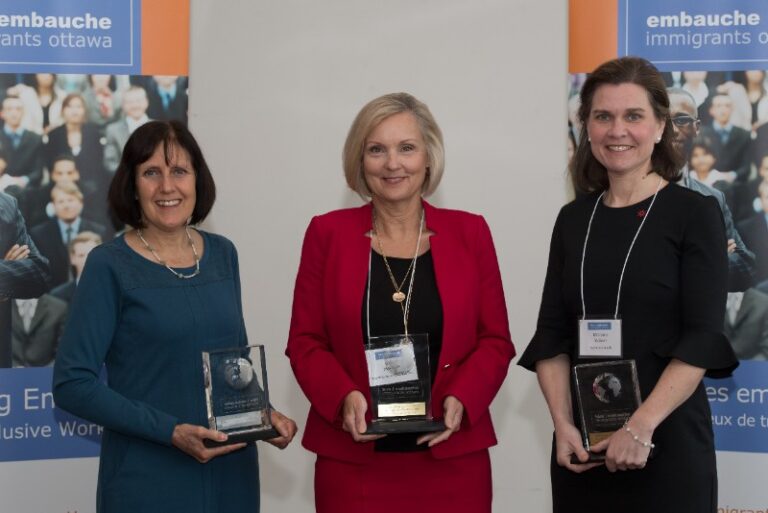
Three of Ottawa’s employers were honoured Wednesday: Northforge Innovations, Payments Canada and Sander Geophysics.

A global leader in secure network communications, Northforge Innovations was recognized for its ability to grow its diverse employee base and build multiple inclusive workplaces.

“Over the past seven years, we’ve hired 45 immigrant subject matter experts from six different countries, many of who have become Canadian citizens,” said president Brenda Pastorek.

“Not only do these international hires contribute directly to our technology advancement, but they’re also instrumental in helping to cross-train the software engineers we’ve hired locally,” she noted.

Delegated by the federal government to meet the payment needs of consumers and businesses, Payments Canada was also acknowledged for its efforts with immigrant worker inclusion. 

“At Payments Canada, we really do believe that diversity and inclusion is key to our success,” said senior director of organizational effectiveness Micheala McBean.

Sander Geophysics, which provides high-resolution airborne surveys for petroleum and mineral exploration as well as environmental and geological mapping to companies around the world, also accepted an award. 

The honour touched close to home for co-president Louise Sander.

“My parents were immigrants, both my parents grew up in Berlin, Germany. My grandfather was Jewish, so they went through a difficult time in the war and they came to Canada,” she said.

“So we continue my parents’ efforts at trying to hire immigrants because it adds great value to our company.”

Calls to give Ontario more power to select immigrants

Co-chairs of the Employer Council of Champions Gaye Moffatt and Frank Bilodeau introduced an employer pledge for immigrant inclusion.

“Our goal is to rally employers to take more action to advance diversity and inclusion,” Moffatt said.

In Ontario, both the ministries of labour and immigration are calling on the federal government to increase the allocation of immigrant workers for the province. 

“Ontario needs, deserves and is requesting the same kind of selecting power that’s being exercised in other provincial jurisdictions,” said Minister of Labour, Skills and Development Monte McNaughton. 

McNaughton added that compared with the rest of the nation, Ontario is “somewhere near 15 per cent” allowance when it comes to allocating economic immigrants. Every other province is above 40 per cent, while Quebec has full reign to select its entire amount.

Offer skills training to new workers, keynote argues

Before the awards portion of the morning, guests listened to the keynote address from Sunil Johal, a fellow with the Brookfield Institute and the Public Policy Forum. He spoke about the changes in today’s digital economy and the possibilities of automation substituting the need to hire immigrant workers. 

Johal added that by allowing immigrant workers resources such as employment insurance and the development of soft and cultural skills, employers would greatly benefit their own companies in the long term.

“Fixes to EI would help immigrants have access to the skills training they need … when they have challenges entering the labour market,” Johal said during his talk.

“We need to make sure they can receive those soft skills in an effective manner.”