American pool-maker builds production facility near Kingston

0

Latham Group Inc., one of the world’s largest manufacturers of fibreglass pools, is expanding its Canadian operations by building a state-of-the-art pool manufacturing plant in Loyalist Township just outside of Kingston and will be hiring up to 200 people over the next several months.

“This will be the largest fibreglass manufacturing facility for Latham and largest ever investment made by Latham in its 66-year history,” said Sanjay Jain, Latham’s fibreglass operations director in Canada. The company is based in Latham, N.Y. 

According to Jain, the inground pool market is undergoing a “material conversion” as consumers learn that fibreglass pools are better made, cheaper in the long run, easier to maintain and more environmentally friendly.

“Fibreglass pools need less chemicals to maintain the quality of water in the pool on an ongoing basis. Because of the smooth, non-porous finish of fibreglass construction, you don’t need as much chlorine,” said Jain.

Latham has more than 30 manufacturing plants around the world making fibreglass and in-ground vinyl liner residential pools and components, including automatic pool covers and solid and mesh safety covers. The company already has two plants in Canada outside Toronto that manufacture packaged pools, vinyl pool liners and pool covers.

The publicly traded company, worth US$668 million as of September 2022, has been looking to improve its capacity to serve the Canadian and northeastern U.S. markets for some time. In 2021, the company chose Loyalist Township because of its location between Toronto, Montreal and Ottawa and its easy access to markets in eastern Canada as well as the northeast and upper-midwest of the U.S.

“We welcome Latham, it’s a major employer for us, we hadn’t welcomed an employer of that size in years and since then we’ve used what we learned from our experience with Latham to sell the township to other interested investors,” said Steven Silver, chief administrative officer with the township.

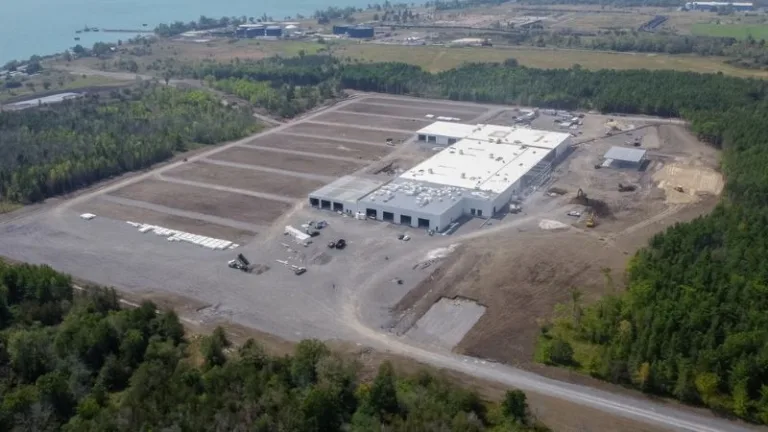
Situated on 148 acres of industrial land off Taylor Kidd Boulevard, the 160,000-square-foot facility will be fully automated with a program logic controller (PLC) system to improve material handling and safety.

“PLCs are very common in a petrochemical industry, not as common in the fibreglass manufacturing industry. We’re bringing some really new concepts of material handling and material delivery to the user,” said Jain.

The acreage will be used to store pool moulds, finished pools and raw materials, as well as dust collection units.  

Shovels went into the ground earlier this year and the plant is well on its way to completion, with plans to start production at the new facility in the spring of 2023. 

“We’ve already hired close to 35 to 40 people in production and supply chain leadership roles that are going to help with the facility, so production managers, supervisors, office managers and shipping managers,” said Jain, adding that the plan is to hire up to 200 employees as production reaches capacity. Most of the new hires will come from within a 30- to 40-km radius of Kingston.

Latham, which acquired Australian Narellan Pools in 2019, plans to manufacture more than 100 Latham and Narellan pool models at the new facility.

Never miss a story. Get OBJ’s daily update in your inbox every Monday to Friday. Click here to subscribe.

That personalized touch makes a resurgence in the big-box world of retail

0

Is the era of the big box retailer coming to a close?

At least two small businesses in Kemptville think so, and there appears to be research to back them up.

In 2021, PwC Canada reported that, “Canadians are adapting to supply chain delays, seeking out socially responsible retailers and using their purchasing power to support the local economy.” In 2016, the Harvard Business Review warned that “big box retail stores are losing relevance, while e-commerce and specialty stores grow in appeal.”  

What is that appeal? By all accounts, it’s old-fashioned personalized service, a phenomenon that has been stoked by the “buy local” movement and possibly by the isolation wrought during the pandemic and the resulting need for personal connection.

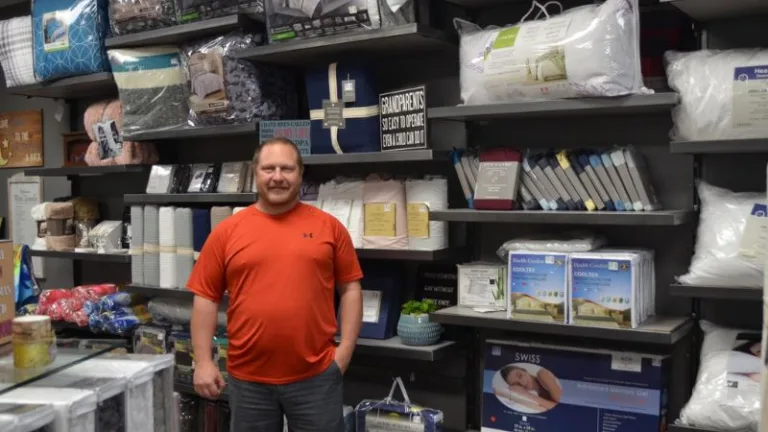
The Stevens Creek Decor Centre owned by Will and Rowena Pearl and the Kemptville Bedding Outlet with owner Tim Lucas are riding the wave of that burgeoning awareness.

However, battling the big guys is not always easy. One thing that stands out for both Pearl and Lucas is the lack of interest from suppliers.

“I asked one of the wallpaper companies, ‘Why has nobody called on us?’ and she was like, well, because nobody else has opened an independent paint store for the last five or six years in Eastern Ontario,” says Pearl at Stevens Creek, which specializes in wall and window coverings.

“I’ve had to call suppliers two and three times just to get a response. I don’t understand. I mean, suppliers are complaining they don’t have any sales but when you call them they don’t want to sell to you,” adds Lucas. 

He would like to carry all Canadian products but says in the bedding industry most items are made in Asia. So far, he’s found Canadian-made pillows and comforters and has snapped them up. Lucas says he maintains reasonable pricing, orders anything a customer asks for and never overwhelms people with aggressive sales pitches.

It took a back injury to nudge him out of the construction industry and into the executive business administration program at Willis College during the pandemic. Lucas started the bedding store in November 2021 and is already doing better than breakeven. 

“I thought the pandemic was slowing down and Kemptville is growing and November and December were great, but January and February were awful and then in March gas prices went up and that just killed us,” says Lucas, adding that since May sales have picked up again.

He’s moving his store to the Kemptville Mall and hopes that better visibility and a larger space will pay off. “Our new place is nearly three times the size of this,” says Lucas, which will allow him to carry the goose down comforters he doesn’t have the room for right now.

It was the pandemic that pushed Pearl into opening a new showroom after having run his business in Kemptville since 2016. 

“I don’t know why I did it during COVID. If I’m going to be honest, it was a little bit goofy. I just knew it would end and I thought it would end sooner,” says Pearl. Before the pandemic, he had a small shop that was more of a consultancy office than storefront.  

“When COVID hit, I could no longer have anybody in that space. It was a small space, not conducive to social distancing, and I always had the plan to do this eventually,” Pearl shrugs, indicating his new showroom on Hwy. 43.

Until Pearl opened in his new location, Kemptville didn’t have a specialty decor, paint or window treatment store. In fact, there isn’t another store like Pearl’s in the region.

“Demand has been high. The housing market has been good, so business has been good, visibility has been good. We’re doing business from Gananoque to Cornwall to Ottawa, so we’re right in the centre of things,” he says.

Pearl carries Cloverdale Paint products, a family-owned Canadian paint brand. The window coverings side is supplied by Hunter Douglas, a well-known brand, but American. “I wish we could get everything from a Canadian supplier, but I can’t, it’s just the nature of that market,” says Pearl. “We only sell North American products.”

Pearl is a third-generation window covering specialist, following in the footsteps of his grandfather, father and uncle. He got his start as a custom drapery track-maker and installer in Hamilton at Artistic Drapery Ltd. and went on to work for Riopelle Drapery, then spent nearly seven years with Lowe’s when it came to Canada. 

Pearl has another ace up his sleeve: he’s married to the queen of paint.

“When I decided to do the paint store, it was with the intention that Rowena would take care of that side of the business,” explains Pearl.

“I have that background in paints and wallpaper, but I think what a lot of people come for is my colour-matching,” says Rowena Pearl. “I do my own formulas and I can get the exact match, I even match stains.” 

Never miss a story. Get OBJ’s daily update in your inbox every Monday to Friday. Click here to subscribe.
‘Stoked on thrifting’: How sustainability is making its mark on the fashion industry

0

In recent years, the image of “thrifting” has evolved as consumers seek a more eco-friendly lifestyle. However, that rise in popularity is bringing its own challenges, including potentially diverting cheaper clothing away from those who need it.

One of the drivers behind the thrifting trend is environmental. According to a 2018 report in Edge Fashion Intelligence, the fashion industry is responsible for 20 per cent of global wastewater and 24 per cent of insecticide use while contributing two per cent of the world’s GDP. Facts posted online for Canada’s Waste Reduction Week in 2019 estimate that North Americans produce 10 million tonnes of clothing waste every year.

​Emma Inns, founder of a boutique in ByWard Market called Adorit, says she remembers her first visits to textile factories in the early 2000s that opened her eyes to the environmental impact of “fast fashion.”

She recalls visiting one community in India where denim was dyed and the residents didn’t have any clean water. The people had nowhere else to go, so “they were forced to drink that water that is slowly killing them for us to wear a pair of jeans.”

In recent years, Inns found that conditions had slowly improved, a situation she credits partly to the growing conversation about sustainable fashion. She works with designers who use eco-friendly fabrics and most of them, she says, are manufacturing zero-waste clothing.

ThredUp, an online reselling platform based in the U.S., found that 62 million women bought second-hand in 2019, compared with 56 million in 2018. ThredUp expects traditional thrifting to increase at a six per cent compound annual growth rate over the next five years. 

“Everyone is just so stoked on thrifting now,” says Chelsea Cochrane, district manager of Plato’s Closet, a consignment store that opened in Ottawa six years ago. “Because it’s cool now, we see a huge increase in teens and young adults doing it.”​

As thrifting has grown, the way people thrift has also begun to change. ​

Increasingly, resellers choose trendy pieces from thrift stores, clothing warehouses, other resellers and their own closets to be sold online. ThredUp expects resale thrifting to grow at a 39 per cent annual compound rate over the next five years. 

In November 2020, Vogue declared the future of fashion to be circular – an idea that was unheard of in an industry whose sales model has traditionally depended on constantly creating new items. The goal is to ensure everything is being used, whether it’s by upcycling or reselling. 

Ruth McKay, an associate professor at Carleton University’s Sprott School of Business, explains that the key to circularity is identifying where waste exists in the business process. 

“We are living and breathing that waste, and we need to identify it and remove it,” McKay explains. 

She says that reselling and upcycling old clothing are some ways of giving value to clothing waste. 

“We are degrading our environment in a way that is very difficult to remediate,” she warns.

As more people are willing to spend their cash on thrifted items, the more thrift stores might be able to charge. Goodwill Industries’ valuation guide in 2010 gave base prices for each piece, such as shirts and blouses being sold at four dollars. The 2020 valuation guide priced items on a range, so shirts and blouses could be priced anywhere between two dollars and $12.

And prices aren’t the only things changing. Craig Huffman, marketing manager for Goodwill for the Ontario Great Lakes Region, says the organization has begun shifting to e-commerce as online shopping continues to become more prevalent. 

“Our audiences are expanding; we are becoming a busier attraction in our stores … certainly we have to look at e-commerce.”

Goodwill picks out trendy items and posts them on its new website. Huffman says the process requires extra legwork, which is why many of the items the non-profit organization posts are usually slightly higher in price. 

Huffman says that inexpensive basics remain in the community locations, while items that can be priced higher go online. 

“​A lot of people love that hunt, love the find, to go through tens of thousands of items and take the time to do that,” Huffman explains. “Other people are busy and they really want to go in and have it curated for them.”

He says the profile of Goodwill shoppers is changing as many are becoming less price-conscious.

While innovative store models like those at Goodwill may be reaching a larger audience, some argue that these changes in thrifting are keeping clothes away from the people who depend on them.

Researchers at Brigham Young University conducted a study in 2010 about family patterns in local thrift economies, which found that “lower-income families see second-hand shopping as a necessity, whereas higher-income shoppers view it as a commodity.”

Never miss a story. Get OBJ’s daily update in your inbox every Monday to Friday. Click here to subscribe.
Regional conference brings together hundreds of Eastern Ontario reps

0

As municipalities grapple with a tight labour market, supply chain bottlenecks, and the challenges of post-pandemic economic recovery, the Ontario East Municipal Conference is making a comeback to its original in-person format after two pared-down virtual years.

Opening Sept. 14 in Cornwall at the former NAV Centre, OEMC is the largest annual regional municipal conference east of Toronto and brings together economic development staff and elected officials from 13 counties and 10 separate municipalities, along with business owners and government officials for three days of professional development and networking.

“The goal of OEMC is unique in that it offers the opportunity to hear from experts on the various topics we’re involved with, whether it’s attracting new investment, developing workforces, building tourism, even some technical issues that municipalities are interested in,” says Jay Amer, executive director of the Ontario East Economic Development Commission, the non-profit organization that organizes the event.

“The OEMC is unique from other opportunities for information exchange and networking to the extent the content is focused on Eastern Ontario and the unique challenges we face in this part of the province,” says Malcolm Morris, chief administrative officer with the Town of Smiths Falls.

“It’s nice that it’s a conference focused on Eastern Ontario, the subjects are more attuned to what we’re dealing with in our region,” agrees Melissa Marquardt, economic development manager for Renfrew County.

“It’s the only conference of its kind to focus on Eastern Ontario and is very valuable to attend,” adds Merrickville-Wolford Mayor Doug Struthers. “While not every topic on the agenda is relevant to every municipality, it’s also a great opportunity to network and share experiences with people who share the same challenges.”

For Tara Kirkpatrick, economic development manager with the County of Stormont Dundas and Glengarry, the challenge is around rural education.

“Rural schools are at higher risk of closure than metropolitan areas, but the closure of these schools tends to have a more resounding impact on not just the students, but the entire local economy and community,” she says.

For the past two years, the conference has been held virtually, which meant some features had to be abandoned.

“The biggest thing we didn’t have was our very popular exhibit hall, where people come and learn and visit with exhibitors. So that’s back and we have a very diverse group of exhibitors — businesses and government agencies, non-profits and other organizations, so we’re back on track and really happy after two years,” says Amer.

The conference kicks off with opening remarks from local politicians followed by a keynote address from actor/comedian Bill Carr. Once the ice is broken, the conference continues with topics ranging from housing to Internet connectivity to tourism.

The OEMC is being hosted at the DEV Hotel and Conference Centre, formerly known as the NAV Centre. 

Never miss a story. Get OBJ’s daily update in your inbox every Monday to Friday. Click here to subscribe.

Bright Side of Business: Prezdential gives marginalized youth a new, confident voice

0

Two years ago, Manock Lual, a former pro basketball player, was working hard on his non-profit, Prezdential Basketball Training, which gives youth across Ottawa basketball lessons combined with important life skills, from cooking to financial literacy. 

Since then, Lual has grown the non-profit to new heights, including launching Prezdential Youth Media (PYM), which creates opportunities for youth to sharpen their skills in content creation, journalism and videography. 

“We’ve become something (that’s able to) offer so many different resources in one place to youth (in) communities that need it most,” Lual explains.

One part of this vision is the Overbrook Show. Launched at the start of the pandemic, the first show covered stories of creative expression and the value of celebrating culture. For the second season, Lual partnered with Rogers TV to create a four-part docu-series unpacking how sports, arts and mentorship can transform a community. 

While brainstorming the second season, Lual created space for youth to come on board with the production with the launch of PYM. “I didn’t really know what (the program) was going to be,” he says. “I just knew I wanted to give the opportunity for the youth to tell beautiful stories that were important to them.” 

In the end, Lual was joined by eight young people. “Seeing them grow throughout the whole program and seeing the confidence that they had at the end — that’s what the program is.”

The PYM program ran for nine weeks. During the first week, the youth went into the ByWard Market to film. At first, they were nervous to approach people, but slowly began to relax, says Lual. 

By the end of filming, “they understand rejection,” he adds. “They understand how to create a pitch, a reason for someone to give you their time.” 

PYM

Other activities included filming a basketball tournament. Another week was spent shooting a commercial for a hair salon, mentored by an established filmmaker. For one section of the program, Lual partnered with Rogers Communications for a field trip to their local studio. There, the young people created content that covered the municipal election, exploring important issues and choosing which questions to ask interviewees.

“I think the questions and the stories we usually get in the media are coming from middle-class voices,” Lual explains. “It was very important to show what (people from) all walks of life feel and what they’re concerned about coming into this election.”

With the first PYM program having just wrapped up, Lual is already planning for the next one. “When somebody shares their voice, you see their confidence and others step up and share their voices along with them,” Lual says. “I’m just hoping this program can create the next generation of leaders.”

As well as continuing with PYM, Prezdential will partner with the Ontario Network for Education and Junior Achievement to launch JA Summer Hoops: a business program built around basketball. 

“(Participants) will learn how to build business concepts, pitch to people and have a budget,” Lual says. “It’s like a real-life simulation of a business.”

Looking to 2023, Lual says that Prezdential is “seeing a lot of respect for the efforts we’re putting in. I think the next step is, how can we create more impact, not only in the areas that we’re working with but also areas that we haven’t gotten to.”


Never miss a story. Get OBJ’s daily update in your inbox every Monday to Friday. Click here to subscribe.

The Bright Side of Business is an editorial feature focused on sharing positive stories of business success.

This column is presented by Star Motors, Ottawa’s original Mercedes-Benz, Mercedes-AMG and Mercedes Van dealer.

Since 1957, Star Motors has provided its customers with the Mercedes-Benz “The Best or Nothing” standard in vehicle selection, service, genuine parts and certified collision repair.

For your convenience, you may shop, research, chat and compare vehicles online at starmotors.ca, visit the 400 West Hunt Club location or call (613) 737-7827 for the very best in personal service.

Big plowing match comes to Kemptville — but is it a fading tradition?

0

It’s North America’s largest outdoor agricultural and rural expo and this year it’s landing in Kemptville, Sept. 20 to 24.  

The five-day International Plowing Match (IPM) is an educational and competitive event that began in 1913 at Sunnybrook Farm, the site of today’s Sunnybrook Hospital in Toronto. Its economic impact is estimated at $25 million for the hosting community but, with very little young blood coming into the event, it’s in danger of fading into the past, some observers suggest.

“I think the IPM has a lot to offer, but I’m not sure if it will be able to continue into the future; young farmers aren’t interested in taking over the organizing,” said Ellen Biemond of Upper Canada Creamery in Iroquois.

Biemond has an exhibition and retail space already booked at the IPM and is looking forward to the event, where she says she meets feed and seed suppliers and does a lot of networking.  

Certainly, the plowing competitions, often a highlight of the event, seem to be facing a shaky future given the average age of the competitors.

“It tends to be primarily the older generation competing. Probably because in today’s world plowing isn’t as popular as it was back a generation or two ago,” said Harry Bennett, chair of the local IPM organizing committee.

Plowing is a skill that’s honed over many years and competitive plowing is expensive, with travel time and fuel and equipment costs, explained Bennett. Plus, not all farms are suitable for plowing and there are other methods growing in popularity.

“I think it’s inevitable it will slowly die out as the older farmers go,” said Aaron Klink, a farmer in Merrickville. While he and his family enjoy the event whenever they can get to it, they like it more for its nostalgia than its relevance to their own small farm operation.

Biemond thinks it’s still relevant but worries that the new generation of farmers is complacent, while some of the older generation are averse to the changes young farmers want to introduce.

“We’re estimating there’s going to be 20 teams of horses with their handlers competing in horse plowing, I don’t know how much that’s dropped over the years. Not too many young people are into horse plowing, but it’s kind of neat to watch and quite an art, too,” said Bennett.

The IPM is a massive undertaking, with a budget of $1.5 to $2 million, covering an area of almost 500 acres and manned by close to 1,000 volunteers.

“We started organizing in February 2020, but then we had COVID and lockdowns, so it was a bit slow in the beginning,” said Bennett.  “Right now, we’re installing power and water to the tented city exhibitors and the RV park.”

The tented city where exhibitors will set up is a 65-acre area, while the RV park covers about 100 acres.

Held in a different location every year, the IPM has never been held in Kemptville and was last in Leeds and Grenville in 2015.

“This is the first time for the IPM in Grenville County and we’re mostly agricultural,” North Grenville Mayor Nancy Peckford told EOBJ. “We wanted to put North Grenville on the map and we couldn’t think of a better event to showcase the area.”

The IPM will be staged at Kemptville Campus and the lands south of the campus that have been slated by the province for a prison.

“We think this is an opportunity to help the agricultural community realize the potential of that campus. Already, 80 per cent of the existing buildings and greenhouses on Kemptville Campus are occupied. That being said, there’s still a lot of potential for small businesses and agricultural industry within the campus,” said Mayor Peckford.

IPMs are a partnership between a local organizing committee and the Ontario Plowmen’s Association and profits from the event are split evenly between the two. As the host community, the municipality is closely involved with the organizing committee and provides $100,000 in seed money that will be repaid at the conclusion of the event, as well as supports negotiations with the province and the Kemptville Campus.

“So, at the end of the match, the Ontario Plowmen’s Association gets 50 per cent and they use that money to continue to stage matches and other events down the road and our 50 per cent that the local committee gets is all donated back into the community,” said Bennett. Traditionally, the funds are allocated to health care or to a charitable organization within the host community.

As is often the case in recent IPMs, the growing focus on experiential tourism means there’ll be a regional showcase set up by the county at this year’s IPM.

“As one of the sponsors of the IPM, we have a space that’s been designated to us and we’ve been working with all 13 municipalities to put a regional showcase together,” said Ann Weir, manager of economic development with Leeds and Grenville.

The showcase will be interactive and informative, according to Weir. A lot of the exhibits will be outdoors in a nod to COVID and this year’s main attraction will be the touch-a-truck area, where firetrucks, snowplows, a Zamboni and more will be on display with visitors invited to get close. The showcase will also feature nature and outdoor recreational facilities and activities in the region — local trails, camping, kayaking and boating – along with other unique features of the region. 

“I’m just getting approval to do food and culinary – some sampling, cooking demonstrations and things like that,” said Weir.

It’s a theme that fits well with the overall focus of the IPM, which will also feature a rodeo and tractor-plowing competition.

“A big portion of the plowing match is educating school kids about where food comes from. So, we have a large — approximately 10 acres — area for education and we’ll have volunteers manning different displays on education in the area,” said Bennett.

The event is deliberately held during the school year, so invitations can be sent to all the schools in the region.

“We’ll probably have 1,500 to 2,000 kids per day coming to the education area and that’s pretty important because I think in today’s world not many kids and not many people live on farms like they did a generation or two ago and it’s a good opportunity to provide education about where food comes from, who produces it, the procedures that go into producing it,” explained Bennett, who is an agronomist by day.

Organizers are ready to implement whatever COVID-related health protocols are required come September, but are generally optimistic that the pandemic has created an appetite for outdoor events.

“We’re conservatively thinking that we’ll have around 60,000 attendees this year,” said Bennett. The last IPM held in Finch, Ont., attracted 80,000 visitors.

Never miss a story. Get OBJ’s daily update in your inbox every Monday to Friday. Click here to subscribe.

 

Turbulent waters: Ottawa Valley business navigates search for new owners

0

A unique adventure business in the Ottawa Valley is up for sale, but there’s a caveat.  

Ottawa Whitewater Leaders Rafting, or OWL Rafting, as it’s affectionately known, is for sale to the right buyer — one with a passion for paddling, who’ll keep developing the business.

“We’re in no rush,” says Claudia Kirchhoff-Van Wijk, co-owner of OWL. “This is paradise and paradise is an opportunity for someone. We want to find the right people that will continue this business, it doesn’t have to be the way we’re doing it, but it will continue.”

complete view

Located on the Ottawa River at Rocher Fendu Lake in the heart of the Canadian Shield about 30 minutes from Renfrew, OWL Rafting is both a resort and a whitewater paddling adventure experience that the Van Wijks have been developing over the past four decades.  

County officials also have an interest in seeing the property sold to the right buyer. Since its opening in 1982, OWL has had a huge impact on the local economy.

“The rafting business brings thousands of paddlers into the area every year,” says Melissa Marquardt, manager of economic development for Renfrew County. While seasonal, the business employs around 100 people each year. Wilderness Tours, a similar operation, is located next to the OWL property, creating a hub for adventure tourism along the river.

The idea for the business originated with Kirchhoff-Van Wijk’s parents, Hermann and Christa. The German immigrants fell in love with the sport of whitewater paddling in Canada. In 1968, they became Canadian slalom champions. In 1972, Hermann competed in the Olympics. In 1974, when Claudia was 14 years old, she and her father made the first kayak descent of the Ottawa River. 

“We couldn’t believe what we’d discovered; that there’s this gem (Rocher-Fendu rapids), right on the Ottawa,” says Kirchhoff-Van Wijk, herself a 10-time Canadian women’s whitewater kayaking champion, gold medalist at the 1976 Pan American Games, and bronze medalist at the 1982 World Championships.

Van Wijk

As much as the Van Wijks have developed the property, there’s still room for growth.

“There’s so much potential still in this business,” says Kirchhoff-Van Wijk.  

Appreciative of the land’s history with the Algonquin people and its value as a wilderness resort, the Van Wijks have tried to preserve the resort’s environment, using commercial composting toilets, solar heating and reusing as much waste as possible.

The property is being sold in two connected parts; the land at an asking price of $1 million and the business for an asking price of $6.5 million. OWL Rafting has been on the market since June 2022.


Bright Side of Business: Ross Video recognized for its compassionate approach

0

Chris Stone has had an exciting career, from being a paramedic to a commercial diver to a construction safety specialist. Today, he’s a health, safety and disability specialist at Ross Video — a company he says he’ll retire with.

It’s not hard to see why: recently, Ross Video became the first Canadian Compassionate Company (CCC), certified by Canadian Hospice Palliative Care Association, recognizing the support and care the company gives its employees.

“Throughout COVID-19, our primary focus has been on ensuring the health and well-being of our employees,” said CEO David Ross in a news release upon receiving the recognition. “When they need time off work to care for a loved one who is terminally ill, the right thing to do is to offer them understanding, empathy and job protection. An official CCC designation humanizes that mindset and demonstrates our commitment to our people and their families.”

This award-winning care is something that Stone experienced firsthand at Ross Video, which provides solutions and services to the live production industry. Last year, he was busy setting up a COVID-19 vaccine clinic at work that would serve staff and community members alike. Just as he was preparing to accept the first few visitors, Stone received a call from his mother, who told him that his father, who had terminal cancer, was at the hospital. 

“I immediately ran home,” Stone recalls. “I called my director on the way and I said, ‘I need to go to the hospital; (my dad) is probably not coming out.’”

Stone was a two-hour drive from the hospital. As soon as he hit Hwy. 401, he got a call from his colleague, Cathy McCallion.

“She said, ‘I just heard what’s happening, are you okay?’, no mention about work or the tasks I’d left unfinished,” Stone says. 

He put McCallion on speakerphone and, for the whole drive, she “made sure I was calm, that I wasn’t going to get into an accident and that I wasn’t completely falling apart, flying 100 (km/h) down the highway.”

Stone was able to say goodbye to his father. “It proved to me that I’ve landed in the right place,” he says. “This is the company I want to stay with until I retire.”

Building a healthy team culture takes hard work. “It’s possibly some of the most important documents I ever wrote,” Ross says of the policies he initiated.

When Ross moved to Ottawa to start the Ross Ottawa Lab for Research and Development, there were only five employees at the facility. Now, 25 years later, it’s grown to a 600-person operation across a multi-campus building. 

David Ross

“Everything I needed to know to work at Ross Video, I learned in kindergarten,” Ross explains. “Play nice with others, treat each other with respect, maybe don’t run with scissors.”

Today, despite employing over 1,300 people, Ross says he often hears that the business “feels like a small, family-run company.” 

“You care about people and then they will care about the company, they’ll care about your customers. It’s a virtuous circle — to me, this is good business.”

Private- and public-sector employers qualify as a CCC if they have formal human resource policies that accommodate employees who are unpaid caregivers with paid leave options, a supportive work culture and job protection.

Since the CCC designation, Ross himself has experienced loss when his stepmother passed away. She had been unknowingly living with stage-three cancer and her health declined rapidly. Ross and his family put his stepmother on life support. 

“The thought of (having to say), as I’m beside my 87-year-old father in the hospital, watching his grief, ‘Well, I’m sorry, but if I don’t go back to work tomorrow, I’m going to lose my job.’ I would not think much of my company at that moment.”

“We didn’t know whether she was going to pass away in an hour, in a minute or in two weeks,” Ross remembers. During those days, Ross thought a lot about compassionate care. 

“I’m living it personally, with the founder of the company, my father,” he explains. “The thought of (having to say), as I’m beside my 87-year-old father in the hospital, watching his grief, ‘Well, I’m sorry, but if I don’t go back to work tomorrow, I’m going to lose my job.’ I would not think much of my company at that moment.” 

Ross’ stepmother passed away after five days on life support. “It makes it very real,” Ross adds. “It’s not just a policy. It’s not just something that we happen to qualify for; it’s nice to be able to take care of people in moments like that.” 

“Most of us have experienced the death or dying of someone close to us,” adds Ross’ director of employee development and recruitment Mary Clement. “In the battle for top talent, we know employees are very interested in how we treat our staff. The CCC designation is another way we can demonstrate, through an independent national association’s review and official designation, that our commitments, HR policies and values put people first. At Ross, we believe that compassion belongs in every workplace.”

The Canadian Hospice Palliative Care Association strives for all Canadians to have equal access to quality hospice palliative care for themselves and their family.

“The movement to grow compassion within an organization’s workplace culture is gaining momentum and employers have an important role,” says the chair of the association’s champion’s council Russell Williams. “Unsupported employees are more likely to use more sick days, be less productive and even quit their job if the demands of work outweigh their capacity to care for a loved one and grieve their loss. If every company followed the Ross example, productivity, employee satisfaction, retention, and recruitment would thrive.”

The Bright Side of Business is an editorial feature focused on sharing positive stories of business success.

This column is presented by Star Motors, Ottawa’s original Mercedes-Benz, Mercedes-AMG and Mercedes Van dealer.

Since 1957, Star Motors has provided its customers with the Mercedes-Benz “The Best or Nothing” standard in vehicle selection, service, genuine parts and certified collision repair.

For your convenience, you may shop, research, chat and compare vehicles online at starmotors.ca, visit the 400 West Hunt Club location or call (613) 737-7827 for the very best in personal service.

Never miss a story. Get OBJ’s daily update in your inbox every Monday to Friday. Click here to subscribe.

Le Boat changes tack and taps into whole new base of Canadian consumers

0

The owners of Le Boat didn’t just pivot during COVID-19; they managed a full pirouette.  

The luxury canal houseboat purveyor, one of the largest in Europe, responded to the pandemic in a way that not only preserved but also expanded its market while much of the travel and tourism industry floundered.

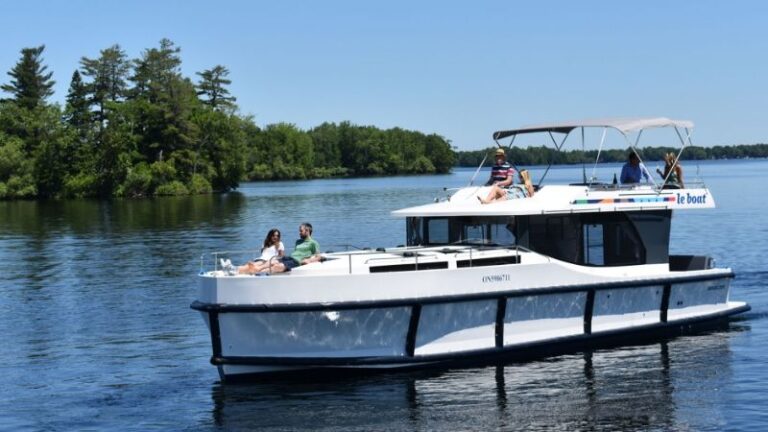
A global company based in France, Le Boat launched its Canadian operations in 2018 out of Smiths Falls, offering a variety of cruises on the Rideau Canal where travellers rent a houseboat and captain it themselves.  

Because its operations in Europe were affected by the global pandemic before COVID reached North American shores, Le Boat had already experienced the disruptions and knew that the product was ideally suited to pandemic restrictions.

“We did a lot to try to drive awareness that Le Boat is in your own backyard and that this is a very safe type of holiday where you could literally explore Ontario’s great outdoors from a luxury perspective,” explains Lisa Mclean, marketing manager with Le Boat. 

“That was one of the keys for our type of product. We’re not a group tour, we’re not at a campground with other people, you’re floating on your own cottage and in your own social bubble.”

So, just as the pandemic reached Canadian shores, Le Boat was already soliciting coverage from mainstream media outlets that could reach a high-end market of Canadian consumers wishing to explore different aspects of the Rideau Canal. 

“Le Boat is a great example of a business that pivoted their marketing efforts to capture a new demographic of customers during COVID,” says Julia Crowder, manager of economic development in Smiths Falls. “I also believe that by offering shorter vacations — three days instead of their usual seven days — it put the vacation into a price point and timeframe which was more appealing to the domestic market.”

LeBoat

Le Boat targeted its marketing geographically in Canada, McLean explains. “When I plotted where our customers came from, I could see that the clusters were all around (Hwy.) 401, so we really targeted our marketing to people living along the 401 corridor, all the way from Windsor to Quebec and within anywhere from a one- to five-hour drive time.”

Given the turbulence caused by the pandemic, the company doubled-down on efforts to build confidence in the Le Boat brand in both customers and staff, including a full refund policy during the pandemic and now a flight cancellation guarantee.

“So, if your flight is delayed by two days, we’ll hold your boat for you and we’ll only bill you for the days you’re on the boat or give you a refund,” says Mclean. “One of the things I’m proud of is that Le Boat didn’t lay off staff. They did everything possible to make sure all our staff still had jobs. They were even quick to refinance to keep the money flowing through the travel industry. I was probably one of 10 of my friends that still had a job during COVID.”

As a marketing strategy, it was a complete about face for Le Boat, which, when it first set up shop in Smiths Falls in 2018, had focused its marketing almost exclusively on its existing 18,000 customers from Europe, the U.S., Australia and South Africa.  

The company, which marked 50 years in business in 2019, can be traced back to English entrepreneur Michael Streat, who in 1969 founded Blue Line with eight boats. Le Boat today is a combination of three companies: Crown Blue Line (originally Blue Line), Connoisseur, and Emerald Star in Ireland. It offers houseboat rentals that cruise the waterways in France, England, the Netherlands, Belgium, Ireland, Italy, Scotland and Germany, as well as in Canada.

In the company’s first two years of operations pre-COVID in Smiths Falls, 60 per cent of bookings were from Europe, 30 per cent from the U.S., and 10 per cent from Canada, according to McLean. Most were from past Le Boat customers interested in seeing more of Canada by boat, especially since the Rideau Canal is a UNESCO World Heritage site. 

The change in tack brought about by the pandemic did not go unnoticed by local municipal officials.

“Their pivot brought new tourists from the region, who discovered not only Smiths Falls, but also all the towns along the Rideau Canal,” comments Crowder. “The town is working with Le Boat to help expand their fleet and provide more opportunities for both domestic and international visitors.”

As a result, Le Boat is expanding not only on the Rideau, but potentially beyond.

“We now have 30 boats and because demand from the domestic market has been so strong, we are getting four additional boats next year, so we’re exceeding our original business plan of only 32 boats on the Rideau,” says Mclean. “We’ll have 34 boats on the canal in 2023 and we’re currently looking for a second base somewhere along the canal – hopefully in Ottawa.

The company is also exploring expanding operations onto the Trent Severn waterway over the next few years. But its growth has not been all smooth sailing.

“With the demands of COVID, boat sales in Canada are actually up 20 to 25 per cent so it looks like people from Ontario turned to boating during COVID and a lot of people bought their own boats, so dockage space is actually a challenge,” says Mclean.

Never miss a story. Get OBJ’s daily update in your inbox every Monday to Friday. Click here to subscribe.

Some townships are taking connectivity into their own hands, with mixed results

0

As the Eastern Ontario Regional Network (EORN) continues to build connectivity in the vast region, some municipalities that support EORN are taking their own steps to improve services for their residents.  

The townships of Rideau Lakes and Leeds Thousand Islands both went out on a limb to explore solutions to help overcome their specific challenges.

“We decided to go our own route because we didn’t see progress moving fast enough,” Rideau Lakes Mayor Arie Hoogenboom told EOBJ, adding, “We are supporters of EORN and the work they’re doing — it’s great work, but it was going to take years.”

“Although the township supports EORN, it recognizes that the EORN model is not ideal for the township’s particular challenges,” said Stephen Donachey, chief administrative officer with Leeds Thousand Islands.

“We support whatever municipalities are doing to improve connectivity for their residents,” said Jim Pine from EORN, adding that EORN recognizes that it can’t provide services quickly enough or in the format that some areas need.

EORN is currently working in partnership with Rogers Communications to close gaps in cell coverage in the region. According to Pine, Rogers will be building an additional 256 towers and upgrading existing towers to improve cellular service.

“As we build new towers,  Rogers is able to come along and add fixed wireless, but they’re paying for it, we’re not,” said Pine. 

Both Rideau Lakes and Leeds Thousand Islands are rich in lakes, Canadian Shield rock and old-growth trees. In Leeds Thousand Islands, there’s the additional challenge of rolling hills and a sparse population spread over a large area with few urban centres. The terrain means that fixed tower connectivity leaves too many residents with poor to non-existent service.  

Each of the townships took a different approach to the challenge. Rideau Lakes chose a public/private partnership, while Leeds Thousand Islands decided on a publicly funded model supported by government grants.

By the end of this year, 1,400 homes in Rideau Lakes will have gained fibre-to-the-home (FTTH) and 1,200 homes will get 50/10mbs fixed wireless via broadband tower upgrades, while many more are getting improved fixed wireless reliability and capacity through fibre backhaul. All homes and businesses in the township’s villages — Portland, Elgin, Delta, Lombardy, Newboro and Chaffey’s Lock — will have access to FTTH. That represents more than 40 per cent of the township’s properties.

“I think we got it right, I know other municipalities have tried to do too much too quickly, but we also had some opposition initially from our own council in terms of getting into the partnership,” said Mayor Hoogenboom.  

On the other hand, the Leeds Thousand Islands project stalled when the federal government rolled the Universal Broadband Fund program over to the province, which, in turn, changed the criteria for funding under what it called the Improving Connectivity for Ontario program.

“Essentially, the province decided to run an RFP process where only established internet service providers (ISPs) can bid to receive territories to provide internet services and receive funding assistance from the province,” explained Donachey. “I suspect that, if an ISP bid the territory in which Leeds Thousand Islands falls, it will likely provide fixed wireless internet services (such as towers), as it is the most cost-effective, rather than running fibre optic cables to each home, which was the approach to be taken in our network design.”

While Leeds Thousand Islands is disappointed with the change in funding formula, officials are not giving up entirely.

“I have reached out directly to the provincial government to seek answers on how it will ensure high-speed internet access for the township,” said Mayor Corinna Smith-Gatcke.

Meanwhile, by the end of this year, Rideau Lakes will have a $5.2-million system that cost the township $880,000.  

“My understanding is that this contribution rate (16 per cent) is considered exceptional value on the dollar in the industry in terms of rolling out fibre via a partnership like this, especially in a rural setting,” said Mike Dwyer, chief administrative officer with Rideau Lakes.

Certainly, it seems the investment is paying off, because in just the last year the township saw record growth, with 80 new homes being built when the norm is closer to 25. That means new tax revenue to the township will help offset the investment quickly. 

“Likely not in a single year, but definitely over a short period of time, as this is all new development that will be taxed at market value; so good for the township, county and school board,” said Mayor Hoogenboom. “In addition, properties with better connectivity increase in value. So, I believe taxpayers will see a significant short-term return on this investment.”

From a business perspective, it seems likely that installing fibre optic lines in Delta weighed positively on the decision by Willows Agriservice to not only stay in Delta, but to invest in a $10-million expansion.

In 2019, when Rideau Lakes issued an RFP, officials were gratified to receive five separate submissions.

“Unique to our process was keeping it simple and also engaging two independent industry experts to assist with the technical language in the RFP as well as scoring the resulting submissions,” explained Dwyer. 

As a result of the competitive process, the township entered into a three-year build-out agreement with WTC Communications. WTC chose to go with a mix of fibre and fixed tower services.

“We try to go with FTTH wherever we can because we see that as where the technology is going,” said Mike Lynn, CEO of WTC. “Fixed wireless is great and it makes sense in places where fibre is difficult to install. Right now, FTTH exceeds the need but it’s future-proof.”

“We have been able to build a great working relationship with WTC,” said Dwyer. “This has been both at the operational level — such as coordinating roadwork to allow conduit to be laid before the new road surface is applied — and the administration level, which resulted in two grants … being gained to expand the project.”

With the project already rolling, WTC was able to secure an additional $1.2 million from the two government grants, one provincial and one federal, to expand the project to reach more homes and businesses.

“So, it made the project quite a bit bigger. It’s been a successful partnership and we’re happy with the rate of return and compare it to places that have more dense populations,” said Lynn.

While not all the councillors in Rideau Lakes were on board with spending public money on the project, Mayor Hoogenboom’s argument was that it’s an essential service.

“I treated it as the infrastructure of this century. We’ve always been involved in building roads and bridges and picking up garbage. Internet and cell connectivity is the infrastructure of today.”

Never miss a story. Get OBJ’s daily update in your inbox every Monday to Friday. Click here to subscribe.