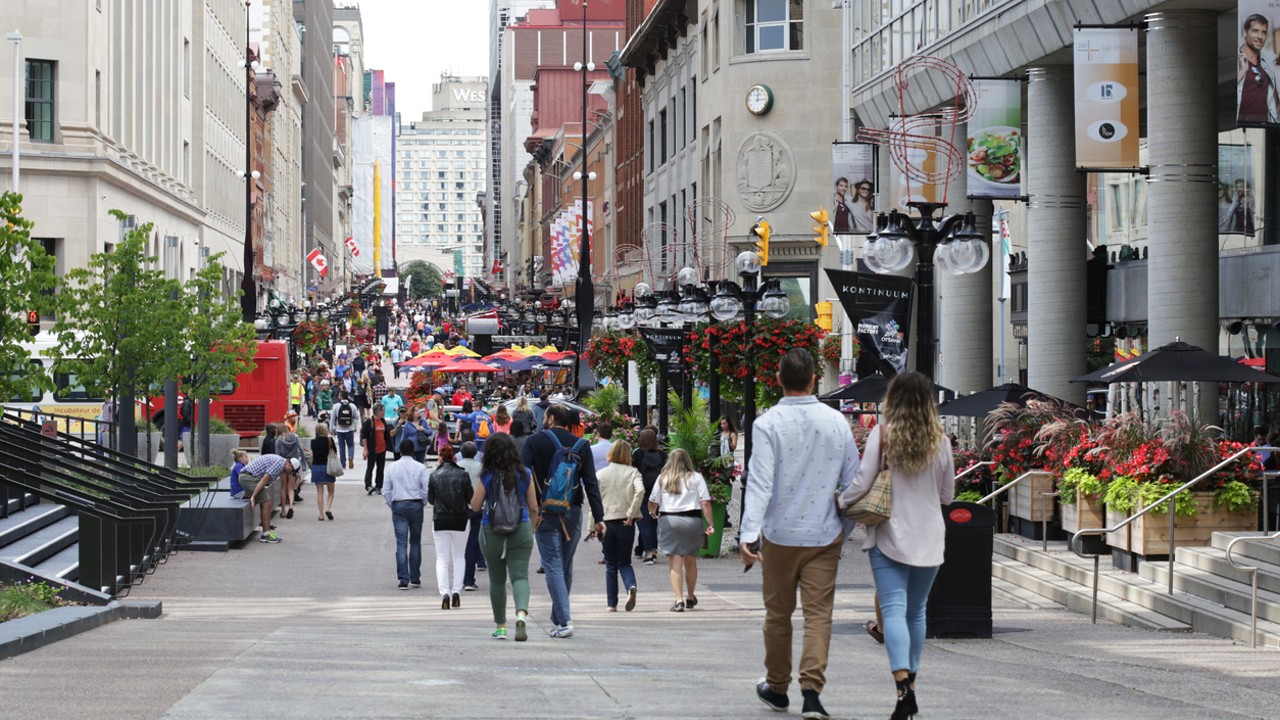
The federal government’s proposal to turn a two-and-a-half-acre site across from Parliament Hill into an office and retail complex is a “great start” toward revitalizing the Parliamentary Precinct, a prominent Ottawa real estate executive said Friday – but other business leaders say they’re not convinced the project will give struggling downtown merchants the boost they need.
Already a Subscriber? Log in
Get Instant Access to This Article
Become an Ottawa Business Journal Insider and get immediate access to all of our Insider-only content and much more.
The federal government’s proposal to turn a two-and-a-half-acre site across from Parliament Hill into an office and retail complex is a “great start” toward revitalizing the Parliamentary Precinct, a prominent Ottawa real estate executive said Friday – but other business leaders say they’re not convinced the project will give struggling downtown merchants the boost they need.
Michael Church, the managing director of Avison Young’s Ottawa office, said Public Services and Procurement Canada’s plan to restore and modernize nearly a dozen buildings on a block bounded by Wellington, Sparks, Metcalfe and O’Connor streets shows the feds are “committed” to bringing new life to an area that’s currently filled with decaying, half-empty buildings and vacant storefronts.
“I applaud it,” Church said of the restoration project, which is expected to get underway later this year and is slated to take nearly a decade to complete.
“The feds often take a bit of a (bad) rap, but they do take the long-term view of things … and I understand what they’re trying to do in creating a destination.”
PSPC says the work will include “a combination of new build components, restoration and refit while preserving the heritage character of the historic streets.”
The redesigned buildings will provide space for the Senate, the House of Commons and the Library of Parliament and will also include renovated retail space on the Sparks Street Mall.
Toronto’s Zeidler Architecture and U.K. firm David Chipperfield Architects will oversee the redesign process. Montreal-based Pomerleau will manage construction of the first phase, which is expected to begin this fall.
Church, who is also part of the Ottawa Board of Trade’s push to craft a downtown action plan that is expected to be released next month, said projects like the one proposed by PSPC will work only if the whole community is involved in the process.
“We need to be collaborative, and I think this is a great start,” he said. “We need some innovative thinking. We need support of not only the feds, but the province and quite frankly the business community.”
Acknowledging the hot-button related issue of closing Wellington Street to vehicular traffic, Church suggested Ottawa could find inspiration in tourist meccas such as Florence, Italy, that restrict vehicles from entering certain parts of the city at specific times of day.
“There’s all sorts of ways to get creative on that,” he added. “That’s part of that thinking that you have to have at getting all the stakeholders at the table. You can’t do this in isolation.”