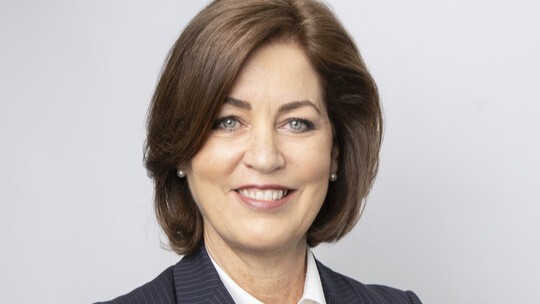
Across the board, businesses are dealing with uncertainty, even in the country’s most talked-about industries, according to Robyn Osgood, CEO of government relations firm Vantage.
Get Instant Access to This Article
Become an Ottawa Business Journal Insider and get immediate access to all of our Insider-only content and much more.
Across the board, businesses are dealing with uncertainty, even in the country’s most talked-about industries, according to Robyn Osgood, CEO of government relations firm Vantage.
The Ottawa-based firm, whose staff includes former journalists and high-ranking public servants, is marking its 10th anniversary by spinning off from MacMillan LLP as an independent organization.
“I don’t know what that is in dog years, but it felt like it was time for us to be out on our own,” said Osgood. “The shifts in everything happening geopolitically and in the economy just happened to coincide with our anniversary and we thought, okay, we need to be doing things differently.”
Over the past decade, Osgood said the firm has entrenched itself in multiple sectors that have recently become targets for investment, from defence and procurement to critical minerals and health-tech.
With the government looking to make impactful moves, Osgood said there’s opportunity for clients to get in on the ground floor, but only if they can deal with uncertainty.
In this conversation with OBJ, Osgood discusses how businesses can get comfortable with uncertainty, the topic of conversation she’s most invested in and what she’s hoping to see from her team over the summer.
The transcript has been edited for length and clarity.
What’s one thing that has been top of mind for you recently?
I think it’s trying to get into the mindset of our clients. It is a very difficult time to run a business in this country because so much is changing. I look at our clients, many of whom are national companies, some international, large or not-for-profit, everybody's asking us the same thing: do you have a sense of when x and y will happen? Do you know what the government is thinking?
People are looking for certainty and we can help organizations manage through uncertainty. There's no doubt about that. Encouraging organizations to feel comfortable in the uncertainty is hard. I don't blame them at all. When you look around at the market in which you're working, what’s the same as it was three years ago? Almost nothing. It’s a pretty dynamic time. You either have a growth mindset to take advantage of those changes and lean into the discomfort, or you turtle. And we’re not working with a team that wants to turtle.
What are you focusing on with clients when it comes to being comfortable in uncertainty?
Let's take a sector like defence or critical minerals. Staying ahead of, or at least in lockstep with, the government's priorities and understanding what the federal or provincial government wants to do is a good way to ride the wave of uncertainty, because those governments are dealing with it too. If the federal government's priorities around critical minerals are this and this is what they're thinking, how does that align with your business strategy as a client? Let's understand where the government's going. Understanding government priorities is probably as certain as it's going to get in the current environment.
We’re helping businesses see that now. Just because you know a government's priorities doesn't mean that your business aligns with it, but at least you know what they're thinking. Then you can make some decisions about your own business priorities.
If you’re in a sector like defence, which is going to see major investment in the coming years, but you don’t feel like you’re aligned with the government’s priorities, how do you instruct clients to move forward and potentially get in on the conversation?
It’s always a balance. Clients are best positioned to make the business decision they need to make. Our job is to make sure they understand the possible impact of those business decisions in the Canadian context, based on what we know about those priorities. We can’t, of course, predict the outcome, but our job is to say, here are your options and here are the possible scenarios around those options. We’re here to help you make business decisions as effectively as possible. No option is perfect. You need to know the pluses and minuses.
Whether it’s a challenge or opportunity, what else is top of mind for you?
What is so interesting is rolling up your sleeves and really digging into topics; defence, for sure, is one, and critical minerals is another. Also, what's happening in the health-care sector, like the conversation around what role private health care should play in a publicly funded system. We fully believe that the publicly funded system is the system and it's a point of pride for Canadians. It's bursting at the seams right now, so it needs a little help, but it is the system that has made this country so strong. There are more and more private players coming into the system, so digging into this on behalf of our clients and determining the appropriate role for private health care while maintaining the single-payer system has been a really interesting conversation. It feels like an adult conversation that's long overdue. There's no doubt that our system is strained and there isn’t going to be one solution. I think we have to look at private as an option, not to restructure the system, but to be part of the system.
When these new conversations emerge, how does your team strategize before going to your clients to help them understand the issue?
We like to marry the inside and outside perspectives of what’s happening. What’s the context in which our client is working? That makes all the difference. Did they just finish a merger? Did they just enter the Canadian market? Are they in growth mode? Whatever the context is, we marry that with the deep knowledge our team has about these topics. What can we bring to the table that would be useful, while also recognizing that the client is the expert in their area?
We’re never going to be as expert in a particular topic as the client who lives and breathes it every single day. What we are experts in is the policy that impacts the client. We also do a lot of communications work around reputation. While the client is the expert in their reputation, we understand how something they do may impact their customers or their investors. We have that third-party, neutral perspective.
We never go to a client saying, oh, we have the answer. First of all, that’s obnoxious. Second of all, it’s not true. What we have is a perspective they might not have because we’re outside of their business.
Is there anything else that’s been top of mind for you recently?
For my team to find some break time over the summer. It’s been a really busy year. Business is a team sport and we can’t operate as a firm at the highest and best level if the team is not there. They need to take a break and take a step back. I want them to come out of the summer feeling energized.