

At CHEO, innovation isn’t a buzzword – it’s a tradition rooted in community action. Over 50 years after local families advocated for a dedicated children’s hospital in Ottawa, CHEO has grown into a world-class pediatric health care and research centre combining clinical care, discovery, and technology to improve outcomes for children and youth across the region and beyond.
Emily Jamieson, vice-president of innovation, corporate and strategic partnerships at the CHEO Foundation, helps connect partners, donors, and innovators with CHEO’s clinicians, researchers, and scientists.
“For us, innovation is more than chasing the newest technology,” she explains. “It’s about getting families and their children answers faster, reduce the burden on clinicians, and deliver better outcomes for kids.”
 That focus shows up in current research projects that have the potential to improve the patient experience and, ultimately, their quality of life. Dr. Hana Alazem, clinical research chair in pediatric rehabilitation at CHEO, is studying an AI-powered “smart hallway” to evaluate its accuracy in gait analysis for children with movement disorders like cerebral palsy. The goal is to create a cost-effective method that improves local access to gait analysis, leading to better treatment decisions for patients who don’t have easy access to specialized clinical gait analysis labs.
The CHEO Research Institute developed a world-first AI algorithm called ThinkRare to help flag kids who may have undiagnosed rare diseases. ThinkRare continuously scans clinical information within CHEO’s electronic medical record system to identify children who may have an undiagnosed rare genetic condition – shortening their diagnostic journey and enabling them to get earlier access to treatment and other supports.
“ThinkRare is an incredible example of what happens when clinicians, data scientists, and families come together to build meaningful, responsible AI. It has had remarkable success at CHEO and is now expanding to other sites across Canada, meaning more children and families will get the answers they need sooner,” said Dr. Jason Berman, CEO and Scientific Director of the CHEO Research Institute, and Vice-President of Research at CHEO. “CHEO is uniquely positioned to develop impactful algorithms like ThinkRare because we have thoughtfully brought together all the necessary elements that foster meaningful AI advancements in health care.”
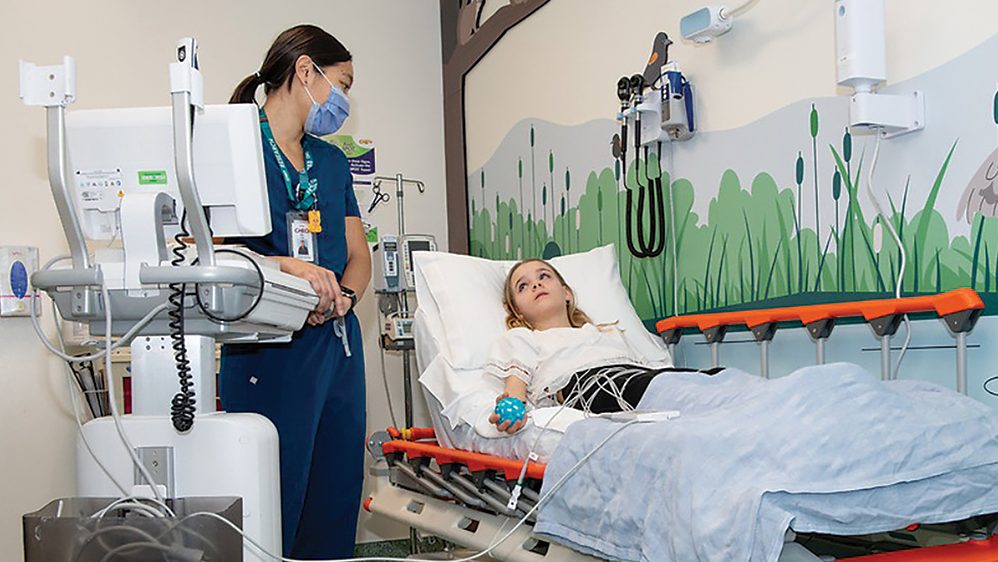
Meanwhile, CHEO’s campus redevelopment – its largest expansion since its opening – has created new opportunities to design care and research spaces purpose-built for modern pediatrics, including technology-enabled approaches to rehabilitation and mobility.
Jamieson argues that progress hinges on an entrepreneurial drive to collaborate, transforming bold ideas into measurable clinical impact. Philanthropy often fills the gap between promising concepts and ministry-funded adoption, supporting proof-of-concept work, pilots, and early implementation.
CHEO works with entrepreneurs and researchers to help innovations cross the chasm between prototype and real-world use, strengthening the health-tech ecosystem locally while building solutions that can be shared nationally and globally. As Jamieson puts it, “Some of the most meaningful breakthroughs happen in the space between sectors, when donors, industry, researchers, and front-line teams sit at the same table and commit to moving an idea from pilot to real-world care.”
Looking ahead, CHEO’s mission is as bold as it is essential: To harness frontier technologies and pioneering methods that sharpen its efficiency, champion equity, and keep children and families at the heart of every breakthrough. Fifty-two years in, CHEO’s story is still in its opening chapters. For Jamieson, the next act belongs to those who lean in – the clinicians, researchers, and donors whose collective hands will shape a future where Ottawa’s pediatric care continues to set the global standard.
This article first appeared in the Executive Report on Health Innovation in the June Magazine produced by the Ottawa Business Journal. That publication is available in it’s digital format below: