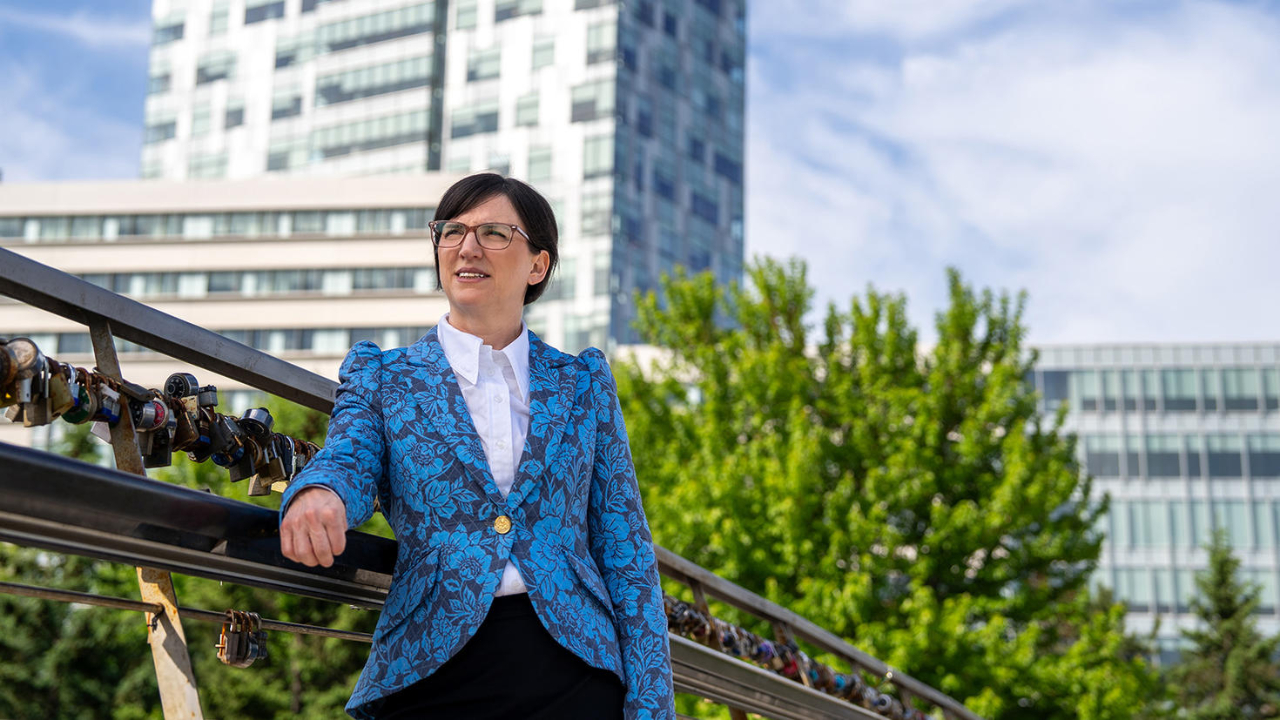
A year into her role at the helm of the University of Ottawa, Marie-Eve Sylvestre is busy balancing budgets, creating new branding and reaching out to industry players in areas such as defence, artificial intelligence, cybersecurity and scientific research. At the same time, she’s not forgetting her background in the humanities, and the role it can play in the current climate.
Already a Subscriber? Log in
Get Instant Access to This Article
Become an Ottawa Business Journal Insider and get immediate access to all of our Insider-only content and much more.
A year into her role at the helm of the University of Ottawa, Marie-Eve Sylvestre is busy balancing budgets, creating new branding and reaching out to industry players in areas such as defence, artificial intelligence, cybersecurity and scientific research. At the same time, she’s not forgetting her background in the humanities, and the role it can play in the current climate.
“It’s certainly been a learning curve to understand those universes and the sciences and the health sciences in particular,” she told OBJ in a recent interview. “But what’s interesting, and I think what I bring, is really the policy side of things and how important social sciences and the arts and humanities are to this moment in our history.”
Last year, on July 1, Sylvestre was appointed president and vice-chancellor of the university, the first woman to hold the role. She joined the institution in 2005 as an assistant professor, holding a variety of positions, including director of graduate studies, associate dean of research and communications and, most recently, dean of the civil law section of the faculty of law. She was also co-chair of the Senate Committee on Academic Freedom.
As the university works to keep pace in rapidly evolving sectors, Sylvestre said she’s drawing on her experience to highlight the role of the humanities, which she said are more important, and more in demand, than ever.
“When we speak about AI and these technologies, whenever I speak with employers, whether they’re from the government or from the private sector, people tell me how important it is to have people with problem-solving skills, communication skills, critical thinking,” she said. “It’s good to understand the technology, but it’s even better to be able to exercise judgement and to validate the outputs coming out of that technology.”
Over the past 10 years, Sylvestre said the school has increased its research output, generating $500 million in research revenues each year. Now, it's focusing on commercializing that work, helping to launch startups out of its labs and securing partnerships with industry leaders across STEM fields.
Last month, Sylvestre appointed a special adviser on relationships with industry, a move she said is part of an ongoing effort to deepen ties with key sectors such as tech and defence.
“We’re ranking top five in the country for research intensity,” she said. “It’s really about getting the word out and telling people about the connections we already have. We have a campus in Kanata North, where we have student placements, where we have researchers working with industry on autonomous vehicles and drones. We’re really getting people to realize the importance of that integration of our university into the business ecosystem.”
While these are important areas for the university to invest in, Sylvestre said her priority has been to ensure that the approach is multidisciplinary. With its public affairs and international relations expertise, the university is well-positioned to help industry leaders and governments achieve innovation goals amid geopolitical concerns, she said.
“We have researchers talking to the media, talking to the government about Iran, about China. As our tech sector is expanding and finding its place on the global scene, it’s important to understand the landscape, the needs, the supply chain. At the school of political science, we have an expert in supply chain management and critical minerals with China. She has a very sophisticated understanding of the strengths of that country, but also their vulnerabilities, and how we can work in terms of getting the best deal for Canada,” she said.
“The humanities and social sciences are so key to understanding what’s going on. All of this is so relevant to the moment.”