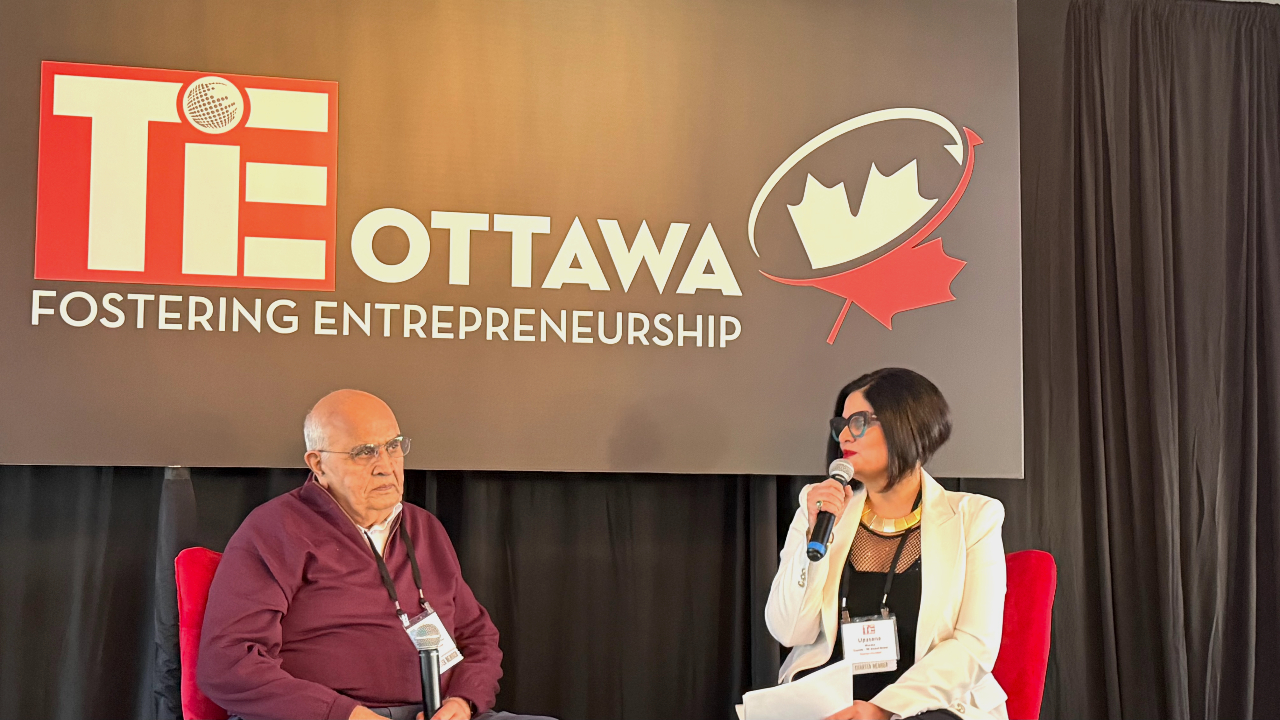
Kanwal Rekhi arrived in America with $8 in his pocket. It was 1967, and the Indian government had restricted the amount of money departing citizens could take with them to prevent capital flight, but the 22-year-old electrical engineering graduate left anyway and landed in Michigan. Six decades later, the man Fortune magazine called “The Godfather […]
Already a Subscriber? Log in
Get Instant Access to This Article
Become an Ottawa Business Journal Insider and get immediate access to all of our Insider-only content and much more.
Kanwal Rekhi arrived in America with $8 in his pocket.
It was 1967, and the Indian government had restricted the amount of money departing citizens could take with them to prevent capital flight, but the 22-year-old electrical engineering graduate left anyway and landed in Michigan. Six decades later, the man Fortune magazine called “The Godfather of Silicon Valley Indian Mafia” visited Ottawa to launch his memoir, “The Ground Breaker.”
The event was held last week at Irish Hills Golf & Country Club in Carp. It brought together founders, investors and business leaders for a gala organized by TiE Ottawa together with the Technology Innovation Management program and the Sprott School of Business. The visit marked the fourth time Rehki has travelled to Ottawa to support the local chapter of The IndUS Entrepreneurs (TiE), the global network he co-founded in Silicon Valley in 1992.
Rekhi said the staying power of the Ottawa chapter proves something about the local entrepreneurial community.
“The chapter has sustained itself for 25 years,” he told OBJ in a sit-down interview. “Many chapters form and they fade, but there’s a community here, a bunch of people who are committed to making it happen. And the only reason you do it is because you’re seeing the results.”
Ottawa ranks among the top technology concentrations in North America, particularly in cybersecurity, telecommunications and defence-tech. TiE Ottawa was founded in 1992 and holds at least two events per month. Rekhi flew to Ottawa 25 years ago to help found the chapter. Today, it runs the TiECon Canada national conference, where Rekhi once shared a stage with HubSpot co-founder Dharmesh Shah.
But Rekhi’s path to Silicon Valley greatness was not guaranteed. He went through many failures, which he now counts as essential education. He was laid off from three consecutive engineering positions after earning his master’s in electrical engineering from Michigan Technology University in 1969.
“Don’t get comfortable,” he said. “Ever. There’s going to be something that throws you off your job. Always try to stay a step ahead.”
He described entrepreneurship as similar to surfing. “You paddle out, you catch a wave, and every wave brings you back to the beach,” he said. “And then you’ve got to paddle out again. Learn to paddle out, don’t be afraid of the waves. Learn to ride them.”
He also had advice for founders who reach early success.
“When you climb the mountain, personally you reach the mountaintop,” he said. “That’s the time to move on, because if you stay at the mountaintop, you’re going to start sliding down. The next stop is always down. So you better find a higher mountain to climb.”
He earned those lessons directly from his experience building Excelan Inc., a networking hardware company he co-founded in 1982. He stepped in as interim CEO during an internal crisis and restructured the company’s pricing, bundled its products with money-back guarantees and bypassed slow-moving distributors to sell directly to corporate buyers. He offered prices around $14,995, compared to competitors charging upward of $30,000 for comparable products. His strategy transformed Excelan into a profitable business, and he took the company public on NASDAQ in 1987 at a $120-million valuation. He became the first Indian founder and CEO of a venture-backed company to list on a U.S. stock exchange.
Two years later, Excelan merged with Novell Inc. in a $210-million transaction. Rekhi joined the new entity as executive vice-president and CTO. He helped create the NetWare operating system that gained 70 per cent market share in local area networking. Novell ranked as the second-largest software company in the world at the time, behind Microsoft.
He later pivoted to angel investing. He has a guiding principle for evaluating founders.
“If you are honest and you have a product, you have to know what you’re saying,” he said. “If I start to learn more from an entrepreneur than I already know, I invest.”
He co-founded Capital Partners in 2007 to support early-stage ventures bridging Silicon Valley and Indian tech companies, and has backed more than 200 companies with exits including IPOs and acquisitions. He co-founded TiE, which now counts nearly 20,000 members across 62 chapters around the world. Companies founded by TiE members have generated more than $250 billion in collective wealth.
Rekhi said TiE’s durability reflects an organizational philosophy he has held since the beginning.
“It should be values-driven,” he said. “It should not be controlled centrally, where chapters are being told what to do. Chapters should be free to grow themselves. There’s a lot of innovation that comes from the chapters.”
TiE Ottawa is the perfect example of this philosophy. Rekhi said every time he comes to Ottawa, he notices something bigger than networking.
“TiE has become an integral part of the Ottawa ecosystem,” he said. “It is a selfless volunteer effort. For me, at least, and for many, it is a spiritual movement. You’ve seen the impact, you’re seeing the good that is being done. Many chapters open and fail. TiE Ottawa has a rare resilience thanks to the type of people who live here.”
When it comes to AI, he said the anxiety about technological disruption follows a familiar pattern he’s seen before.
“You have to learn,” he explained. “Learn to ride with it. AI, like every other technology — the steam engine, the internet — you can see it as the new way. Your business models, your jobs, half the work will be obsolete. But history tells you AI can find a new, cheaper and better way of building things, and if it destroys jobs in one area, it creates jobs in another.”
His book is a memoir that addresses the partition of India, his family’s displacement from what is now Pakistan, his early years in America, his investments and the passing of his wife, Ann, less than a year before the book’s publication. His son, Ben Rekhi, has directed a documentary called “Breaking The Code” that premiered at the Indian Film Festival of Los Angeles and will be on streaming platforms later this year.