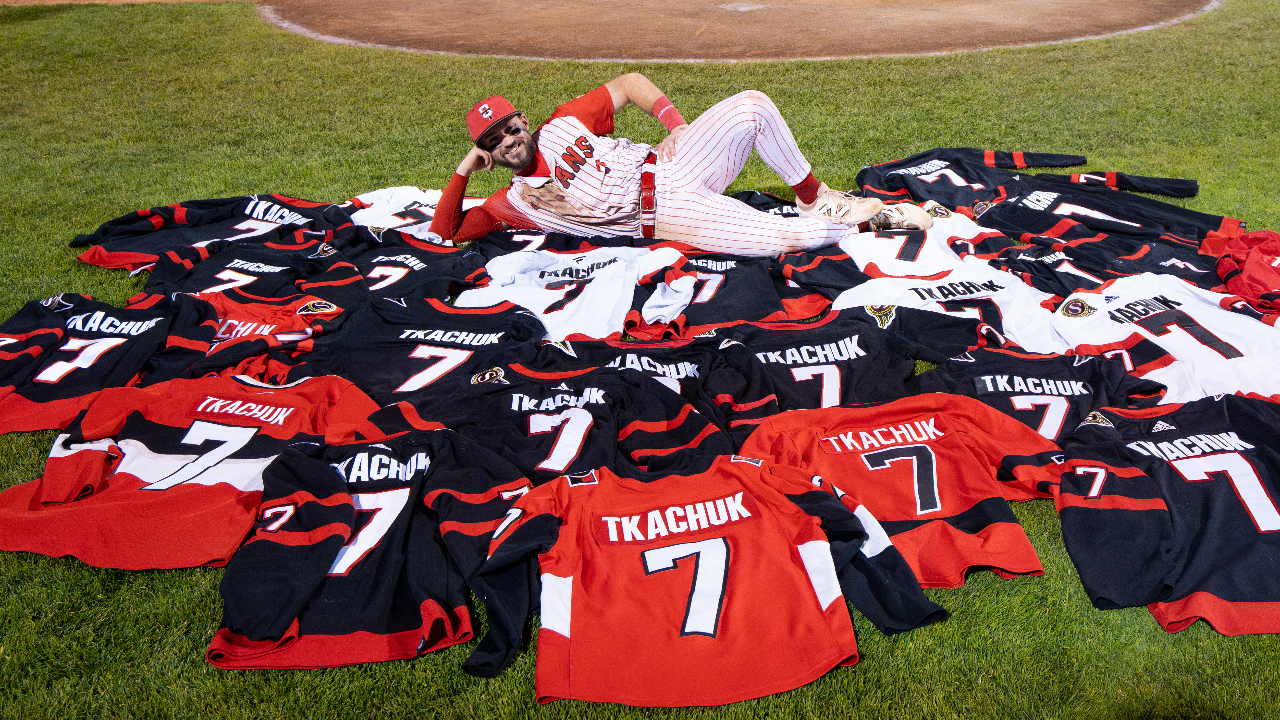
A.J. Wright of the Ottawa Titans posing with some of the Brady Tkachuk jerseys the Ottawa Titans received at its "Forget Brady Day" jersey swap. Photo from the Ottawa Titans.
Get Our Email Newsletter Local news about the companies, people and issues that impact business in Ottawa and beyond delivered to your email inbox.
On June 21, many people were probably enjoying a leisurely Father’s Day, but in the hockey world, something was brewing. The NHL had announced that Brady Tkachuk, captain of the Ottawa Senators, would leave the organization after nearly 10 years to join his brother at the Florida Panthers. Within hours of the news going public, […]
On June 21, many people were probably enjoying a leisurely Father’s Day, but in the hockey world, something was brewing. The NHL had announced that Brady Tkachuk, captain of the Ottawa Senators, would leave the organization after nearly 10 years to join his brother at the Florida Panthers. Within hours of the news going public, another sports team across town was capitalizing on it. Martin Boyce, general manager of the Ottawa Titans Baseball Club, said the team’s digital marketing manager wrote to the front office’s group chat, suggesting they host a jersey swap: bring in your Tkachuk jersey, the former Sens No. 7, to receive an A.J. Wright jersey, the Titans’ No. 7 and the longest-tenured player of the club’s history. “It was an instant yes from everyone,” Boyce told OBJ Wednesday. “In a matter of hours afterwards, the idea was formed and it was tweaked and refined and parameters created to ensure that it was successful, both from a marketing perspective where it can reach as many people, but from a business perspective, where we can capitalize on the new fans who are going to participate.”With social posts drafted, the team set up an online form where people could commit to participating, putting in their order for a Wright jersey. All that was left to do was collect the Tkachuk jerseys at the Titans’ July 7 game, which they dubbed “Forget Brady Day.”“We picked July 7 because it’s seven-seven and Tkachuk was No. 7. We were very fortunate to have a player in the No. 7 jersey who also happened to be our longest-tenured player and probably the player that fans would recognize the most. In marketing, luck is usually the biggest portion,” Boyce said. Leading up to the game, the team needed to consider other logistics, such as having enough Wright jerseys to give out. “We don’t, or didn’t at the time, sell player jerseys because that’s the nature of independent professional baseball, there’s a lot of player turnover. It’s very rare to have a player for multiple seasons. They could have their contract purchased by a major league team and they’re gone. Or on the flip side, (they could have) a season-ending injury and their career is over.“We didn’t have the jerseys, so we had to make sure that we could get them in a reasonable amount of time, which for us was about a month. Then we had to make sure that we could acquire a quantity that was low enough that they could come in a month. Then, obviously, the cost. Jerseys are expensive, so we had to internally decide what we were comfortable with cost-wise,” Boyce explained. On July 7, the team collected 50 Tkachuk jerseys from fans, though not all of them were officially licensed Fanatics jerseys. “We were accepting some replicas that were probably fakes, but that’s fine because someone probably still paid $75 for it. We just weren’t accepting some more obvious fakes. Someone did bring in a jersey with letters taped on the back. Our representative at the fan services booth had to decline that one,” he said. All in all, Boyce said the marketing campaign that was put together in the hours following Tkachuk’s departure from the Senators was a success. “The first success marker was just the engagement on social media. We post so often because of the nature of our schedule, so we know when a post is going to exceed expectations. It was instantly one of our best-performing posts of all time (and) within the first hour we knew this would be a huge success.”As time progressed, Boyce saw the campaign being covered by media such as The New York Times and The Athletic. “Seeing this story from a small sports organization reach such a wide audience is great. For minor league sports in general, it’s great. It’s great for the city of Ottawa because it shows that people care about their sports. Fans are passionate,” Boyce said. Boyce said the campaign succeeded because it showed people what the Titans are all about. “Doing a promotion like this really captures who we are at our core as an organization,” he said. “That’s something that I think is so valuable for people to know. The more people can relate to us, the more likely they are to come out and participate in what we’re doing. Probably the most valuable thing is that it gave us an insight into the people who work here, how we think and what we want to achieve.”Boyce added that unplanned marketing campaigns can sometimes be the most impactful.“There are no expectations. You’re not going into it with a set of criteria that need to happen for you to deem it a success … The ones that are unplanned usually turn out to be the best (because) you usually learn a lot from it too. You learn what people want.”He said the experience taught them to be creative in their marketing strategy. And the Tkachuk jerseys they received? They’re still on an intern’s desk, but Boyce said the team plans on donating them when the regular season wraps up.
Bring on the heat
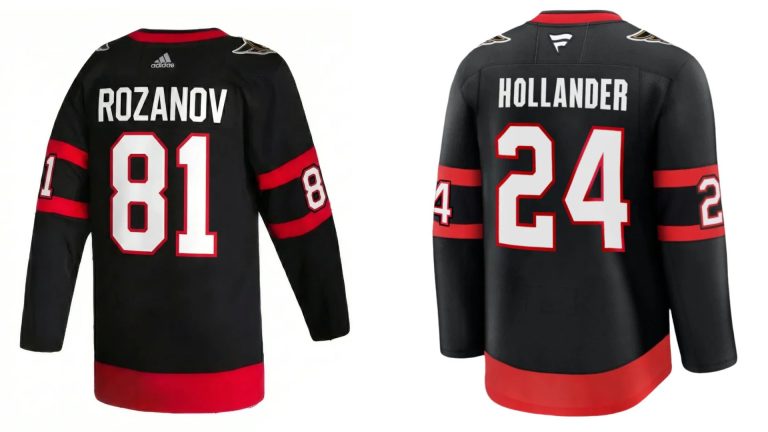
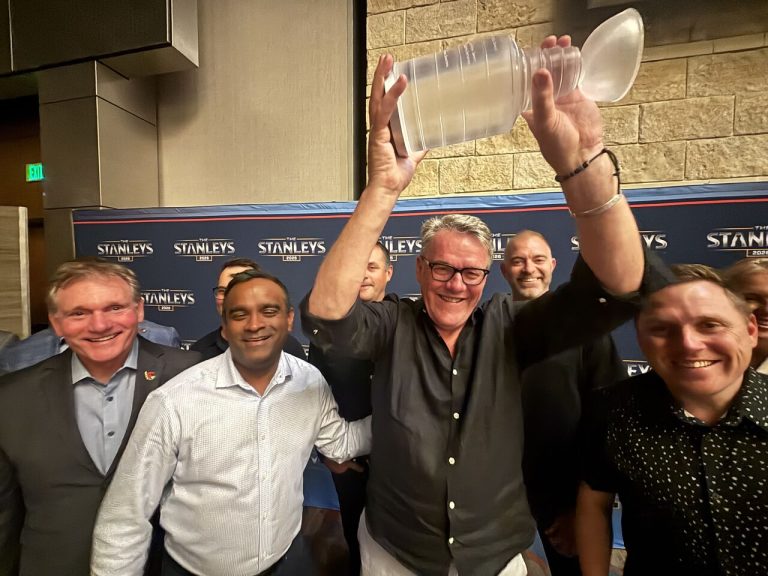
About a week-and-a-half after the news that Tkachuk was going to Florida, the Ottawa Senators promoted their own jersey swap, encouraging fans to “Chuk (their) Tkachuk jerseys” for a 40 per cent discount on new merchandise at the club’s souvenir shop at the Canadian Tire Centre. Peter Shier, vice-president of marketing at the Ottawa Senators, said that while the team netted 261 Tkachuk jerseys, it wasn’t the campaign that created the most buzz this past season. When the popular Crave show Heated Rivalry started generating noise around hockey earlier this year, Shier said the Senators marketing team started thinking about ways to take advantage of the moment. On Jan. 16, someone called the team, inquiring about jerseys bearing the name of the popular show’s main characters: hockey players Ilya Rozanov and Shane Hollander. The show follows the pair’s love story as they face off on rival hockey teams.“Taking advantage of a social phenomenon in marketing, we call it catching lightning in a bottle … The lightning bolt hit on the Friday (Jan. 16). I heard the call and we answered, ‘Of course! We have them right here. Come down to (Sens merchandise) store and get them.’ We quickly printed them.” Realizing that the idea could extend beyond one customer, Shier said the team printed a limited batch of Rozanov and Hollander jerseys to sell at the team’s home game the next day. He then turned to then-marketing co-ordinator Brooke Hamilton to recruit internally to help bring the Heated Rivalry campaign to life. “I said, ‘Here’s the mandate. I only want you to recruit people who will say yes. I don’t want any nay-sayers’ … We recruited a bunch of people that said yes and got it done.“Within 24 hours, we had a bunch of jerseys ready. We didn’t do any advertising. We didn’t do any social posts. We had one announcement on the score clock. It was a Montreal game and, keep in mind, Montreal usually puts a lot of fans here and they don’t buy Senators jerseys by and large. We were sold out, 10 minutes before puck drop,” Shier said. The Ottawa Senators created jerseys bearing the names of the main characters from Crave's Heated Rivalry. Photos from Ottawa Senators online store.By Jan. 18, Shier said the team saw web traffic skyrocket, with interest from markets in which the Senators don't generally have a large following, such as Indonesia, Sweden, Brazil, Kazakhstan and the U.K. This was a welcome byproduct of the campaign, Shier said. “I think part of the reason why the NHL liked this promotion was because a goal of the game is to grow the game, not only geographically but within different consumer bases. The people who were reading and reacting to Heated Rivalry are not typically hockey fans, so it’s a whole new market for us to go after.”According to the team’s data, the interest generated from the Heated Rivalry promotion has been sustained, especially among young women. Shier said viewership for the NHL playoffs was up 55 per cent this season compared to the yearly average, driven by young people between the ages of 18 and 34 and female viewers. “It’s our job now to keep them around, so we need to look at what’s next. At the league meetings, they talked a lot about the impact that this had on that demographic. It’s been good and it’s been sustained. Now they’re shooting another season of Heated Rivalry, so that’s going to come back on the radar and drive more numbers.”When planning a marketing campaign on the fly, Shier said that speed is key. “You have to be really quick because just as fast as (opportunities) come, they go,” he said. Just identifying the moment and turning around a campaign fast meant it was successful, Shier said, with the Sens selling more than 900 Rozanov and Hollander jerseys and donating the proceeds to Ottawa Pride Hockey.“We sold out twice. When you sell out, you have to disappoint some people in the short-term, but it gives you an opportunity to come back into the market and reinvigorate it. We had a secondary and tertiary moment with this thing.“We were really happy to be able to do the community thing as well. It’s a big part of Mr. Andlauer’s mandate to grow the game in the community. I think we sort of put our money where our mouth was there,” Shier said, adding that Rachel Reid, the author of the book Heated Rivalry, attended the Sens’ pride game in early April.This week, Shier took to social media to announce that the Senators had won a Stanley Award for “best social impact and growth initiative” for the Heated Rivalry campaign. “The only unanimous winner in any of the eight categories,” Shier said on LinkedIn of the award, which resembles a mini Stanley Cup. “Over 900 jerseys sold in 17 countries, $1.5 mm in earned media, 10mm social media impressions and a huge donation to Ottawa Pride Hockey. All done with a total paid media budget of $0. Scrappy and bold can pay dividends.”Peter Shier holding the Ottawa Senators' Stanley Award for best social impact and growth initiative, alongside some of the Senators corporate team. Photo from Peter Shier via LinkedIn.Reflecting on the experience, Shier said there are many valuable takeaways. “Being bold and agile in today’s market is imperative. You just have to be aware of what’s going on in your marketplace and be able to react quickly. Honest to goodness, we did not know whether this was going to sell. We had no idea.”Shier said the Ottawa Senators hope to play a role in the show’s second season. “We met with the (Ottawa Film Office) because they were obviously trying to pitch Ottawa as a locale to shoot. I don’t know where they’re shooting the hockey scenes, but I don’t think it’s in Ottawa right now. Obviously we’d love to help and do what we can. We’re still in talks with the film people. We also have some ins with Heated Rivalry too, so we hope to do more. “I think this shows that if we say that hockey is for all, then let’s put our money where our mouth is. I think we’ve proven that Ottawa is a very accepting market and this has been a wonderful exercise. We hope we can continue it.”