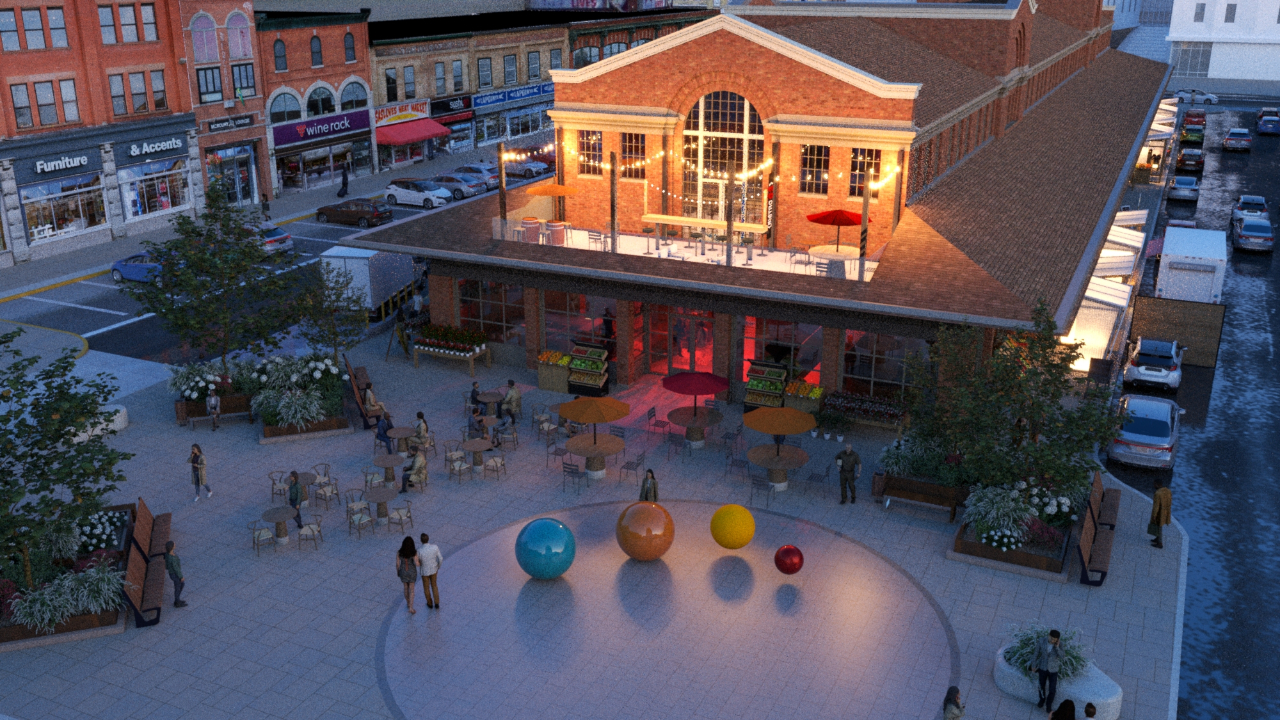
ByWard Market businesses are expressing mixed reactions to the city’s plan to revitalize the area, citing social infrastructure and parking as potential issues. Last month, Mayor Mark Sutcliffe announced a plan to revitalize the ByWard Market, including short- and long-term goals designed to “restore the Market to its vital place as the heart of our […]
Already a Subscriber? Log in
Get Instant Access to This Article
Become an Ottawa Business Journal Insider and get immediate access to all of our Insider-only content and much more.
ByWard Market businesses are expressing mixed reactions to the city’s plan to revitalize the area, citing social infrastructure and parking as potential issues.
Last month, Mayor Mark Sutcliffe announced a plan to revitalize the ByWard Market, including short- and long-term goals designed to “restore the Market to its vital place as the heart of our city and to revitalize the Market for an even more exciting future.”
The $200-million ByWard Market Action Plan was approved by council earlier this month, with immediate steps such as implementing design phases for the plan’s long-term projects and implementing a parking replacement strategy set to cost $7.4 million. The plan’s longer-term goals include developing the ByWard Market Building into a modern space with food-focused tenants, re-imagining the 70 Clarence St. parking garage into a “destination hub” with underground parking to replace the garage, and turning York Street into a pedestrian-first plaza.
Alex Sirois, managing partner of Ottawa Venues, which operates several restaurants in the Market such as Barrio, Lowertown Brewery, Bar Ocelli and Sky Lounge, told OBJ that he welcomes the new plan.
“We’re the heart of the city,” he said. “A ton of tourists come here and I think it’s super-important that we (put) our best foot forward when entertaining tourists or just having people experience Ottawa as a whole.”
He said one of the strong points of the plan is not immediately closing William Street, which would become a pedestrianized street under the plan.
“We just recently had construction on William Street, right by Rideau (Street), in front of one of the restaurants that I’m a part of. It was a ‘month or two’ job that ended up taking seven months and it just completely killed our business there,” Sirois said.
The plan will be “short-term pain for long-term gain,” he added.
“We’re definitely not complaining about the work getting done because it’s absolutely fantastic that they’re investing so much money into the area. But it’s going to be tough and I’m hoping that all the businesses can make it through. It changes the footpath that people are going to be taking throughout the Market just because some areas are under construction.”
One misstep the city made in the plan is overlooking the issues that could come with less parking, he said.
“If you look at the ByWard Market, there’s over 17,000 restaurant seats, when you factor in patio seats. We’re sitting at about 3,000 parking spots (in the Market). If you include Rogers Centre (Ottawa) and the Rideau Centre, we’re up to about 5,000 spots. There’s just not enough parking,” Sirois explained.
With many ByWard Market establishments focused on nighttime business, Sirois said parking is invaluable to the success of the area.
“I would say about 70 per cent of our customers are coming down by car … Removing parking is super-tough for mom-and-pop retail shops and for the people that come down for lunch. We are predominantly in the nighttime business economy. I would say that there are way more nighttime drivers than people using public transportation.”
That need will be exacerbated if and when the 70 Clarence St. garage is transformed into a “destination hub.”
“(The plan for the 70 Clarence St. garage) is great, but it’ll only be great if we can add additional parking. I think what they would need to do is dig deeper and get more parking underground.”
Over on Guigues Avenue, Josiah Frith, owner of Salon Frith and vice-president of the Lowertown Community Association, echoed Sirois’s concerns over construction.
“The hard thing with any public realm project is that it’s going to be disruptive. As we’ve seen with the big dig on Bank Street and Elgin (Street), it was a real concerted effort to try and get the business community through. We see none of that here,” Frith told OBJ.
When he first heard of the plan, Frith said he was surprised.
“I was the co-chair of the (ByWard Market) BIA when the original public realm plan was brought out, so I’m very familiar with the original plan,” he said. “Whenever any part of that plan gets mentioned, I pay attention. I know quite a few business owners on William (Street) and I’ve heard rumblings of their displeasure at how that was all being handled.”
However, he said the new plan is better late than never. “The ByWard Market does need help. It has needed (help) for quite some time. I’ve been a resident down here for almost 30 years and it hasn’t gotten any attention from the city in that time and it’s just sort of been allowed to degrade and people treat that as the status quo.
“I’m glad to see that there’s some interest in actually improving the environment down here. What (the plan) really misses is the underlying issues that really plague the ByWard Market.”
Those underlying issues are the “overconcentration of social services” in the downtown core, Frith explained. “Since COVID, every other part of Ottawa has developed its own business, shopping or entertainment centre, but they’re not sharing the load (of social services).”
Sutcliffe told the media last month that the city is working to spread social services to other parts of the city.
“We're not asking any of those agencies to stop what they're doing or to move, but what we need to do is add services in other parts of the city so that the pressure on the ByWard Market is reduced,” Sutcliffe said at the time.
While Frith said he welcomes the idea of pedestrianizing parts of the Market, he said the plan to do so comes at a time where residents don’t have trust in the city’s transit system.
“I wish we were talking about this at a time when our public transportation was more functional (because) we’d be having a very different conversation,” he said. “Pedestrianization would be natural (for the Market). But it’s not the ByWard Market’s fault that the city has fallen short on providing proper public transit.”
Frith said that he’d like to see more levels of government pitching in to address issues around the Market’s social infrastructure.
“There’s a lot of hesitancy in the private market to invest right now … This whole idea that we put all of the problems downtown, because that’s just naturally where they belong, is broken. It’s only allowed to succeed because people are saying, ‘We’re going to start our business outside of downtown where it’s safer, cleaner and quieter.’ There’s a reason why it’s safer, cleaner and quieter out there, because everything else is shipped downtown.”
Pat Nicastro, owner of La Bottega Nicastro, which has a location on George Street, told OBJ he was pleased to see a plan that will bring more residents and tourists to the Market.
“The ‘hits’ of this plan are considering the retailers’ needs, which are safety, cleanliness and ease of getting clients down here,” Nicastro told OBJ.
He added that he was happy to see that the 70 Clarence St. parking garage was going to be repaired and improved upon.
“The parking garage definitely needs a complete revamp, just structurally. I think that’s where the focus should be at this time. If it becomes a destination building, as long as underground parking is considered, I think it’s a great idea.”
While he said he was happy to see plans to elevate the Market as a tourist attraction, Nicastro said the plan also considers those who are in the Market all year-round.
“We appreciate the mayor’s continued advocacy of the vision (for the Market). If you heard the speech that he did at council, when he spoke about his personal experience in business, it really resonated deeply with us. It was very encouraging to have a mayor that understands the day-to-day challenges of running a small business,” he said.
“The reality is that people are here every day. It’s great (that the city wants to) make the area flexible so we can accommodate these special events, but we can also accommodate what goes on every other day.”