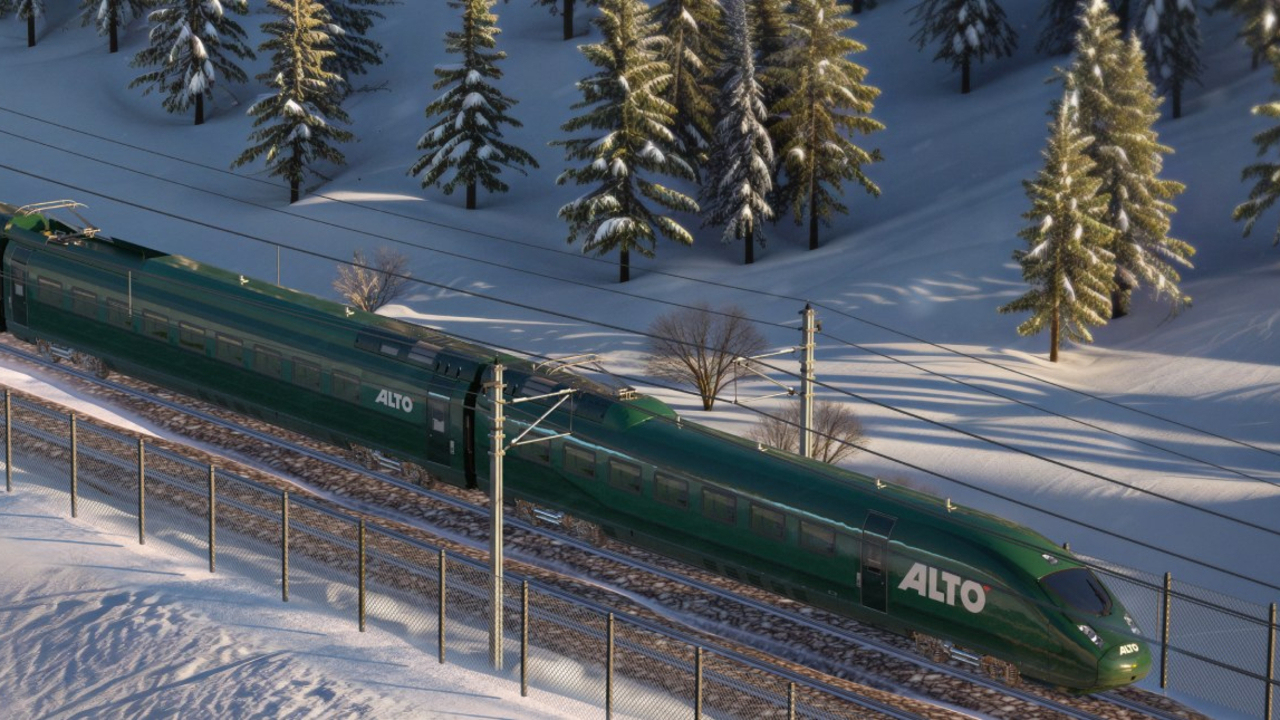
The Alto high-speed rail project could include a stop in Kingston, the Crown corporation said Monday.
Transport Minister Steven MacKinnon and Martin Imbleau, president and CEO of Alto, released the Crown corporation’s “What We Heard” report on Monday, summarizing feedback gathered from stakeholders during a public consultation process that lasted from October 2025 to June 2026.
In response to the report’s findings, MacKinnon has directed Alto to “develop a plan to assess a southern route option between Peterborough and Ottawa that includes a potential stop in Kingston that would interconnect with Via Rail services, subject to technical feasibility and project requirements,” the Crown corporation said in a news release.
According to Alto, high-speed rail could reduce travel times between Kingston and Toronto to about 90 minutes, while “establishing Kingston as a key regional mobility hub,” meaning most residents between Peterborough and Ottawa would be within a 25-minute drive to an Alto station.
“Consultation is an ongoing dialogue. Public input, as well as feedback from organizations, experts and Indigenous communities, is invaluable in helping us refine the project, especially as we chose to engage early in the process,” Imbleau said in the release.
“Alto’s objective is to develop a project that delivers the greatest collective benefits, while minimizing impacts on communities and the environment. Technical and environmental analyses are continuing rigorously, and this work will allow us to present a more precise alignment this fall that reflects the comments we have received.”
In a conversation with OBJ Monday, Imbleau said the feasibility of a Kingston stop will be evaluated in the coming months to make sure it does not detract from the original mission of the high-speed rail project.
“If we add (to) or change the project and it affects the overall economic (value) and speed of the project or ridership, we would be losing our time and losing taxpayers’ money, so that’s why we need to be very strict about the project requirements,” Imbleau told OBJ. “The Montreal-Toronto (corridor) has to be below three hours, we can do it with our services, even by including Kingston.”
If a Kingston stop becomes a part of the official plan, Imbleau said not every train will stop there. “Bear in mind that most services, when and if Kingston is added, will not stop in Kingston. We will have express services that will go through to have faster services. Same thing as for Peterborough. So, basically everyone wins,” he said.
The vision is for Alto to be the “backbone connecting communities,” Imbleau said. “We want to create a transportation hub in Quebec City by being connected to the tramway that is being built there. We want to be connected in Montreal and Laval with the (Réseau express métropolitain) and the metro. In Ottawa, we want to be connected to the LRT and Via Rail. Same thing with Kingston.”
In the “What We Heard” report, Imbleau said the comments that jumped out the most were that the project was needed, it has to be turned around quickly and it needs to be readily accessible. “Of course, we have (had) a lot of comments about people being preoccupied on where this will be built, how we’re going to use farmers’ land and what the compensation will be. It’s a mix of that, but … the overall comments are region-specific, so it’s very useful and I can tell you that the project will be better because the engagement was done early and in a meaningful way.”
The original plan for Alto’s route through eastern Ontario followed a mostly straight line between Ottawa and Peterborough, with no stops in eastern Ontario. However, since consultation began on an alternative, more southerly, route, local groups have been weighing in.
Councils in South Frontenac and Rideau Lakes voted to formally oppose the alternative route due to its potential impact on properties in the area, including environmentally sensitive areas such as the Frontenac Arch Biosphere.
Imbleau told OBJ that Alto will be working to avoid the Frontenac Arch Biosphere. “This is where the consultation was very useful and meaningful. We’ve engaged with a lot of people (that are) educating us on how to go around the sensitive area. We do have options to avoid what we call the ‘centre zone’ or ‘buffer zone’ that are protected in the biosphere and we’ll find a way to avoid those zones when we build this project.”
At the same time, local employers and business groups appeared before Kingston city council on Feb. 17 to push for an Alto stop in the Kingston area and for Alto to go back to the drawing board and find another route through eastern Ontario. Kingston city council passed a motion calling on the minister of transportation to add a Kingston-area stop to Alto’s mandate and expressing the city’s opposition to the project should it not include such a stop. The letter suggested Alto seek a route more closely aligned with Highway 401.
“The release of Alto’s ‘What We Heard’ report demonstrates that Kingston’s voices were thoughtfully considered throughout this important consultation process,” said Mark Gerretsen, MP for Kingston and the Islands, in Monday’s release. “The announcement that Kingston is being considered as a potential stop on Canada’s future high-speed rail network reflects the strength of local engagement and advocacy. It marks an exciting step toward greater connectivity, economic opportunity and a more sustainable transportation future for Kingston and the surrounding region.”
The extra stop would lengthen travel times along the 1,000-kilometre corridor between Toronto and Quebec City but draw more riders, MacKinnon said.
“Yes, it is a longer route, but it does not add enough time such that it would dissuade people,” he told reporters in Kingston on Monday.
To the contrary, the stop could open up zippy travel to tens of thousands more, including students at the city’s two universities — “people in Kingston who might want to go to a Blue Jay game or a Montreal Canadiens game and can be back at home in their bed by midnight.
“By our presence here today, we’re telling you what our strong preference is,” he said.
Not everyone is on board. The possibility of an eighth stop on the route drew immediate criticism from opponents online and in person, with protesters demonstrating outside the event.
“You get a stop. And YOU get a stop. And we all get a stop. Pretty soon we have just rebuilt Via,” said Kathleen O’Connell Renaud, a resident of St-Eugène, Ont., and a spokeswoman for the so-called Altno movement, in a post on the group’s Facebook page.
Others questioned why, if the project was based on a fully fleshed-out business case, Kingston wasn’t on the map from the start.
“This Alto project is improvisation,” said Christian Hébert, president of Quebec’s Union des producteurs agricoles, in a social media post.
MacKinnon countered that the proposed change stems from feedback from residents through the first four months of the year.
“One of the very distinct and clear voices that we heard from was that of this community led by their member of Parliament, their mayor, councillors,” he added.
The project has garnered vocal opposition in rural parts of eastern Ontario and in Mirabel, Que., where critics worry about how the line would slice through their properties and force expropriations.
Ahmed El-Geneidy, a professor at McGill University’s School of Public Planning, claimed the government’s push to tack on a stop in a Liberal riding reveals that politics plays an outsized role in the project, though it’s run at arm’s length by a Crown corporation.
“It means that this project is a highly politicized one, and we are not looking at what is the best; we are just trying to make sure that different politicians are happy,” he said in a phone interview.
Each stop adds another 15 to 30 minutes, said El-Geneidy, who co-authored a study of the line in March.
“This is a train that you can’t stop right away,” he said. “Then you have to take a while until you get to the 300 km/h, and then you needed to stay at 300 km/h as long as possible.
“The more you stop, the slower it’s going to be,” he said.
The line originally proposed by Alto would go from Toronto to Quebec City, with stops in Peterborough, Ottawa, Montreal, Laval and Trois-Rivières.
The rail network would span 1,000 kilometres, with trains reaching speeds of 300 kilometres per hour. The project, estimated to cost between $60-90 billion, would begin with construction on the segment between Ottawa and Montreal in 2029-2030, with the full network expected to be operational in 12 years.
With files from The Canadian Press.