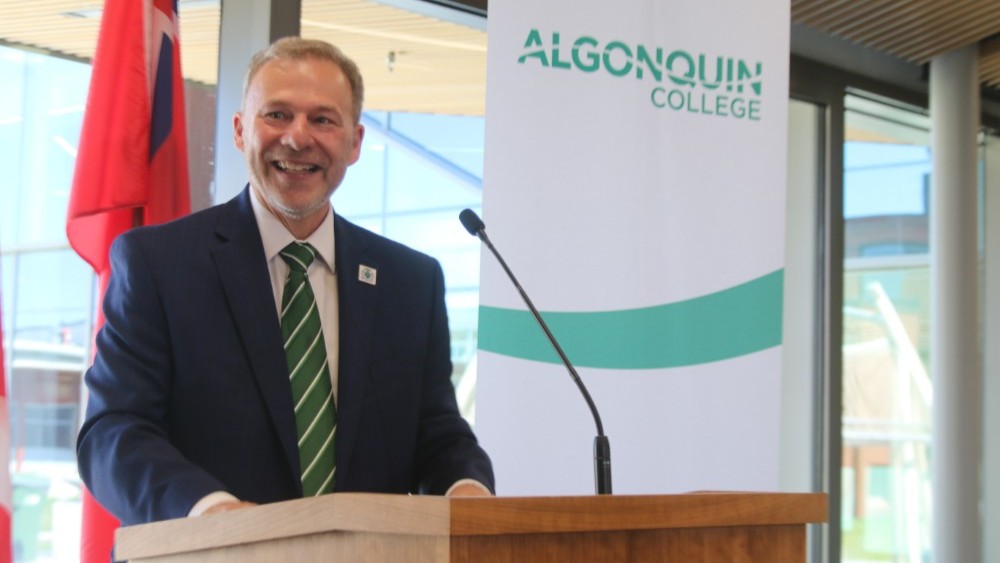
While it wasn’t easy to cut programs earlier this year, Algonquin College president and CEO Claude Brulé said it did allow the institution to focus on areas such as defence and skilled trades, where demand is on the rise.
Already a Subscriber? Log in
Get Instant Access to This Article
Become an Ottawa Business Journal Insider and get immediate access to all of our Insider-only content and much more.
While it wasn’t easy to cut programs earlier this year, Algonquin College president and CEO Claude Brulé said it did allow the institution to focus on areas such as defence and skilled trades, where demand is on the rise.
“We're in a people business, so every time you make decisions, you know that it's impacting people, it's impacting livelihoods,” he told OBJ on Friday. “We don't take it lightly. Our focus was on ensuring alignment with the priorities of the province and the federal government.”
Earlier this year, the college’s board of governors voted to suspend 30 academic programs starting this fall, including journalism, music industry arts, hospitality, culinary arts and bartending. The college also closed its Perth campus, which is currently for sale, and its downtown corporate training centre.
Despite a $6.4-billion injection of provincial funding into the post-secondary sector — which Brulé said helped put the college on better footing — the cuts went ahead.
“Those were all difficult decisions, but necessary ones in order for us to restore financial sustainability,” he said, adding that the cuts were the result of a variety of factors, including a decision by Immigration, Refugees and Citizenship Canada to limit international students.
“This was not something in isolation for Algonquin College. All the policy changes related to the international student program really impacted all of us and that meant quickly pivoting in order to make sure that we could see to the financial future of the institutions, because obviously the revenues were declining much faster than expenses."
Now, with students back on campus, Brulé is looking to the future. While the college couldn’t add courses due to cost and capacity constraints, Brulé said it was able to focus on some of its most popular programs that were already at the centre of its corporate strategy.
As a result, the school is emphasizing sectors where talent is increasingly in demand, such as the trades, technology, defence and health.
"Our strategic plan speaks to our polytechnic education and that alignment manifests itself in how we focus on skilled trades for construction, for the energy sector, for transportation, aviation, information technology,” he said. “Defence is becoming a very large portfolio for us as well and ever-present health care and life science."
On defence, Brulé said the college has unique opportunities. Next year, it will celebrate 20 years of partnership with the Canadian Armed Forces School of Military Mapping. The college has also worked with CAF for years to help personnel transfer military certifications into civilian ones and prepare for life after service.
That means the college has a solid foundation to build upon as the federal government invests in defence.
“We're looking to grow, for instance, our applied research in areas of technology, in areas of human performance and perhaps in health as well,” he said. “It could be in communication. It could be in drone technology, it could be in vehicle technology, anything that the region is intending to produce as part of the defence industrial complex, we can support their talent needs.”
On the trades side, demand is particularly high. Brulé cited one program with a wait list of 1,500 students. It’s an indication that more focus is needed on increasing capacity, which means pushing for capital investment from all levels of government, he added.
“The need for more capacity, more lab space, for instance, requires capital. That's why we're really advocating with all levels of government right now. We have capacity needs in carpentry, for instance, in plumbing, in heating, in refrigeration and air conditioning.
“Some of the cuts we've made will free up some capacity, but then it has to be retrofitted and that also costs money. You can have the free space that's been vacated, but you still need the dollars to retrofit it and equip it.”
Still, he said the growing demand is a sign that Algonquin’s reputation hasn’t taken a massive hit, despite recent challenges.
“Reputation is something that I work on every day,” said Brulé. “Algonquin College is a real pillar of this community. Our eye was always on our mandate, our mission and making sure we could fulfill that.”
On a more personal note, he said he’s glad to be on the other side of the crisis, with students back on campus.
“The credit goes to the team. This was an all-Algonquin College effort. We're turning the corner with a solid foundation,” he said. “To me, it's (all about) the energy on campus, having a chance to meet with (students) and share their dreams, what they want to do with their education. That's so rewarding.”