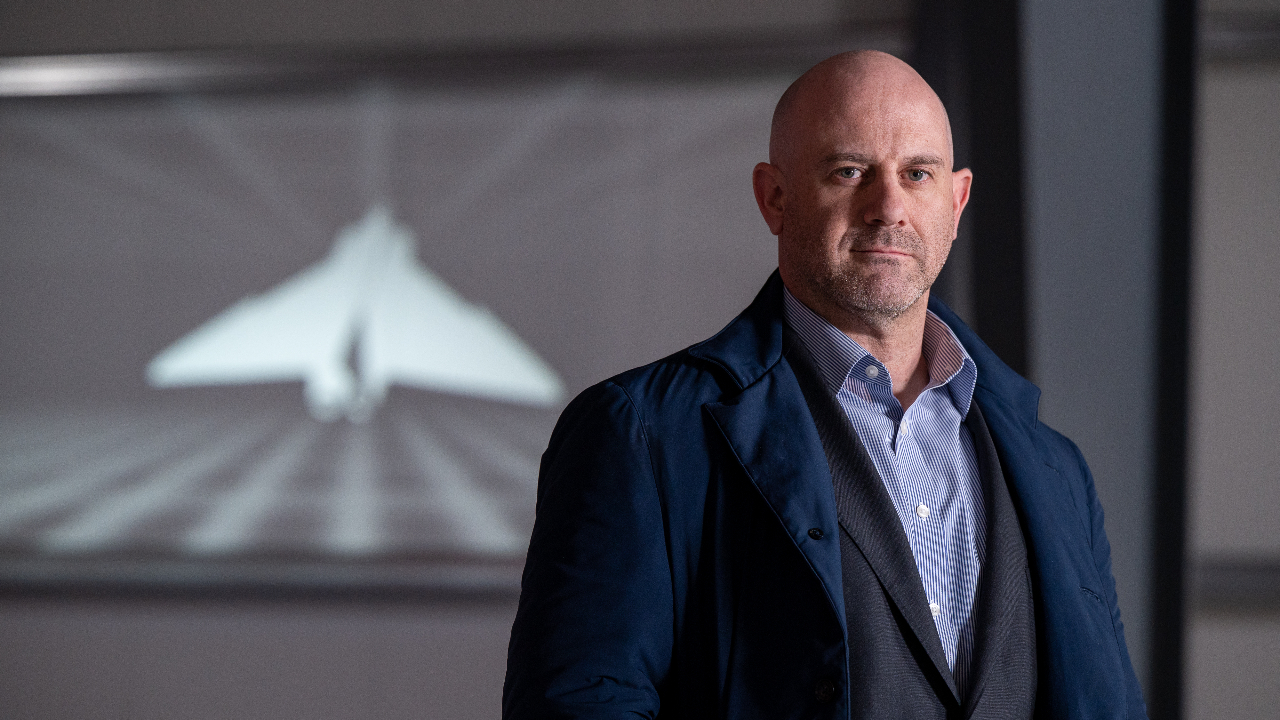
“We are at an inflection point both as a country but also obviously as a business,” Eliot Pence, the founder and chief executive of Dominion Dynamics, told OBJ in a recent interview. “This raise really propels us forward in a pretty incredible way.”
Already a Subscriber? Log in
Get Instant Access to This Article
Become an Ottawa Business Journal Insider and get immediate access to all of our Insider-only content and much more.
The head of a Kanata-based startup that just raised the largest Series-A funding round in history for a Canadian defence technology company says his burgeoning firm could more than triple its headcount to 200 employees by the end of this year as production at its new facility accelerates.
“We are at an inflection point both as a country but also obviously as a business,” Eliot Pence, the founder and chief executive of Dominion Dynamics, told OBJ in a recent interview. “This raise really propels us forward in a pretty incredible way.”
Dominion Dynamics announced Tuesday it closed a $139-million round led by Toronto-based venture capital firm Georgian Capital.
OMERS, the Business Development Bank of Canada, Royal Bank of Canada and existing investors Bessemer Venture Partners and the British Columbia Investment Management Corp. are among the group that provided the funding.
The latest funding haul means the company has now raised C$169 million since launching in June 2025. Pence said amassing a warchest of that magnitude allows his fledgling firm to “play a different game” than traditional defence-tech startups that have to chase RFPs and government grants.
Dominion can “come to the government with a slightly different” set of proposals than most defence-tech startups, Pence explained.
“Rather than just asking for money or contracts, (Dominion) can come to them with a public-private partnership that is of material size,” he said. “If you raise $170 million over the course of 12 months, the government will interpret what you can do differently than just a tech startup.
“You can generate jobs at a completely different scale, you can generate intellectual property, you can partner with primes. Primes often have a challenge with partnering with smaller companies. So it just allows you to play a different game than your average startup. We will live or die by our ability to either change the rules of the game or play a different game.”
That approach has attracted high-profile investors such as Georgian, the largest venture fund in Canada, and major pension funds such as OMERS and BCI, Pence said.
“The velocity of our product development and deployment I think is ultimately what compelled other investors to come in,” he explained. “I think it says we have the pedigree. They understand what we’re doing.”
Dominion Dynamics is best known for AuraNet, a network of sensors and a map-based platform that can collect, trace and transmit information from remote regions with no or patchy cell service.
The Canadian Rangers — a part of the military stationed in isolated and coastal regions — used the technology earlier this year in the High Arctic, perhaps the country’s harshest environment.
The Series A will bolster AuraNet and help develop Scout, an uncrewed, AI-powered drone Dominion Dynamics is building to operate independently or alongside fighter jets. It will be deployable to environments too dangerous or remote to risk sending pilots into.
Dominion is now ramping up hiring at its new 30,000-square-foot factory on Schneider Road in Kanata, which is expected to be fully operational by the end of the summer.
“Talent is the central challenge, I think, for every company,” Pence said. “If you get that right, you can do completely different things.”
Pence said he’s already looking at building another facility that would be 10 times as large, possibly in Ottawa, Toronto or Montreal, as demand for military technology is expected to skyrocket thanks to a wave of federal spending that is “transforming the Canadian defence industry.”
“I want to go as fast as we possibly can, and I want to think big — frankly, as big as we possibly can,” he said.
With drones and other cutting-edge military technologies evolving at warp speed on battlefields in Ukraine and other global hotspots, Pence said “normal R&D processes” that often take years to produce new equipment no longer cut it.
“The thing that we bring to this market, not just in Canada, but globally, is pace,” he added. “We just move at a completely different velocity than any (other) company. And the government responds to that. The capacity to transform and develop and produce and co-develop is the thing that we’re selling. And that’s what we’ve demonstrated.”
Rather than waiting for the government to tell Dominion what it wants, Pence explained, his company’s philosophy is: “We've built it. Just buy it.”
“I think that’s also what the government is wanting,” he said. “It means that industry is taking a risk, that industry is responding to the demand signals that they’re putting out. We’re raising money and putting our money where our mouth is.”
The firm has yet to land a contract with the federal government, but Pence says he’s “cautiously optimistic” that Prime Minister Mark Carney’s push to streamline defence procurement processes and open the door to more domestic companies will bear fruit.
“I think it just takes personal and political courage to move at the pace of the threat,” he said. “I think a good part of this is about political leadership.”
The Canadian Venture Capital and Private Equity Association’s data suggests only four other Canadian companies have managed to raise more for their Series A, a term used to describe a startup’s first significant round of venture capital financing, which is typically meant to help a company scale.
Toronto-based login management firm 1Password garnered US$200 million in 2019, while Borealis Biosciences, a Vancouver firm working to treat kidney disease, raked in US$150 million in 2024, the CVCA data shows.
Rounding out the pack is LayerZero Labs, a Vancouver-based blockchain company, which raised US$135 million in 2022, and Element AI, a Montreal-headquartered artificial intelligence firm that attracted US$102 million in 2017 and has since been acquired by ServiceNow.
— With files from The Canadian Press