Defence leaders urge feds to speed up efforts to modernize Canada’s procurement process
System 'designed for the 20th century' is ill-suited for fast-changing technology such as drones and discriminates against smaller businesses, industry insiders say
Get Our Email Newsletter Local news about the companies, people and issues that impact business in Ottawa and beyond delivered to your email inbox.
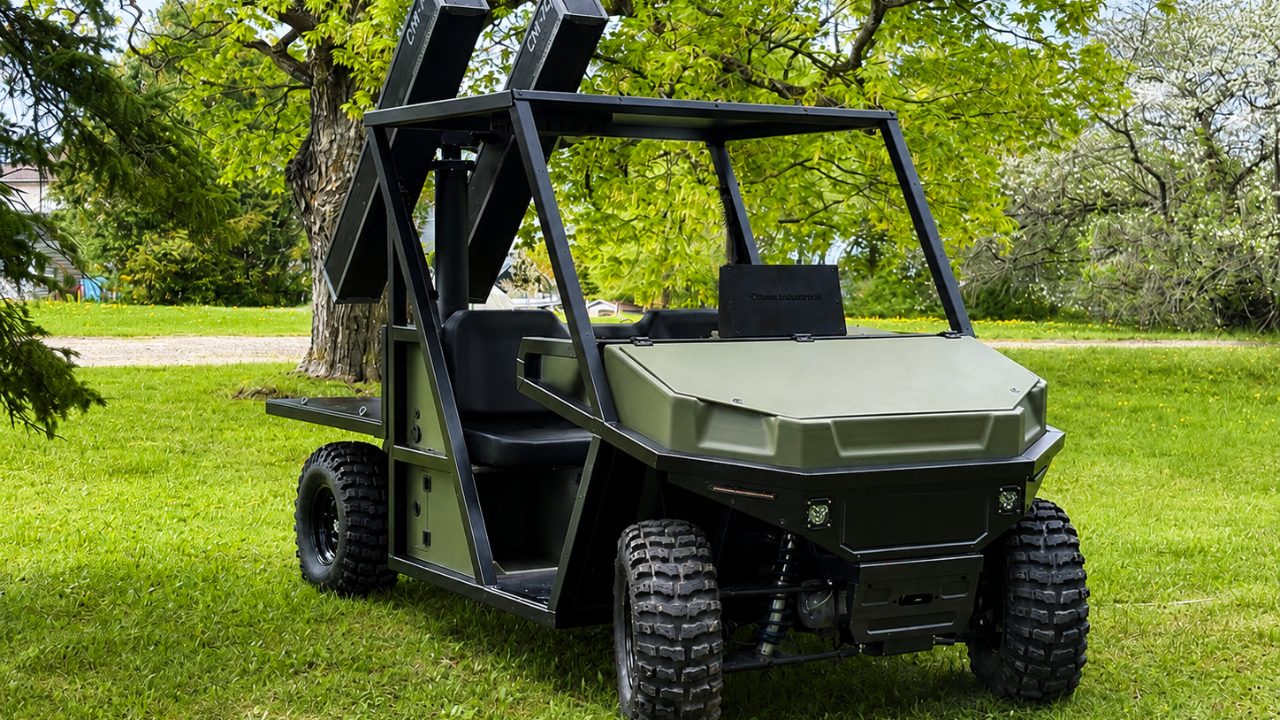
Ben Seaman’s plight is probably familiar to almost any founder of a Canadian defence-tech enterprise who’s ever tried to secure a federal government contract. The chief executive of Arnprior-based Convergence Design Services strongly believes his company’s newest product — a self-driving vehicle dubbed the MIL-V that is being unveiled at the annual CANSEC defence trade […]
Ben Seaman’s plight is probably familiar to almost any founder of a Canadian defence-tech enterprise who’s ever tried to secure a federal government contract.The chief executive of Arnprior-based Convergence Design Services strongly believes his company’s newest product — a self-driving vehicle dubbed the MIL-V that is being unveiled at the annual CANSEC defence trade show in Ottawa this week — can become a valuable part of Canada’s military equipment stack.But try as he might, Seaman has yet to land a deal with the Department of National Defence. While Convergence has pending agreements to produce vehicles for a couple of private firms, the feds are proving a tougher nut to crack.“That’s been a bit more challenging than we would have anticipated, we’ll just say,” Seaman admits.Seaman isn’t alone. Canadian entrepreneurs have long lamented having to jump through a myriad of hoops to do business with DND. They say the procurement process moves too slowly and is designed to favour multinational defence primes that have the resources and expertise to win the lion’s share of military contracts.But now that the ongoing tariff dispute with the U.S. has made sovereignty Canada’s hottest topic, it appears the federal government is ready to change its approach to buying goods and services for the Canadian Armed Forces in a way that benefits smaller, homegrown companies.For example, under the new multibillion-dollar Defence Industrial Strategy, the feds say they plan to raise the share of new defence contracts awarded to domestic suppliers to 70 per cent — up from the current 43 per cent — within a decade.As part of a new “build-partner-buy” framework, the feds say they will prioritize purchasing from Canadian companies. If that can’t happen, they will work together with manufacturers from allied nations on projects that will trigger new investment in Canadian firms.Only if those options are exhausted, Prime Minister Mark Carney said when announcing the policy in February, would the Department of National Defence buy from foreign entities. Even then, he said, “we will ensure that the maximum benefits are returned to Canada throughout the value chain, including through a modernized industrial and technological benefits regime.”The feds expect the plan will boost revenues for Canadian-owned small and medium-sized defence businesses by more than $5 billion a year and create 125,000 new jobs. But defence industry insiders say the proof will be in the pudding.“Getting the money moved and getting the policy in place, that’s the easy part,” says Michael Smith, chief operating officer of Ottawa-based One9, which funds up-and-coming defence-tech ventures. “Now you have to operationalize it. You have to make it work.”Smith, whose firm is one of the few Canadian organizations devoted to backing defence startups, says the federal government has traditionally been hesitant to invest in smaller homegrown companies that might not have established track records. Taking risks is “not a Canadian strong suit,” he says. But he argues a long-overdue “change in mindset” is needed quickly as modernizing the country’s defences takes on a new urgency amid dramatically shifting geopolitical winds. Global trade tensions are flaring, the U.S. president has teased wanting to make Canada the 51st state and two wars are threatening to shape a new world order.“These are monumental challenges, the success or failure of which is honestly going to define this moment in time,” Smith says. The problem, he explains, is that Canada’s procurement system is not designed to be agile.Federal rules, for example, typically prevent officers closest to troops, such as unit commanding officers at the rank of major or lieutenant-colonel, from giving the green light to purchases of more than $100,000. Arnprior's Convergence Design Services has yet to find a government buyer for its new high-tech military vehicle, the MIL-V. Photo courtesy Convergence Design ServicesSmith says that means most procurement decisions are made by civilians at Public Services and Procurement Canada who are not experts in defence. He’s calling for “dedicated defence procurement officers” who are based at DND and “understand the challenges of the end users.”“It’s almost like we don’t trust our subordinates to take calculated risks and spend money for things that they know would make them more operationally effective,” Smith adds. “There is nuance and technicality to what they're trying to buy that is absent from a lot of other fields. It's really time to reimagine how this is done.”Smith also wants to see federal officials authorize more “buy-and-tries” from Canadian firms that are pioneering innovative technologies such as drones and cybersecurity tools.“The (Canadian Armed Forces) doesn’t have to figure out innovation,” he says. “It has to figure out how rapidly it can adopt technology that is already available in the commercial sector and integrate it. Nobody can pretend that the threat is amorphous or ambiguous. The writing is on the wall internationally. Every other ally is moving to do the same, and we’re a bit of a laggard.”Eliot Pence, chief executive of Kanata-based defence contractor Dominion Dynamics, says government procurement simply moves too slowly.He said it took the country 16 years to buy F-35s and 20 to consider what drones to buy. Meanwhile, Ukraine, which is locked in a war with Russia, is "buying things, honestly, like overnight from a sort of Amazon-esque marketplace.""We're now at an inflection point where we can't consider what to buy for a decade. We have to buy it now," Pence said Monday during an event at Toronto Tech Week. He thinks a better procurement process would see decisions made in less than a year and would prioritize Canadian firms."What 'good' looks like to me is privileging explicitly Canadian companies because they're Canadian — Canadian-owned, Canadian-controlled — and doing it very quickly," Pence said."I'm talking like week cycles, day cycles, hour cycles. We shouldn't be considering these things for more than a year."Pence recently founded the Alliance of Canadian Defence Companies in hopes of generating the kind of support he wants to see the country’s defence industry receive.
Long waits 'the valley of death'
Paul Ziadé, who chairs the organization with Pence, is the co-founder of Calgary-based North Vector Dynamics. Founded four years ago, North Vector now has about 20 employees and is working on a number of projects, including the MIL-V with Convergence.Ziadé says small and medium-sized businesses like North Vector and Dominion Dynamics account for more than 90 per cent of the defence industrial base, and they don’t have the luxury of waiting years for bids to wind their way through the defence procurement labyrinth because they need income now to keep the lights on.The current system — which often requires requests for proposals to be vetted by multiple federal departments, including DND, PSPC and Innovation, Science and Economic Development Canada — works against them, he explains.Even the newly created federal Defence Investment Agency, which is aimed at fast-tracking the procurement of military equipment, looks like it intends to focus on big projects worth upward of $100 million, he notes.“The vast majority of (SMEs) are not bidding for these contracts, and we cannot survive these 10-year procurement cycles,” he says. “We are bidding on $5-million contracts, $2-million contracts, and these, at least according to the current framework, would still have to go through the traditional process. Reducing that threshold is going to be very, very important.”Alexander Salt, a senior researcher at the Ottawa-based Canadian Global Affairs Institute, describes slow procurement cycles as “the valley of death” for young defence-tech firms. Canada’s procurement system was “designed for the 20th century,” when old-school equipment such as tanks and warships ruled the battlefield, Salt explains. But as rapidly evolving technology such as unmanned vehicles that employ artificial intelligence become the new weapons of choice, Canada needs to rethink how it equips its fighters, he says.“This is technology that fundamentally from an engineering perspective changes in months, let alone years,” Salt says. “So a procurement cycle … that could drag on for five, six, eight, 10 years, that doesn't work with artificial intelligence because it's going to be out of date.”Philippe Lagassé, an associate professor at Carleton University’s Norman Paterson School of International Affairs, says smaller Canadian defence-tech firms traditionally got involved in DND projects through avenues such as the Industrial and Technological Benefits Policy, which requires companies awarded defence procurement contracts of $100 million or more to undertake business activities in Canada equal to the value of the contracts they won.Typically, that means that when big defence primes — the Lockheed Martins and Hanwhas of the world — land huge contracts, they bring in Canadian-owned firms to supply components for equipment such as the Royal Canadian Navy’s new submarines and River-class destroyers.Initiatives like the DIS aim to give domestic firms a faster, more direct route to landing federal contracts, Lagassé says, but just how much that will benefit a typical defence-tech SME remains to be seen.“Right now it's all a little bit ephemeral,” he says. “There's going to be a lot of money spent, but when you look at the DIS, it says — not plainly, but pretty clearly, in my view — that the priority is going to be on the national champions and the big players. “Small and medium enterprises are in there, but I just don't know if what we're going to be acquiring is going to be at the scale that would be sufficient to keep a lot of these companies afloat. Until (the federal government’s new) defence policy comes out, which is supposedly soon, there is this lack of clarity around what exactly is happening.”Ziadé says domestic defence startups need DND to be their “first and flagship” customer to show the capital markets that Canadian-built military technology can match up with the world’s best.“They want to build for Canada, but they are not getting that demand signal,” he says of small firms like his. “They are not getting the support, they are not getting the purchase orders. They even have to go abroad for capital. A lot of these companies, ourselves included, are venture-backed, and venture capital is not going to take the risk on small companies, on startups, without strong signals from the government. And so what I would love to see is the government becoming a much more predictable purchaser of technology being developed by the non-incumbents.”Salt says many defence SMEs are hamstrung by a lack of familiarity with the military and its culture. Many founders “don’t even know the lingo” that DND officials use or how to establish a rapport with military members. He’s calling for more “guidance and transparency” for companies trying to navigate the procurement system.“There’s a lot of homegrown talent here,” Salt says. “It’s just, we need to make it easier for them to get into the defence space. The DIS is trying to change some of the things in the right direction, but talk is cheap. You have to meet that with actual, tangible action.”As someone who is heavily invested in the Canadian defence industry at One9, Smith is anxiously waiting to see whether the government’s efforts at modernizing procurement will bear fruit. So far, he says, there’s not much to report.“Have things changed? Honestly, not yet,” he says. “Writ large, Canada seems to prefer crafting exquisite policy delivered too late rather than good enough today. My worry is not so much that we don’t turn the ship, it’s that we don’t turn the ship in time.”The country “risks essentially squandering a generation's worth of goodwill within the private capital community” if the situation doesn’t improve soon, Smith says. “Everybody who's putting their money into these up-and-coming venture-backed companies, they’re doing it on the bet that Canada has to change because of the geopolitical environment, because of everything that the prime minister has said. There’s still a risk that the failure … is not because these companies don’t deliver, but because Canada can’t get out of its own way.”Nevertheless, Smith says he’s doing his best to keep the faith.“Our grandfathers stormed Normandy. Don’t tell me Canadians don’t know how to take risks. We’re in risky times. Now is not the time to play it safe.”— With additional reporting from The Canadian Press