Ottawa has become a leader in office-to-residential conversions over the past few years, according to one local real estate observer.
Already a Subscriber? Log in
Get Instant Access to This Article
Become an Ottawa Business Journal Insider and get immediate access to all of our Insider-only content and much more.
Ottawa has become a leader in office-to-residential conversions over the past few years, according to one local real estate observer.
“We’ve seen a number of (conversions) in Ottawa,” Maxime Foucaud, managing director of CBRE Ottawa, told OBJ on Tuesday. “I think we’re second in Canada in terms of conversion.”
Only Calgary, which has had more vacancies as well as more incentive programs to encourage developers to undertake conversions, has outpaced Ottawa, according to Foucaud.
Conversions have a dual advantage, he said. They allow older office space to retire, while adding more residential capacity to the market. Foucaud said both have positive ripple effects on the real estate market as a whole, especially in downtown Ottawa, where more residents could lead to better retail and increased activity.
“I think Ottawa has been proactive, to have more residential downtown,” he said. “The housing crisis is real for every community, but I think we had an opportunity to have more people downtown and support auxiliary services and retail.”
He added, “Not every building is apt for conversion, but perhaps we had more that were well-situated and well-configured. I think a combination of things really pushed us and we had developers who had the vision to do it.”
According to its recent report on the fourth quarter of 2025, CBRE said Ottawa’s office market recorded a negative net absorption of 497,600 square feet in office space, leading to a slight increase in the overall office vacancy rate from 12.8 per cent to 13.2 per cent.
Despite the increase, Foucaud said the city’s office market is stable heading into 2026. And in addition to return-to-office plans in both the private and public sectors, Foucaud said Ottawa has gotten good at handling empty buildings.
“If you have a larger building that’s fully vacant, that’s not necessarily a detriment,” he said. “You have the ability to retrofit. It’s an opportunity to do something different with your building. You could stay an office, or you could attract a whole new tenant base.”
A number of conversions are underway or have been proposed across the city.
An office building at 495 Richmond Rd. was recently confirmed for conversion to residential with 143 units.
In the downtown, Ottawa engineering firm Novatech has submitted an application to convert a six-storey office building at 240 Bank St. into residential, with 45 units and 183 square metres of ground-floor retail. Nearby, at 396 Cooper St., Mortar Land Development Consultants has proposed converting a four-storey office building into 33 residential units, while retaining 300 square metres of existing ground-floor commercial space.
KTS Properties filed a plan last year to turn an eight-storey, 55,000-square-foot office building at the corner of Bronson and Carling avenues into a 70-unit rental complex with ground-floor retail space.
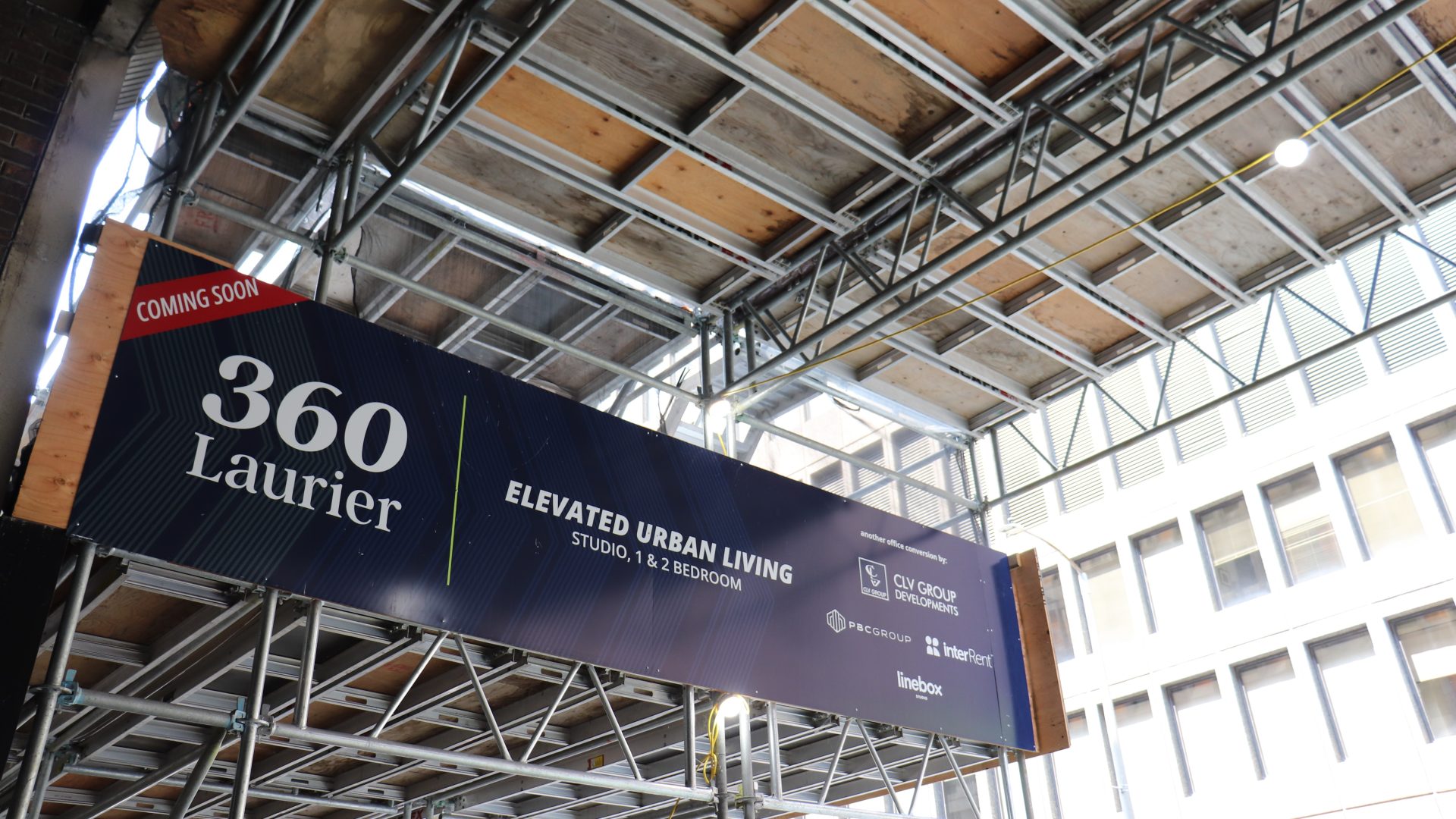
Other companies with conversion projects in the pipeline include CLV Group, which is gutting the Narono Building at 360 Laurier Ave. W., and District Realty, which is redeveloping an 11-storey office building at 200 Elgin St. into a multi-residential complex.
East of Bank Street, District Realty is currently redeveloping an 11-storey office building at 200 Elgin St. into a multi-residential complex.