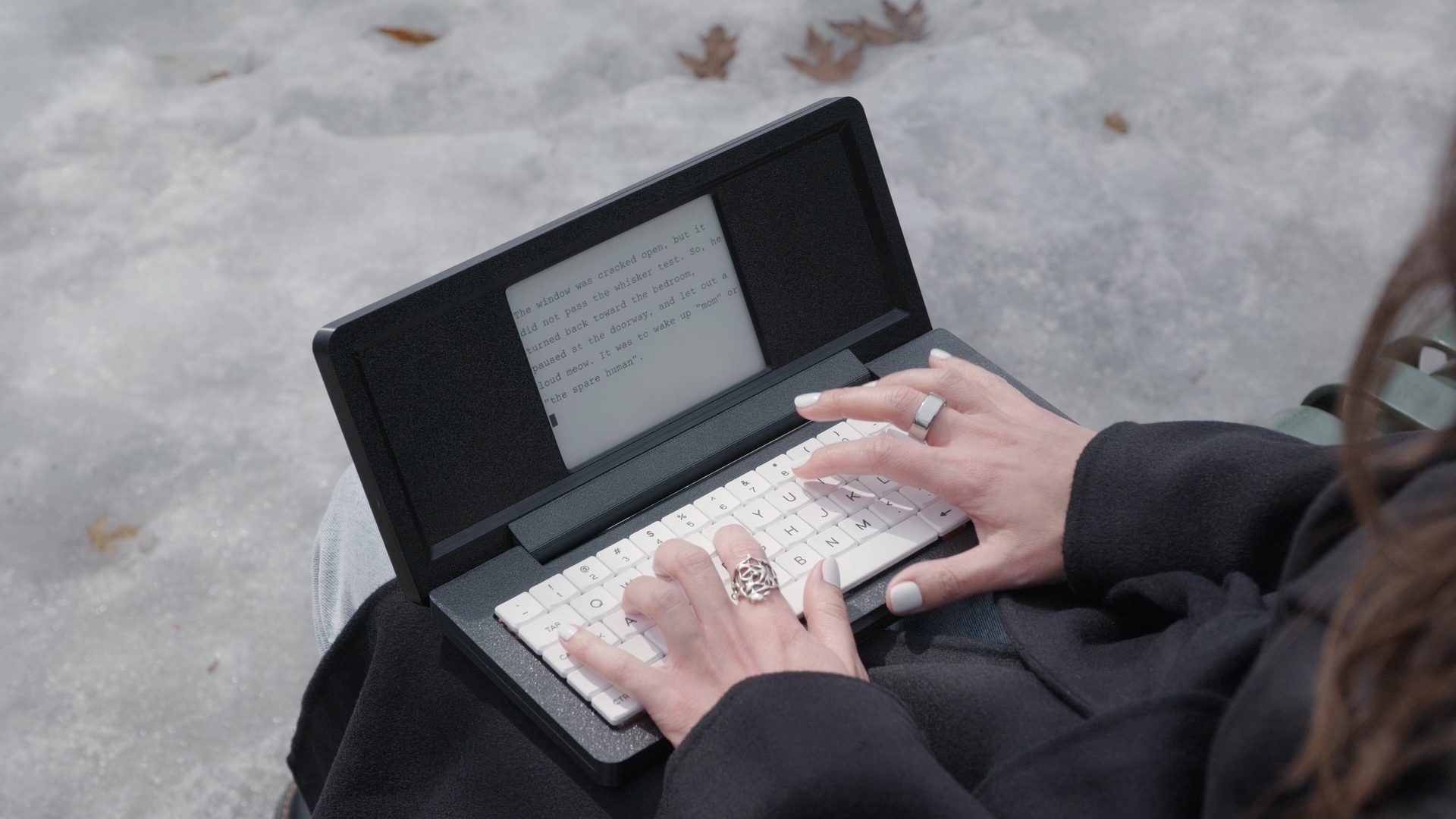
Adam Wilk is the Ottawa-based founder of Zerowriter, which makes a distraction-free word processor that uses e-ink displays, the same low-glare technology found in e-readers. It connects to nothing. There’s no browser, no notifications and no video player.
In 2014, Adam Wilk paid $100 on eBay for a 20-year-old word-processing machine and, in the process, discovered a market nobody was servicing.
Wilk is the Ottawa-based founder of Zerowriter, which makes a distraction-free word processor that uses e-ink displays, the same low-glare technology found in e-readers. It connects to nothing. There’s no browser, no notifications and no video player.
“It’s a new take on old technology,” Wilk told OBJ. “It just does the one thing.”
The devices are designed to feel familiar. Wilk built the retro aesthetic deliberately to evoke an earlier era of computing for writers who spend their days staring at screens.
“Somthing stable and reliable is a big thing for people,” he said. “You open it up, it turns on and you just start working. You don’t have to boot up. You don’t have to log in to anything. There’s none of that.”
The device was inspired by the machine he bought on eBay more than a decade ago. It was an AlphaSmart, a word processor built for elementary school classrooms in the early 2000s by two former Apple engineers. School boards bought the devices because they were cheaper than laptops. The company eventually went bankrupt after Google Chromebooks arrived and made the products obsolete. But the devices never disappeared.
“These devices remained, all they did was word processing,” Wilk said. “Writers picked up on that.”
In fact, online communities of writers kept trading AlphaSmarts back and forth. By the time Wilk found his, the going rate on eBay had climbed to around $100. Today, they sell for more than $200. Wilk saw a community that wanted a modern alternative and was not finding one at an accessible price.
His background has nothing to do with hardware. He graduated from Carleton University, taught English in Cambodia and worked in an Apple retail store, helping customers use their devices. His first foray into entrepreneurship involved selling leather notebooks online. Then he landed in digital marketing and e-commerce, where he has worked for the past seven years.
He started Zerowriter in 2022 and taught himself how to build hardware as he went.
“I am not at all like a hardware engineer,” he said. “I work in digital marketing and commerce, so I self-taught myself most of this stuff.”
He started with a Raspberry Pi and an e-ink display. A YouTube video documenting his early prototypes caught the attention of a Croatian electronics manufacturer that specializes in e-ink panels. The company reached out and offered to collaborate and that partnership became the foundation for the Zerowriter Ink’s first production run of nearly 700 units.
The Zerowriter Ink crowdfunded at 385 per cent of its goal and earned coverage in the Financial Times and PC World.
Customer feedback drove the design of a second device. Buyers wanted something foldable with an adjustable screen, something immediately recognizable. And so Wilk is now launching Zerowriter Fold, a foldable laptop-style device.
“You know what it is instantly because it looks like a laptop,” Wilk said. “Your brain just thinks, ‘I know how that works.’”
Wilk is moving the final assembly from Croatia to Ottawa for the Fold. He works with two local contractors, Momentum Design, a hardware enclosure design firm, and 3D Print Room, which produces the device shells.
“It is wonderful having experienced contractors in Ottawa that know what they’re doing and know the hardware scene a little bit,” he said.
The move also opens the door to local job creation and positions the company to access government programs supporting Canadian manufacturing.
The timing, however, has not been simple. Roughly 70 per cent of Zerowriter’s customers are in the United States. Because the Ink was assembled in Croatia, American buyers faced import duties of 10 to 15 per cent, depending on whether the order shipped to them directly from Croatia or shipped to Canada first.
“The vast majority, I would say everybody who ordered one, got impacted by tariffs,” Wilk said. “Whether they’re in the U.S. or not.”
The problem for Wilk was the American distributor he used. Even Canadian orders got hit with tariffs because the units entered the U.S. from abroad and were subject to tariffs, and then when they crossed the border into Canada they were subject to Canada’s retaliatory tariffs.
“A Canadian customer is paying for tariffs that are hurting our country,” Wilk said. “Ethically, it is not cool.”
Moving assembly and fulfillment to Canada addresses both problems.
Wilk is also pivoting away from the U.S. and is now targeting the European market.
“I need a market that has the demand and has the money,” he explained. “Especially Germany and France. These are very good markets for me, markets that my competitors haven’t pursued deeply.”
Astrohaus has been, until recently, the main competitor to Zerowriter. The American company produces the Freewrite line of distraction-free writing devices, although with more bells and whistles and a more modern and minimalist design compared to the vintage aesthetic of Zerowriter. However, the EU’s retaliatory tariffs on American goods have created a competitive advantage for Zerowriter, as Canada operates under separate trade arrangements.
The Fold already supports most European languages. Wilk said he is working on Turkish and adding several Cyrillic scripts.
Zerowriter is entirely bootstrapped. Wilk said he approached Ottawa-area investors and found little appetite for a hardware startup, but he doesn’t mind. “The hardest money you take is money from somebody else,” he said.
He’s also not concerned about the road ahead for Zerowriter. “I’m extremely, extremely confident that it’s going to go well.”