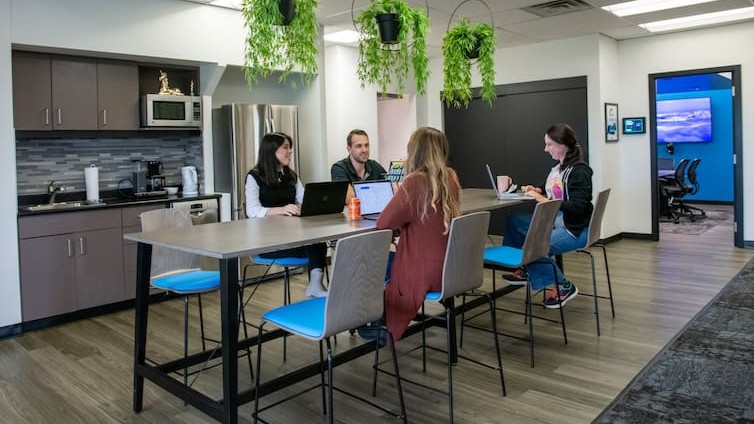
While thousands of government workers are facing return-to-office mandates, many local tech companies are stocking the fridge, booking caterers and finding other ways to encourage employees to spend at least some time in the office.
Already a Subscriber? Log in
Get Instant Access to This Article
Become an Ottawa Business Journal Insider and get immediate access to all of our Insider-only content and much more.
While thousands of government workers are facing return-to-office mandates, many local tech companies are stocking the fridge, booking caterers and finding other ways to encourage employees to spend at least some time in the office.
While it may harken back to the days of foosball tables and fully stocked bars, it’s all part of investing in office spaces and company cultures to make employees want to show up. Tech executives say the strategy is reshaping how they lead their teams and recruit new employees.
At Fullscript, chief business officer Dennis Richter says the digital-health company’s policy, “wherever you work well,” leaves attendance decisions entirely to employees. In fact, he says, it’s the one question that surfaces almost every time he interviews candidates.
“We’ve interviewed tons of people and you know the No. 1 thing that comes up in conversations? They almost always ask us, ‘How often do people come into the office?’”
Richter says the answer is never a mandate, but creating conditions for connection rather than forcing people to connect.
“You don’t have to mandate,” he says. “What you have to do is lead by example and leaders need to be the ones coming into the office. When you make it about not forcing the fun, people are more inclined to come in.”
The culture at Fullscript’s Ottawa offices develops without company direction, Richter explains. Employees organize group food orders from local restaurants and gather for Ottawa Senators watch parties on the office’s big screen.
“None of those things are company-driven,” Richter says. “We never get up there and say come do this or you have to do that. It’s just something that gets brought up and kind of just spreads around.”
Knak takes a similar approach. Zak Michalyshyn is the senior talent acquisition lead at the Ottawa email marketing software company. He says the goal is to make coming to the office attractive, with such things as a ping-pong table, bubble hockey, arcade machines and a driving simulator.
“That one’s probably got people engaged the most because there’s a little competition,” he says of the simulator, which includes a monthly leaderboard. “They’ll pick a car and a lap time every month and there’s a kind of scoreboard where people are trying to get the best lap time.”
Every Tuesday, Knak brings in bagels from Kettlemans Bagel. Every Wednesday, the office serves a catered lunch from a rotating selection of local restaurants. Leftovers often keep employees coming back on Thursdays, according to Michalyshyn.
When employee surveys identified meeting room shortages as one of the biggest deterrents to coming in, Knak renovated its space to add more dedicated quiet rooms equipped with monitors for focused work.
Michalyshyn also says Knak now hires closer to home than it used to. Roles that would have been posted as fully remote during the pandemic, now carry an Ottawa preference.
“We’ve been focused a little bit more on certain roles being in Ottawa where we feel like there’s an opportunity to get certain cross-functional partners together on a more regular basis,” he says.
He recently placed one of the company’s new sales positions in Ottawa for this reason. “We see the value in our sales team that’s here being able to walk over to that person’s desk and ask a question, rather than slacking and waiting for an answer,” he explains.
Things are done a little differently at Solink. Grace Barbosa-Chin, a people and culture leader at the Kanata video security software company, says she thinks about office perks in terms of personal growth.
“For me what really matters in terms of a perk is how do we help up-level a team member?” she says. “How do we grow their career? And for us, something that’s really important is that mentorship piece.”
Solink’s go-to-market team works under a formal office mandate. Business development representatives come in five days a week. Account executives are expected three days a week. An open concept layout reinforces the mentorship goal, Barbosa-Chin says. Candidates ask less about tangible perks and more about career trajectory.
“I think people right now really care about how they can grow in their career and how we can support them,” she said. “I think there are a lot of pros of being in office that allow for that support. And so that’s what we tend to lean on when we speak on those perks.”
Solink recently expanded its Ottawa headquarters to accommodate go-to-market team growth and opened a Toronto office. Barbosa-Chin estimates about 50 per cent of the workforce comes into an office at least once a week. The expectation to show up runs from entry level to the top of the organization.
She says the company’s CEO leads by example. “Mike (Matta) is in office if he can be every single day,” she explains. “I think that’s what made him a really fantastic founder and leader. You’re actually able to get face time with him. You can see him in the office if you have something on your mind. He’s always accessible.”
Other tech companies in Ottawa are finding their own versions of the same formula. Kanata-based Kinaxis gives all employees the last Friday of every month off in a program called K-Days, alongside unlimited paid vacation and a Christmas to New Year company shutdown.
Noibu, a downtown Ottawa e-commerce monitoring company, serves free lunches on Tuesdays and bagels on Thursdays and lets employees take extended breaks through a “90-day away” policy.
Assent, the supply chain software company, rebuilt its office around the reality that most employees would not be there every day. According to a case study by The Globe and Mail, the company cut its desk count from 350 to 180 and replaced large conference rooms with huddle areas and Zoom booths.
Kanata-based AI energy management company BluWave-ai has a “work your way” philosophy for employees and free electric vehicle charging at the company’s headquarters.
At Fullscript, Richter says ordering workers into the office without offsetting their costs puts the burden in the wrong place.
“Now you’ve got train expenses, bus expenses, fuel and parking expenses,” he says. “All of these other expenses that the business, nine out of 10 times, is not offsetting any of those. Not to mention time lost.
“When you just say, ‘We’re coming back to the office’ and then three months later everybody’s asking, ‘Okay, so what’s gotten better?’ and nobody knows, then (employees) get even more frustrated,” Richter says. “And then you start to lose your best talent.”