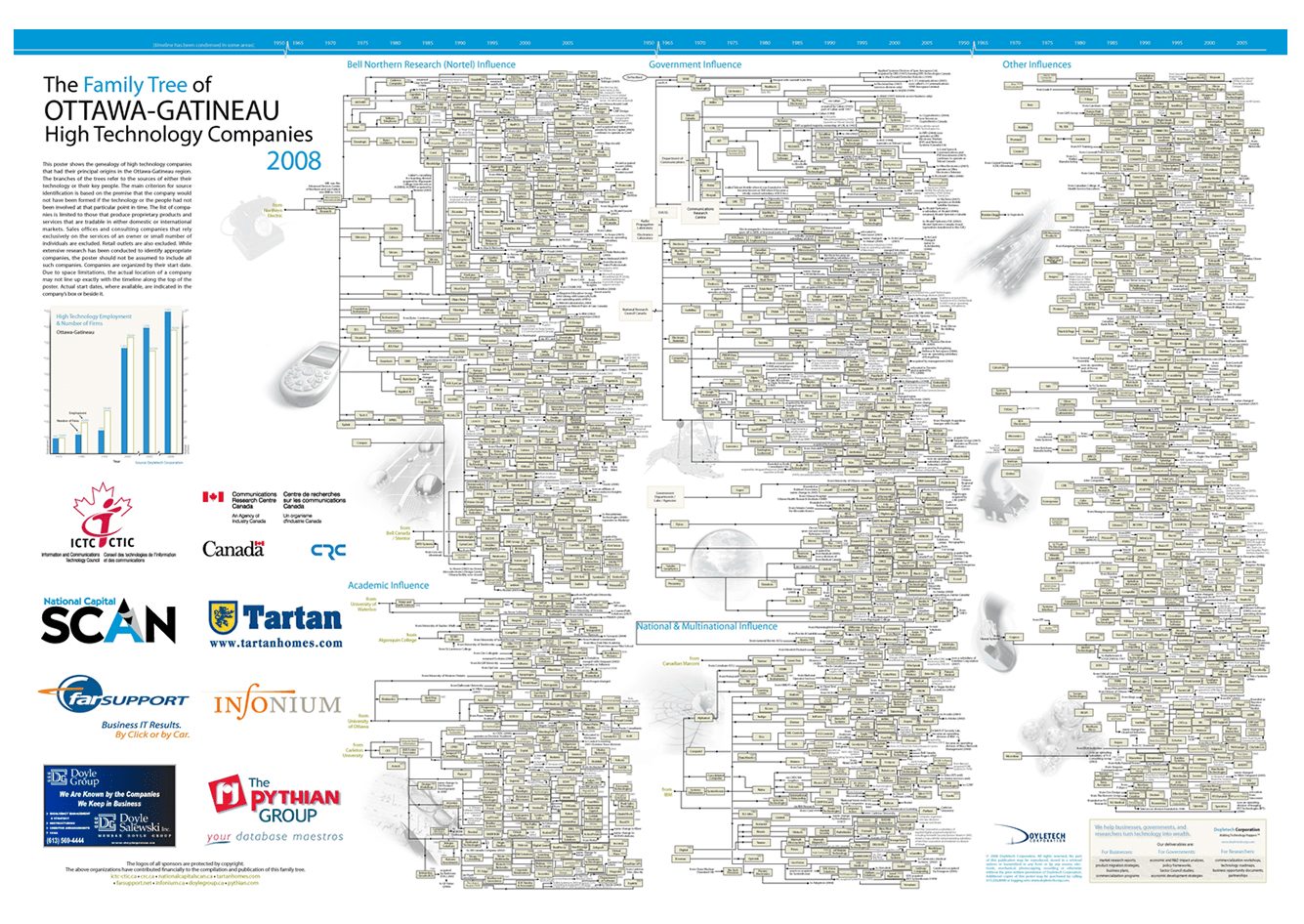
A poster hanging on the wall at Hub350 has not changed in almost two decades. It maps the family tree of Ottawa’s technology companies in hundreds of tiny boxes and traces the lineage of local firms back to institutions such as Bell-Northern Research and the National Research Council.
Already a Subscriber? Log in
Get Instant Access to This Article
Become an Ottawa Business Journal Insider and get immediate access to all of our Insider-only content and much more.
A poster hanging on the wall at Hub350 has not changed in almost two decades. It maps the family tree of Ottawa’s technology companies in hundreds of tiny boxes and traces the lineage of local firms back to institutions such as Bell-Northern Research and the National Research Council.
The keeper of the map faces the same question every time he shows up at a Tech Tuesday networking event.
“Anytime Terry (Matthews) sees me, he says, ‘When are you gonna update that map?’” said Jeffrey Doyle, who runs Ottawa’s Doyletech Corp. “And I say, ‘When someone gives me some money.’”
The poster is one of the last published editions of what Ottawa’s technology community came to know as the map of the region’s high-tech ecosystem. The sprawling document tracked hundreds of local firms for about three decades, tracing each company back to its founding organization. Doyletech printed tens of thousands of copies, which were found in government boardrooms and the offices of executives and consultants across the city. The last version came out in 2008.
The map traces its origins to Doyle’s father, Denzil, an engineer and entrepreneur and one of the pioneers of the Ottawa tech hub. He died in 2022 at age 90.
Known as the “father of Silicon Valley North,” Denzil grew Digital Equipment Corp.’s Canadian operations into a multifaceted corporation from 1963 to 1981. He then founded Doyletech to provide consulting services. He was appointed to the NRC in 1982. He co-founded Instantel, a supplier of instrumentation equipment, and served on the board of directors for many Canadian high-tech companies. He also served as chairman of Capital Alliance Ventures, an Ottawa-based venture capital firm.
In recognition of his work, Denzil received the Queen Elizabeth II Diamond Jubilee medal and was invested as a member of the Order of Canada.
The idea for the map was actually a personal passion, born out of an interest in genealogy. Denzil spent years researching and writing a book on the history of the Doyle family in the Ottawa Valley.
His son, who took over Doyletech in 1999, says his father saw a direct parallel with business.
“Dad has always had an interest in genealogy,” Jeffrey Doyle told OBJ. “And I think … he spun that idea off into the fact that companies come from somewhere. Companies come from other organizations, whether it's (the Communications Research Centre) or a university or IBM or Shopify or Mitel.”
The earliest versions of the map date to the 1980s, when Denzil produced posters for the old city of Kanata showing the local technology cluster. Doyletech later built out separate maps for spin-offs from the CRC and the NRC. The main poster was expanded to cover the entire Ottawa-Gatineau region.
Jeffrey Doyle worked on the map as a student, updating the database during summers in high school and university. The map became his responsibility when he took over Doyletech.
“Technically, for the last 25 years, it’s like me that’s been doing it,” he explained.
The process was not continuous. Jeffrey Doyle would let the map sit for a year or two, then spend roughly three months updating it. Each new edition required tracking down hundreds of companies, confirming their lineage, recording closures and new launches, and producing a poster large enough to show thousands of connections in readable form. Each update ran about $100,000.
“That’s how much (it cost), especially before LinkedIn,” Doyle said. “Now you could probably download all the information in minutes.”
He printed between 20,000 and 30,000 copies of each edition, gave 200 to each sponsor and sold the rest through Doyletech’s website. The maps became ubiquitous.
“Anywhere you went in the ‘80s and ‘90s, you would see the map up in corporate offices,” Doyle said. “I went to the Carp Road BIA and there was a senior guy from the Ontario Ministry of Economic Development, and he says, ‘Oh yeah, I know you guys, I still have your map up in my office.’ And the map hasn’t been updated in over 15 years.”
Price Waterhouse saw the value of the concept and licensed it from Denzil, producing its own tech maps for Ottawa, Vancouver and Saskatchewan. That stopped after a few years when the volume of work became unmanageable.
The final Doyletech edition came out in 2008, as the combination of cost and the sheer growth of Ottawa’s tech sector made it impractical to continue. Doyle estimates the 2008 map would need to be roughly 10 times larger just to fit all the companies.
“Those posters, if you get close to it, you’ll see just how small the boxes are,” he said. “You can barely see the company names in there.”