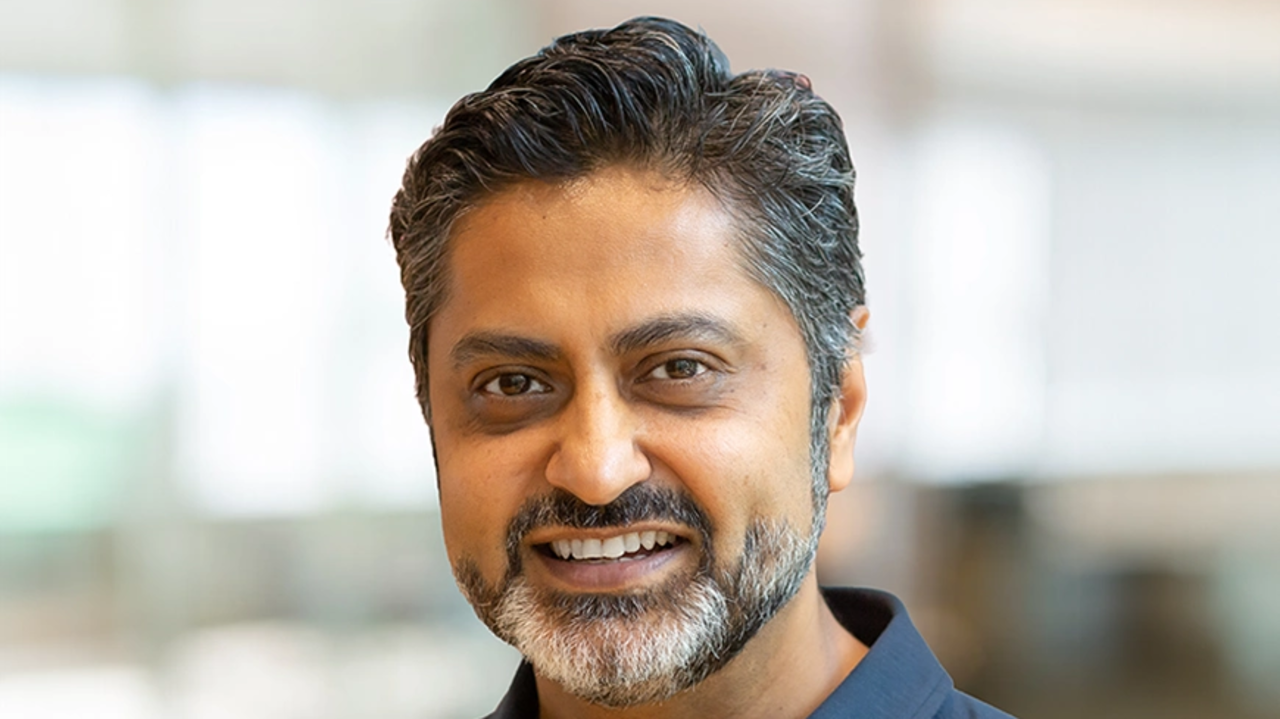
Two months after taking the helm at one of Ottawa’s most prominent software companies, Kinaxis chief executive Razat Gaurav says he’s “even more excited” about the firm’s long-term prospects than he was when he started the job. The veteran tech executive was hired after a year-long search to replace John Sicard, under whose watch the […]
Get Instant Access to This Article
Become an Ottawa Business Journal Insider and get immediate access to all of our Insider-only content and much more.
Two months after taking the helm at one of Ottawa’s most prominent software companies, Kinaxis chief executive Razat Gaurav says he’s “even more excited” about the firm’s long-term prospects than he was when he started the job.
The veteran tech executive was hired after a year-long search to replace John Sicard, under whose watch the Kanata-based firm’s revenues grew from $116 million in his first year as CEO in 2016 to nearly $500 million when he retired in 2024.
As supply chains snarled during the pandemic, demand for Kinaxis’s software – which helps customers solve thorny problems such as ensuring they have enough inventory to meet projected sales – soared.
But Kinaxis has faced headwinds in recent years.
The firm laid off six per cent of its workforce in early 2024 as sales cycles slowed and the firm’s share price stagnated. A few months later, the firm announced the pending departures of Sicard and chief sales officer Claire Rychlewski. Weeks after that, one of the company's largest investors called for the company to seek a sale due to what it described as years of “poor execution” that devalued the firm’s stock price.
Kinaxis has since revamped its go-to-market and sales strategies under president of commercial operations Mark Morgan, who was hired in October 2024. Under the guidance of interim CEO Bob Courteau, Kinaxis's revenues rose 13 per cent in 2025 to $548 million, and the company is projecting similar growth for 2026.
The markets, however, haven’t responded favourably. Kinaxis’s share price has fallen nearly 20 per cent since the start of 2026, and the stock has barely budged since the height of the pandemic in 2021.
Now it’s up to Gaurav, whose resume includes stops at fellow supply-chain management software suppliers Llamasoft and Blue Yonder, to steer Kinaxis through what he hopes will be a transformative era for the company, as it introduces AI-powered products and looks to accelerate the expansion of its global footprint.
The new CEO recently spoke with OBJ about some of the big questions facing Kinaxis as it navigates the opportunities and challenges that lie ahead.
What role will AI play in Kinaxis’s ongoing evolution?
According to Gaurav, artificial intelligence is becoming a “dominant point of emphasis” for the company as it seeks faster, more efficient ways of responding to customer demands.
To that end, Kinaxis recently began rolling out a series of no-code AI agents that build on data and workflows in its existing platform, Maestro, and tap into other embedded large-language models such as ChatGPT and Google Gemini to answer queries about supply-chain issues in real time.
Gaurav said Kinaxis has been using machine learning algorithms for years to help companies like Ford and Unilever predict demand for their products and manage their inventories, and the new AI agents are simply one more tool in the company's growing kit.
“None of those things get replaced by generative AI,” he said of Kinaxis’s legacy products. “But generative AI can provide us with a new, conversational interface into our platform. (Customers) can have a conversation in actual language and derive the power of those predictions … and those insights and even take actions through a conversational interface. That is new and that is exciting. We’re leaning in on (installing) that across our entire platform.”
Gaurav said Kinaxis’s “secret sauce” is its ability to draw on decades of experience in supply-chain networks when it’s creating machine-learning and artificial-intelligence tools that help analyze complex problems.
“You’re dealing with production plants and shop floors and … warehouses and dock doors and ports, which are disrupted right now with what’s happening in the world,” he explained.
“If you don’t understand the physics of the supply chain, you’re going to get all kinds of hallucinations (in your AI models). That’s the journey we’re on, is leveraging our depth of knowledge of the physics of the supply-chain networks, leveraging our advanced mathematical models that are critical to decision-making in the supply chain, and layer on top of that generative AI and agentic AI to really transform the ways of working for our customers.”
What are customers saying about the new AI tools?
Kinaxis’s 400-plus clients fall into different buckets, Gaurav said. Some are “early innovators" that are keen to adopt AI, while others are “fast followers” and still others are content to wait for the technology to become more mainstream before fully embracing it.
Gaurav, who said he’s met with dozens of Kinaxis clients since becoming CEO, said the firm is working closely with some of the early adopters to refine its growing stable of AI tools and tailor them to customers’ needs.
“A good number of them have deep interest in leaning in (to AI),” he explained. “They're getting pressure from their boards and their CFOs on ‘how are you going to get the next wave of productivity … using AI?’ There’s a lot of appetite we see in companies that are willing to co-innovate with us.”
Will Kinaxis continue to focus on supply-chain management or will it morph into more of an ‘enterprise AI company’ over time, as CFO Blaine Fitzgerald suggested in a recent call with analysts?
“I think what Blaine was referring to was potential in the long, long term,” said Gaurav. “I think in the near term – I’m talking about the next three years – I fully expect that there’s so much opportunity in the gory guts of supply chain and operations of companies that we can help on that journey using our platform and all the new capabilities where we are expanding our platform with agentic AI.”
Gaurav predicted Kinaxis could triple its current revenues without branching out into new uses for its software, “because we are not just doing traditional demand-supply planning anymore, we are really getting into orchestration.”
Orchestration, he explained, refers to “closing the loop” between supply-chain management and execution by tapping into data from outside platforms such as warehouse and transportation management systems to make Maestro and its AI agents even smarter.
“In the long run, clearly there will be other opportunities for us to expand into (other fields beyond supply chain),” he added. “Supply chain is a very broad domain. It starts from sourcing, all the way through manufacturing and production, through distribution, logistics fulfilment to customer delivery and everything in between. Right now, we’re going to be very focused on this broader supply chain domain. But that scope is way broader than traditional demand-supply planning only.”
As Kinaxis expands its global footprint, will Kanata remain its main R&D hub?
Kinaxis, which has about 2,000 employees, must “continue to retain and attract high-calibre talent” from around the world, Gaurav said.
While Kanata is still the company’s largest office with about 650 employees, Kinaxis also has growing operations in Toronto, Dallas, India, Tokyo, France, the United Kingdom, Germany and Mexico.
“If I could get away from not hiring a single other person anywhere else (but Ottawa), I would do that,” Gaurav said. “But that’s not practically feasible, because we’ve got customers everywhere, and some of the expertise we need, particularly domain-specific expertise, we do need to hire in other locations as well.
“Our customers are global. So as we grow as a global company … we’ve got to go where the talent pool is.”
Still, Gaurav, who lives in Texas and visits Kinaxis’s headquarters regularly, said the firm will remain “anchored” in the National Capital Region, thanks in large part to the area’s wealth of skilled workers.
“I like the talent pool in Ottawa because there’s a lot of engineering schools, both in the Ottawa area and also the broader Ontario and Montreal (regions),” he said. “So we recruit from universities from the surrounding areas and we have a hub where we can bring (new employees) into an environment where they can learn and get mentored and get coached.
“We’ve got different hubs where we’ve really collected a talent pool. But Ottawa, I expect, will continue to be the biggest office and definitely the heartbeat, especially from a product and engineering perspective.”
Besides finding enough skilled talent, what other major challenges does Kinaxis face?
“Really, it’s about making sure we can deliver to our customers’ expectations,” Gaurav said, adding that “shifting geopolitical situations” are constantly “creating new levels of supply and demand volatility for a lot of our customers.”
Keeping tabs on those issues is top of mind, he said.
“We are part of a global ecosystem, and we want to make sure our employees are safe, that we are able to service our customers appropriately.”