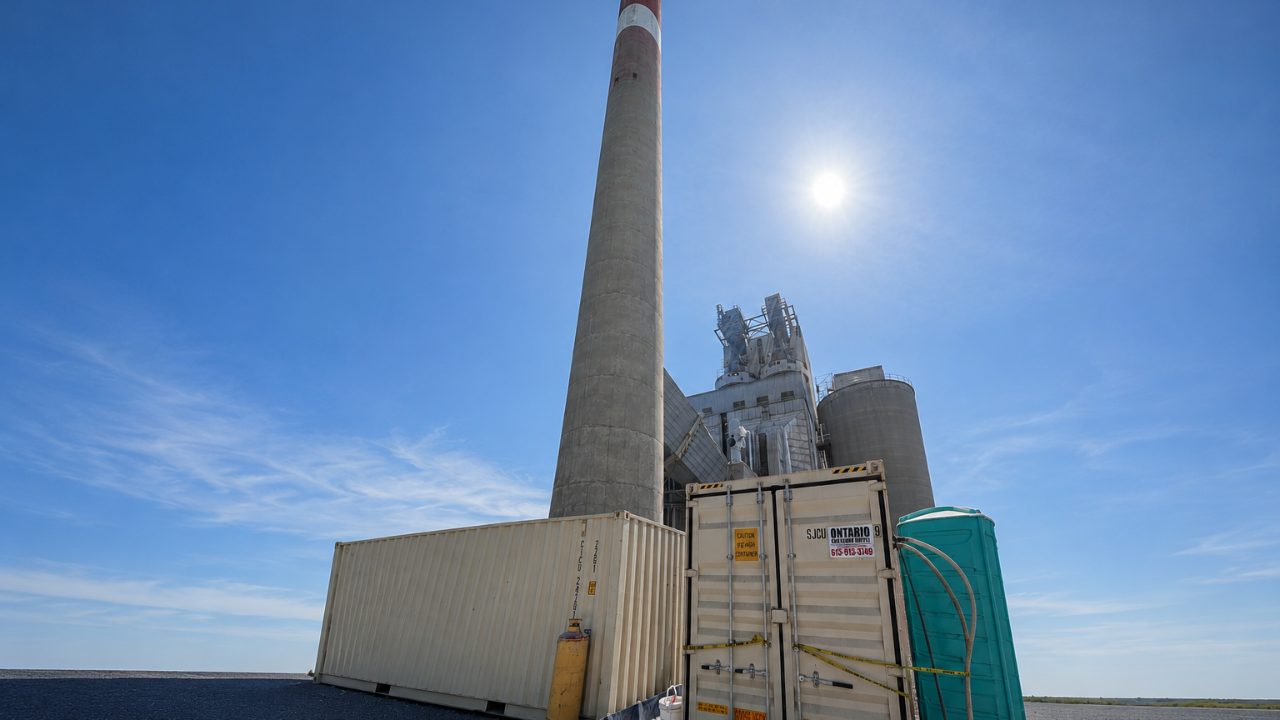
Hyperion Global Energy Corp. has been refining a patented system that captures flue gas from cement manufacturing and converts it into calcium carbonate, a mineral compound used as an antacid and as filler in toothpaste, paint, cement and other products.
Get Instant Access to This Article
Become an Ottawa Business Journal Insider and get immediate access to all of our Insider-only content and much more.
An Ottawa startup that’s working with North America’s largest cement company to turn carbon emissions into a product with multibillion-dollar market potential is aiming to make its technology commercially viable within the next 18 months.
Hyperion Global Energy Corp. has been refining a patented system that captures waste carbon dioxide emissions from cement manufacturing flue gas and converts it into calcium carbonate, a mineral compound used as an antacid and as filler in toothpaste, paint, concrete and other products.
The company, which is based at Bayview Yards, has been testing the technology at Amrize’s plant in Bath, west of Kingston. Amrize, formerly known as Lafarge, was spun off into an independent, publicly traded company by Switzerland’s Holcim Group last year.
Hyperion co-founder and CEO Heather Ward hopes the cement production giant will become an “anchor customer” as her fledgling Ottawa firm looks to scale up its system, known as Tandem Carbon Recycling.
“We’re basically taking the world’s biggest liability, which is carbon dioxide, and turning it into an asset,” says Ward, who pegs the global market for low-carbon materials that are derived from CO2 such as calcium carbonate at more than $44 billion. The global market for carbon-capture utilization and storage technologies to decarbonize cement manufacturing is estimated to be more than $300 billion, she adds, with the cement industry accounting for more than a quarter of all industrial emissions.
Hyperion stores all the equipment for the system, which has been in development for a decade, in 40-foot shipping containers that are installed on site. Ward says the “plug-and-play” nature of the system means it can be easily replicated at other cement plants.
The technology can currently capture and recycle about 1,000 tonnes of carbon annually. Hyperion plans to increase that by a factor of 10 over the next 12 to 18 months, with the goal of producing more than 5,000 tonnes of calcium carbonate.
The company says that once the system is operating at full capacity, it will be capable of capturing 30,000 tonnes of CO2 and churning out 60,000 tonnes of calcium carbonate per year.
Hyperion is one of a multitude of startups that are jostling for position in the fast-growing field of carbon-capture utilization and storage, which Ward says is projected to be a trillion-dollar market by 2030.
What sets her company apart, she says, is that unlike many other carbon-capture startups that rely on carbon credits to stay afloat, Hyperion’s technology is designed to create a product with massive market potential.
Current methods of producing calcium carbonate are “very resource-intensive” because the substance typically comes from rock such as marble and limestone that has to be mined and then crushed or ground down to fine particles, Ward explains. Hyperion’s system, she says, is more energy-efficient and can be rolled out all over the planet.
“It’s a better way of making what the world already needs,” she says.
'An economic business case'
Hyperion’s push to commercialize the technology comes as the cement industry faces growing pressure from governments and consumers to reduce its carbon footprint.
Cement manufacturing accounts for about eight per cent of global CO2 emissions. Amrize is aiming to achieve net-zero emissions by 2050, and the industry as a whole is “really eagerly looking for technologies to help meet” that target, Ward says.
“Concrete has a (carbon emissions) problem, so we’re looking at solving that,” she adds.
Ottawa angel investor Jennifer Francis, one of Hyperion’s financial backers, says startups that rely on carbon credits for revenue are at the mercy of public policy makers. Hyperion, by contrast, has a solution that paying customers already want to buy, making it attractive to investors, she explains.
“Governments change, policies change and you don't want your business case to fall apart with an election,” says Francis, who chairs the Capital Angel Network.
“That's gone now out of (Hyperion’s) business case. There's an economic business case, and while I feel like people should be motivated by sustainable development and environment (goals), right now many people are not. So I think the fact that there's now much more of an economic case for doing this that survives different policies, different mindsets, different views on the environment is good.”
Hyperion has raised about $3 million to finance its efforts so far, including $1.8 million in private equity funding from Thistledown Capital — Shopify founder Tobi Lütke’s family fund that backs enterprises that are developing decarbonization technologies — as well as the Capital Angel Network and other investors. The firm has also received $1.2 million in non-dilutive funding and grants from sources such as the National Research Council of Canada’s Industrial Research Assistance Program and Alberta’s Natural Gas Innovation Fund.
The company, which has fewer than 10 employees, is looking to add another $2 million to its warchest to give it an additional 18 months of runway. It has closed about $1.5 million in non-dilutive funding in the new seed round, along with an additional $250,000 in new follow-on investment from Thistledown.
But finding financial backers willing to bet big on promising carbon-tech startups with unproven track records has never been easy in Canada, and Hyperion is no exception.
Ward hopes a new program based at Toronto’s MaRS Discovery District will give her firm a boost.
Hyperion is one of five Canadian cleantech startups taking part in the new MaRS First-of-a-Kind (FOAK) Lab, which is designed to help the companies scale their technologies into full-scale commercial projects. It was referred to the program by the Cement Association of Canada, which named the Ottawa startup its “decarbonizer of the year” in 2025.
MaRS executive Tyler Hamilton says that while Canadian entrepreneurs are great at devising clean technologies, they often hit a wall as they try to turn those innovations into viable businesses.
“We tend to focus a lot on R&D on Canada, so we’re really trying to shift a lot more of our resources and our program design to that sensitive stage which is critical to helping these companies scale,” he explains, adding that traditional sources of financing such as banks are “notoriously conservative” when it comes to funding cleantech ventures.
“Most private-sector funding organizations, they just stay clear of this space,” Hamilton explains. “Too many times (cleantech startups) die on the vine because companies just can’t get the traction they need.”
Backed by Natural Resources Canada, Chisholm Thompson Family Foundation and the Schmidt Family Foundation, the MaRS FOAK Lab is connecting Ward and other founders with finance experts from organizations such as accounting giant PwC and the University of Toronto to help create funding blueprints tailored to their specific needs.
“It’s really about increasing our horizon in terms of who we pull into our investor network,” Hamilton says. “Over time, we’ll get better at that. We’ll have a deeper bench of investors who specialize in this particular area.”
Francis says bridging that funding gap — what MaRS refers to as “the missing middle within the missing middle” — will be essential for companies like Hyperion to succeed over the long haul.
“You get the starry-eyed investors at the beginning, and then it's a slog,” she explains. “And then you start needing more money. You can do stuff in the lab with a smaller investment, but when you're out in the real world doing your real-world proof of concepts and then proving (you can) scale, you need more money, but you're still not generating revenue.”
Ward says the FOAK program is coming at just the right time for her venture. She estimates it will cost about $10 million to launch Hyperion’s commercial demonstration project in Bath and another $30 million to get it into full-scale production.
“There's a lot to manage along that scaleup,” she says, adding the MaRS initiative is “perfectly aligned with our (current) stage and where we’re going now with our commercial project development.”
While Hyperion is now focused on refining its system at the Amrize plant, there are plenty of other industries that could also benefit from the technology, Ward adds.
“As we grow, we’ll look to see where the fit is in other markets once we’ve tapped out the supply chain for concrete.”