As demand for its indoor farms surges across Canada, Ottawa-based Growcer has dramatically expanded its international customer base after acquiring the assets of a bankrupt U.S. competitor. Growcer bid US$2.6 million at auction earlier this month to purchase vertical farming containers produced by Freight Farms, a Boston-based business that ceased operations last spring. Growcer also […]
Get Instant Access to This Article
Become an Ottawa Business Journal Insider and get immediate access to all of our Insider-only content and much more.
As demand for its indoor farms surges across Canada, Ottawa-based Growcer has dramatically expanded its international customer base after acquiring the assets of a bankrupt U.S. competitor.
Growcer bid US$2.6 million at auction earlier this month to purchase vertical farming containers produced by Freight Farms, a Boston-based business that ceased operations last spring. Growcer also bought the U.S. firm’s intellectual property, including its proprietary software.
The deal immediately springboards Growcer, which has already supplied modular vertical farming units to 125 customers across Canada, into a position of global prominence in the emerging industry. Freight Farms manufactured more than 800 vertical farming containers for customers in 30 countries – units that will now be under Growcer’s umbrella.
“Our No. 1 priority was to ensure continuity for their (customers), and we realized that the best way to do that was going to be to put a bid in to acquire the assets,” Growcer co-founder and CEO Corey Ellis told Techopia this week.
Launched in 2011, Freight Farms was among the first companies to manufacture and sell container farms that grow produce indoors rather than underground.
But despite raising more than US$43 million in funding, the company struggled to capitalize on its first-mover advantage. Last year, Freight Farms scrapped a plan to go public on the Toronto Stock Exchange via a special-purpose acquisition company, and the firm ultimately ran out of cash.
Freight Farms joins the ranks of other high-profile U.S. vertical farming operations such as Plenty and Bowery Farming that collapsed under the strain of rising energy costs and razor-thin margins.
Still, Ellis is confident Growcer has made a good buy. He said Freight Farms’ staffing and overhead costs “were far too big for their current needs and the current size of their revenues,” adding he believes the company’s units can be money-makers under the stewardship of Growcer, which has been profitable for the past 18 months.
“We know this industry is viable if the business is managed in a prudent, judicious way,” Ellis said. “We felt a responsibility to their customers to take the baton and continue the mission that Freight Farms originally set out. Freight Farms was the pioneer in our industry. They really created the industry and the idea that you could put a farm inside a box and ship it pretty fast anywhere in the world. We wanted to carry that baton. We strongly believe in that vision for the world – that more local food is a good thing.”
While the two companies use similar growing technology, the units have their differences – for example, produce in Freight Farms’ modules is grown on “walls” rather than the horizontally stacked racks found in Growcer farms.
Ellis says Growcer will continue to sell both models, describing them as “complementary products” with their own particular appeal.
“We’ll give people the power of choice in this one,” he said.
'Buy local' boost
Now at 30 employees, Growcer plans to hire two or three former Freight Farm staffers. For now, Freight Farm modules will continue to be produced south of the border, but Growcer also plans to start manufacturing the units at its factory in Winkler, Man.
The move to pick up Freight Farms’ assets comes as Growcer is reaping the benefits of surging demand for locally grown produce – an uptick driven in part by concerns about potential tariffs on imported food from the U.S. as well as the growing sense of urgency among Canadian municipalities looking to address rising food insecurity.
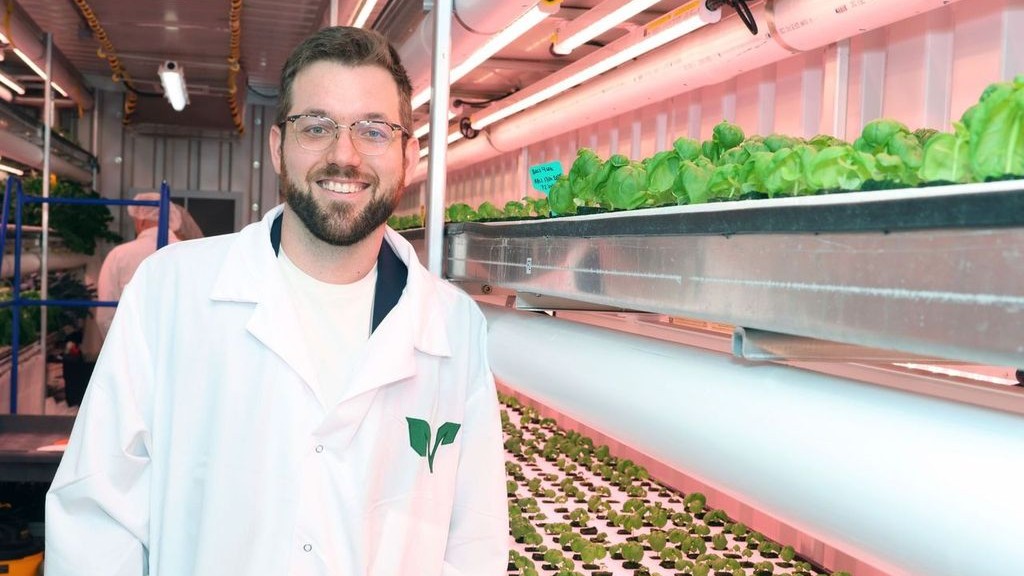
Growcer’s climate-controlled modular units can operate in temperatures as low as -40 C. Each unit is 40 feet long, 10 feet high and 10 feet wide – about the size of a cargo container – and sells for $250,000 plus shipping. Each unit can produce thousands of pounds of leafy greens a year.
While the company initially targeted northern and Arctic communities where outdoor farms aren’t an option, Ellis says Growcer’s units are now drawing more and more interest from organizations in urban areas, such as food banks and schools.
“Food security, even in urban settings, is at a crisis point,” he said. “We are definitely seeing a big appetite for our solutions.”
Ellis said the trade war has put a spotlight on the fragility of the Canadian food supply chain, which relies on the U.S. for about 95 per cent of all leafy greens consumed in this country.
“There’s a really strong local food, call it ‘elbows up’ movement in Canada at the same time as there is a really strong need for more solutions for our food charities,” he said. “Where those two things meet I think is where there is a really exciting near-term opportunity.”
Still, the containers are a significant expenditure for organizations on tight budgets.
To that end, Growcer recently launched a fund to help customers finance the upfront cost of a farm's purchase. The company then charges a $4,000 monthly fee for the container, all capital maintenance and ongoing support services.
Ellis says he expects the $30-million fund, which is backed by a mix of investor contributions and debt financing from the Royal Bank of Canada, to pay for up to 130 new farms across North America over the next three years.
“The goal is to reduce the capital barriers and make it easier for more organizations to start growing locally,” he explained.
In addition to making the units more affordable for organizations that otherwise might have to resort to taking out loans or refinancing land or property to buy them, the “farming-as-a-service” subscription model provides Growcer with a steady source of recurring revenue, Ellis added.
“It’s a win-win on both sides,” he said.
With a price tag of between US$140,000 and $180,000, Freight Farms’ units are about the same cost as a Growcer farm. Ellis says the company has already received orders for a “handful” of Freight Farm containers since it acquired the technology, and he hopes those are just the first of many more sales to come.
“What we aren’t certain of yet and what’s still to be seen is how quickly this will accelerate sales for us,” he said. “That’s still an unknown variable. We’re cautiously optimistic, is maybe the right way to put it.”