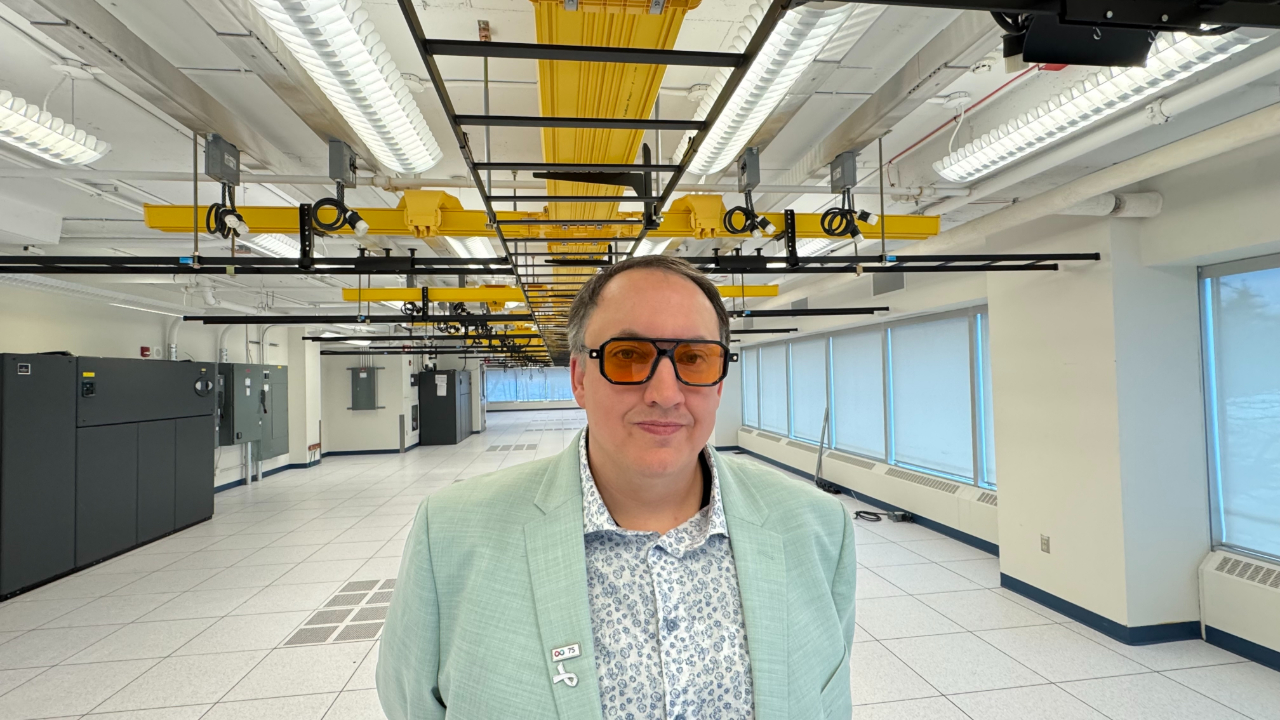
Most Ottawa residents will never step inside a data centre, even though they use one every day. Every video call, cloud document, streaming service and AI chatbot depends on buildings packed with servers, cooling systems and high-speed data connections. Plus, Ottawa’s residents are now plugging in electric vehicles and using AI. All this means that […]
Get Instant Access to This Article
Become an Ottawa Business Journal Insider and get immediate access to all of our Insider-only content and much more.
Most Ottawa residents will never step inside a data centre, even though they use one every day.
Every video call, cloud document, streaming service and AI chatbot depends on buildings packed with servers, cooling systems and high-speed data connections. Plus, Ottawa's residents are now plugging in electric vehicles and using AI. All this means that the city's power grid is facing a surge of demand from the infrastructure powering the digital economy.
But there are many different types of data centres, from small co-location sites serving local clients to large AI facilities with vast power and cooling demands. That distinction has been lost in the public conversation, according to Michael Lalonde, co-founder of Ottawa-based PureColo, which operates data centres on March Road and Riverside Drive.
"We should have been doing a better job at telling the public what these data centres actually do," he told OBJ. "And how important they are. And what the reality is about the consumption and so on and so forth."
Lalonde says the data centre industry has operated largely outside public attention for years. Then artificial intelligence arrived, and suddenly the industry found itself in the spotlight.
PureColo's two sites have about 2.5 megawatts of capacity across 25,000 square feet and roughly 250 server racks serving about 60 customers. PureColo was acquired by Vancouver-based Carrier Connect Data Solutions late last year.
"There's really two flows or two streams," Lalonde explained.
The first is the type of business PureColo has traditionally served. These are companies that need somewhere to house servers, establish a network presence or run research and development infrastructure. Customers can rent rack space rather than building their own data centre.
This kind of demand has typically grown slowly, according to Lalonde. Customers sometimes need one rack, or maybe five or 10 at a time.
"It's solving real challenges," he explained. "Today, this has to happen. This needs to be connected."
The second stream is much different.
"The other stream of demand, which is not Ottawa-centric but if Ottawa has the capacity it would come here, is the hyperscale-AI demand," he said. "They're looking for anywhere that there's power."
AI computing packs much more computing power, called "compute," into the same physical space, but also increases the electricity and cooling required. The scale changes how facilities are built.
Craig McLellan, founder and CEO of Canadian cloud company ThinkOn, told a Global Energy Transformation Summit in Ottawa in September that once data centres move above 20 megawatts, much of the engineering becomes customized.
"You can't buy off-the-shelf components," he said. "You have to go through a much longer development cycle."
McLellan argued that smaller modular data centres can sometimes make more efficient use of existing pockets of electricity, rather than building enormous new campuses that require extensive grid expansion.
Cooling concerns
BluWave-ai CEO Devashish Paul agrees. He cautioned against assuming that all of today's projected AI electricity demand will be permanent. He told the summit that current connection requests can overstate the amount of infrastructure that is ultimately financed and built, while improvements in software and hardware efficiency could reduce the power needed for AI workloads.
"I think the demand as presented is about 10 times more than it really is," Paul said of the broader connection-request environment. He pointed to Alberta as an example. "They have more connection requests than they have capital to fund it. There's not enough capital anyway."
Cooling is another flashpoint around AI data centres. Lalonde said many of the systems used in PureColo's facilities are closed-loop systems, meaning liquid coolant circulates through servers rather than needing to draw and discharge fresh water. Direct-to-chip liquid cooling, such as what is used for high-density computing, generally relies on closed-loop cooling.
"They're not guzzling water," he said.
But former federal environment minister Catherine McKenna, who chaired the United Nations group on net-zero commitments, told the summit that the industry should disclose the environmental impact of individual facilities, rather than ask communities to assume all projects operate the same way.
"Everyone says they use closed-loop," she said. "Maybe they do. Just disclose. Just say what your impact is. How much water are you going to actually use?"
The province is attempting to tackle the issue with a proposed Data Centre Playbook that would assess projects based on economic development, data security, sovereignty and benefits to host communities. The province says new data centres should pay the costs they impose on the electricity system and has proposed a separate rate class for new facilities larger than one megawatt. Those facilities would pay more than participants in the existing industrial electricity program. The province is also prioritizing projects using closed-loop cooling systems and says it will offer non-financial incentives.
At PureColo, Lalonde said the province's direction makes sense for large new projects, but is unclear when it comes to existing facilities. For example, PureColo leases its buildings. An operator may receive electricity through a landlord rather than directly from Hydro Ottawa, while another campus may have several electrical feeds serving different buildings or tenants.
"Does that mean, do I have to be the operator to have that constraint, or is that a resale? What if I'm on eight different breakers in a campus that has many different areas?" he said, adding that the provincial framework doesn't materially change PureColo's day-to-day operations.
For new projects, however, Lalonde sees the playbook as a signal that Ontario intends to scrutinize large loads more closely.
"Are you building something new? Okay, tell us how you're building it and why you're building it and what it entails.”
Ottawa is a good example of why the province is developing new rules. Hydro Ottawa CEO Bryce Conrad told city council in June that the utility was fielding requests for 34 large-load projects requiring a combined 1,075 megawatts, equivalent to 86 per cent of the city's system load from the year before.
About 60 per cent of that requested load comes from data centres. Conrad said the applicants were not major hyperscalers such as Amazon, Microsoft or Meta, but smaller companies, including some working in generative AI.
"We are being asked to build and support in the next two to three years what has taken us the better part of 110 years to build," Conrad told council.
In August, council directed staff to develop a framework to assess data centre proposals, based in part on their size and impact, including environmental and industrial standards, community benefits and potential amendments to the official plan.
The identities of most of the proposed data-centre projects are not public. One likely candidate is Nokia's new campus on March Road. City planning documents for the development describe a five-storey data centre as part of the new campus. Nokia broke ground on the project last November.
Existing Ottawa operators, including PureColo and Qu Data Centres, could also seek additional capacity, while federal government infrastructure represents another major source of demand. Earlier this month, Defence Construction Canada issued an advance procurement notice for a data centre in the National Capital Region to support Canada’s cyber-spy agency. The estimated cost of the project is $1.5 billion to $1.8 billion, with the tender expected to be issued in 2027.
But the uncertainty around who is in the queue is a concern for Community Associations for Environmental Sustainability, or CAFES Ottawa, a network of local community and environmental groups.
Competition for electricity
Shifana Ottathaikal Kareem, the organization's energy program lead, said CAFES raised concerns with the province about how additional AI data centre demand would be powered and the role municipalities would have in assessing projects.
"We can use renewable energy to cover these demands of the grid, as well for the AI data centres," she told OBJ. "But there's no mentioning of restricting fossil-fuel generation for the AI data centres in the proposed Ontario framework."
CAFES is not calling for a blanket rejection of data centres, she said. "AI data centres are good, but we need to know, how do we generate power for these centres?"
McKenna raised similar questions about the cumulative effect of projects competing for electricity while Ontario is also trying to electrify transportation, buildings and industry.
"You have to look at every project individually," she told the summit. "But also you have to look at them as a group, because you need to know how much power you need and how the heck are you building it?"
The federal government released its own Responsible Data Centre Development Principles earlier this month. The principles say projects should pay costs directly attributable to their connection, minimize water consumption and disclose local impacts for host communities.
Data centres can bring benefits to local communities, including jobs, procurement, investment and tax revenue. But the number and type of jobs vary by project. McKenna pointed out that while large numbers of people could be employed for the construction phase of a new AI data centre, it can run afterward with fewer than 10 employees.
"What are these jobs?" she said. "Most of the jobs are actually in the construction. There are not very many jobs involved in actual operation."
She also argues that it’s important to know who controls the computing infrastructure and whose data runs through it. She said this makes the economic calculation different from a foreign hyperscaler building a facility because it found cheap electricity.
"We have to remember who the home team is here," she said.
For Lalonde at PureColo, that brings the debate back to the distinction the industry failed to explain before AI showed up and made data centres a contentious issue. A facility supporting local businesses, government and communications is not comparable to a hyperscale campus using hundreds of megawatts to train or run AI systems, he said, and not all facilities use the same cooling technology or consume water or require the same grid infrastructure.
"What is the data centre? What is it doing? What value is it bringing to the community?" Lalonde said. "Be honest and transparent about that, because if you're not, then people have every right to be upset."