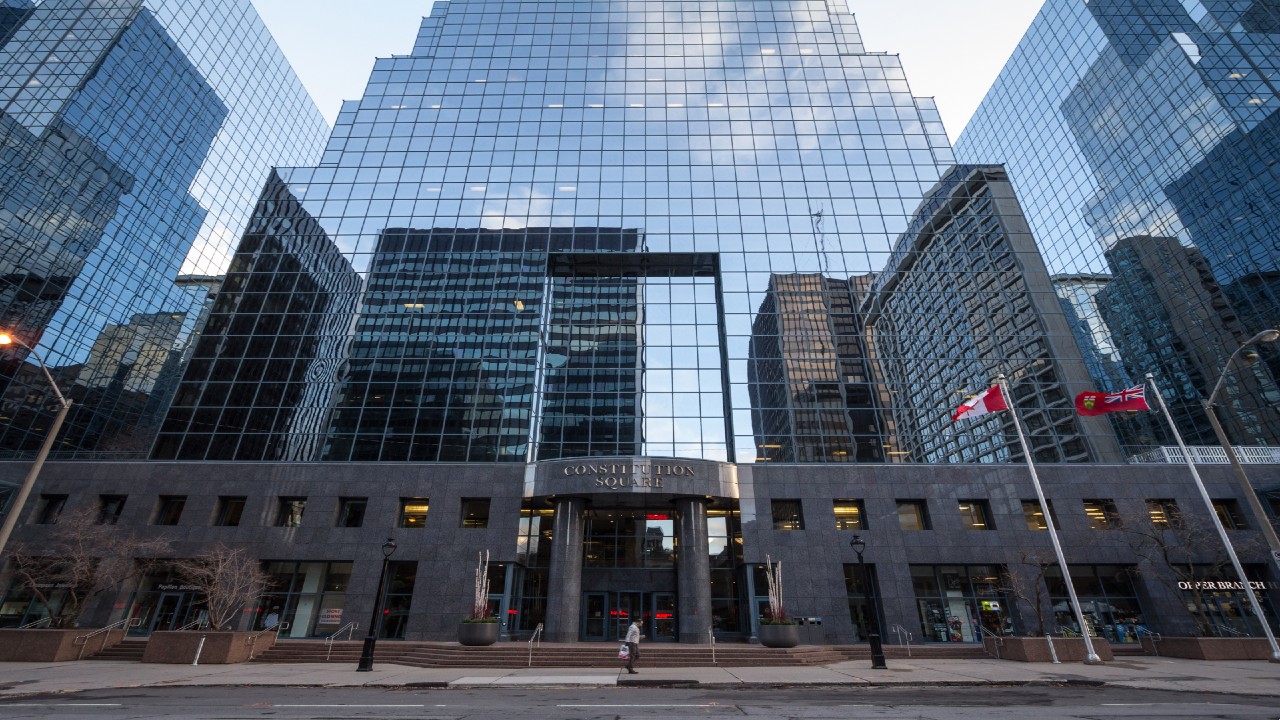
Constitution Square and highrises at 150 and 160 Elgin St. are among the marquee downtown office buildings that could house a new multinational defence bank should Ottawa be chosen as its headquarters, a prominent commercial real estate firm says. The federal government announced earlier this year that Canada would host the institution, dubbed the Defence, […]
Get Instant Access to This Article
Become an Ottawa Business Journal Insider and get immediate access to all of our Insider-only content and much more.
Constitution Square and highrises at 150 and 160 Elgin St. are among the marquee downtown office buildings that could house a new multinational defence bank should Ottawa be chosen as its headquarters, a prominent commercial real estate firm says.
The federal government announced earlier this year that Canada would host the institution, dubbed the Defence, Security and Resilience Bank (DSRB). Expected to be in operation by 2027, the bank would provide “long-term, low-cost financing for defence, security, and resilience initiatives” for defence projects by NATO members and allies, in a bid to help small and medium-sized businesses and member governments “address critical financing gaps,” the federal government said in a news release in April.
A number of major urban areas, including Ottawa-Gatineau, Toronto, Montreal, Vancouver and Halifax, are vying to host the DSRB. A Department of Finance spokesperson told OBJ Monday that details on the selection process and the bank’s location would be revealed “in due course.”
Shawn Hamilton, a principal at Proveras Commercial Realty, says he sees Ottawa, Toronto and Montreal as the “tier-one” contenders for the bank, which federal officials say could eventually create up to 3,500 new jobs.
The veteran commercial real estate broker and his partners at Proveras compiled an inventory of buildings in downtown Ottawa with “significant blocks” of vacant space that could be suitable for hosting the DSRB.
Hamilton said Ottawa’s core now has vacant chunks of space in a “wide range of towers” as a result of federal government downsizing, adding those buildings could easily accommodate “a few thousand people” in various locations.
“We have availability of real estate. We have availability of people. We can create a long-term growth plan embedded within the government system in Ottawa and our real estate is a fraction of the price of what real estate is in Toronto.”
Among the office complexes Proveras identifies as potential locations for the DSRB are the newest of Constitution Square’s three towers at 340 Albert St. and a 188,000-square-foot highrise at nearby 250 Albert St.
Hamilton notes that both properties currently have vacancy rates north of 40 per cent and both are owned by TD Asset Management — whose parent company, the Toronto-Dominion Bank, is one of the key backers of the DSRB.
A few blocks east, Morguard’s Performance Court at 150 Elgin St. has several vacant floors that were formerly occupied by Shopify, Proveras says. The Groupe Mach-owned office tower next door at 160 Elgin St. is “fairly fluid from a vacancy viewpoint with Bell Canada looking to sublease space,” the company notes, adding “several other large-scale tenancies” that are expiring in 2030 and 2031 could provide “more potential space over time.”
L'Esplanade Laurier another candidate?
Other properties on Proveras’s list include a 215,000-square-foot Morguard-owned tower at 333 Laurier Ave. W. that was previously occupied by the federal government and is now two-thirds vacant; Minto Place, which currently has five empty floors covering a total of about 100,000 square feet; Telus’s former Ottawa headquarters at 215 Slater St., which includes more than 57,000 square feet of vacant space; Manulife’s building at 55 Metcalfe St., which has about 56,000 square feet of vacancy; and the World Exchange Plaza at 45 O’Connor St., which is owned by QuadReal Property Group and RBC and has about 50,000 square feet of empty space.
Proveras also suggests that aging downtown properties that are owned by the federal government and currently earmarked for disposal, such as 50-year-old L’Esplanade Laurier, could be repurposed for the DSRB.
“Obviously, the building would need some work, some reconditioning, some repositioning, but if you’re looking at bricks and mortar, it creates a pathway,” Hamilton says of L’Esplanade Laurier, a one-million-square-foot complex consisting of two 23-storey towers.
“Start small with some buildings that your partners own, like 250 Albert and Constitution Square, and then plan to create your global headquarters using the bones of L’Esplanade Laurier. That creates an interesting narrative. It solves the government’s problem of having to dispose of what I’m going to call otherwise white-elephant assets.”
Hamilton also suggests that setting up the bank in its own backyard would allow the federal government to “save face” amid its ongoing campaign to shed about 30,000 jobs from its payroll over the next several years.
“You are creating an employment pathway as well, whereby your downsized civil service now has an opportunity to backfill roles in the defence bank,” he says. “Having a large, what I would call a quasi-private-sector tenant that’s in a growth-oriented business might create some form of further exit strategy for the federal government.”
Municipal leaders, including Ottawa Mayor Mark Sutcliffe and Gatineau Mayor Maude Marquis-Bissonnette, have been pushing for the bank to be headquartered in the National Capital Region, arguing the presence of the Department of National Defence and about 130 embassies and high commissions makes Ottawa-Gatineau a natural destination for the DSRB.
Proveras is urging municipal officials to start laying the groundwork for the bank to set up in Ottawa-Gatineau. It says the cities “should engage early with federal stakeholders and Defence Bank leadership to communicate Ottawa’s interest” and work with real estate experts to compile a short list of “downtown buildings capable of accommodating the bank’s initial and future growth requirements, including opportunities for phased expansion.”
The firm says the cities also need to keep a close eye on leasing activity, especially as the federal government appears poised to start adding to its office footprint again after years of downsizing, and “be prepared to accelerate discussions with the Defence Bank should signs of tightening conditions emerge.”
“Ottawa’s downtown office market is at a rare inflection point that aligns exceptionally well with the operational, reputational, and economic needs of a national institution such as the Defence, Security and Resilience Bank,” it says.
“A combination of elevated vacancy, unprecedented availability of large contiguous Class ‘A’ office blocks, historically competitive rental economics, and a growing policy emphasis on defence creates a narrow but compelling window for strategic action.”
City of Ottawa officials did not immediately respond when asked if there are plans to work with the DSRB to pinpoint sites for a headquarters.
Hamilton says it’s never too early to start thinking about potential homes for the bank.
“If I were the city, I would be starting to cobble together, on top of the synergistic story, the bricks-and-mortar story.”