Andrew Reeves can still recall his reaction to seeing the heritage buildings at Confederation Heights when he moved to Ottawa decades ago. “I remember just looking at them in awe,” says Reeves, who studied architecture at Carleton University and launched Linebox Studio in Ottawa in 2007. “They’re beautiful, international-style buildings, properly designed, properly built. There’s […]
Get Instant Access to This Article
Become an Ottawa Business Journal Insider and get immediate access to all of our Insider-only content and much more.
Andrew Reeves can still recall his reaction to seeing the heritage buildings at Confederation Heights when he moved to Ottawa decades ago.
“I remember just looking at them in awe,” says Reeves, who studied architecture at Carleton University and launched Linebox Studio in Ottawa in 2007. “They’re beautiful, international-style buildings, properly designed, properly built. There’s not a doubt in my mind that this is something we need to fight to keep for architectural preservation.”
The history of Confederation Heights
Located just south of Carleton and east of Hog’s Back Park, Confederation Heights has been home to a federal office campus for more than 60 years.
Earlier this year, the National Capital Commission approved the disposal of seven federal properties, including two heritage buildings, at the 120-acre area. The organization’s board also gave the green light to a master plan aimed at “redeveloping the site into a thriving, connected and sustainable mixed-use community,” in the words of NCC senior planner Marion Gale.
The planned redevelopment of Confederation Heights is part of the federal government’s push to trim its real estate portfolio by selling or transferring aging, surplus buildings in the National Capital Region to private developers.
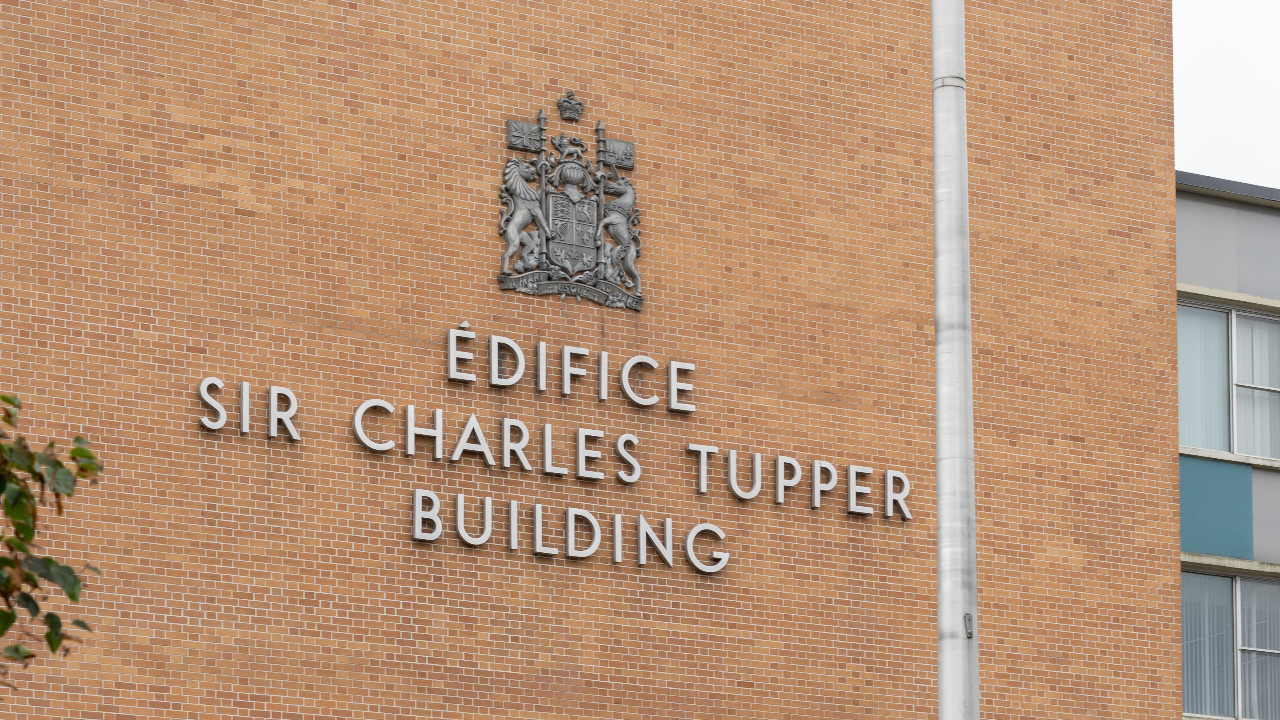
Public Services and Procurement Canada, which manages much of the federal government’s property, put several Ottawa office buildings — including the former CBC headquarters at 1500 Bronson Ave. in Confederation Heights and the nearby Sir Charles Tupper Building on Riverside Drive — on its list of surplus properties earmarked for disposal in 2023.
The NCC approved the Sir Charles Tupper Building for disposal last fall. In June, the organization gave the go-ahead for two heritage buildings at Confederation Heights, 1500 Bronson and the Taxation Data Centre at 875 Heron Rd., to be offloaded.
The Canada Lands Company, a federal Crown corporation responsible for managing property on the federal government’s behalf, was originally responsible for overseeing the redevelopment of Confederation Heights. The process is now being run by Build Canada Homes, a new federal Crown corporation that assumed control of CLC’s land holdings and developments in August in a bid to streamline construction of affordable housing on government lands.
A Build Canada Homes spokesperson told OBJ the Confederation Heights master plan calls for “a minimum of 8,500” housing units, “with affordable housing reflected across the planned area.”
The NCC said the plan would allow buildings of between three and 40 storeys on the site, along with green space and a network of trails for pedestrians and cyclists. Gale said the blueprint includes the possibility for the “adaptive reuse” of 1500 Bronson, 875 Heron Rd. and the Sir Charles Tupper Building, “or a portion thereof.”
In August, a BCH spokesperson said “no decisions have been made regarding the future use of the heritage buildings, including whether they may be converted for residential use.”
Buildings with potential
Reeves and other Ottawa entrepreneurs involved in land development believe all three buildings have the potential to be repurposed.
“Maybe these buildings don’t have to be just office-to-residential,” says Reeves, the lead architect on two major conversion projects in downtown Ottawa. “Maybe a couple of floors are a school, a couple of floors are a daycare. There could be a whole community-type approach to this. There’s a massive opportunity.”
Anthony Bassi is also a keen proponent of letting the private sector find new uses for the heritage buildings at Confederation Heights.
Bassi is director of business development at Ottawa-based JPBA Developments, which has worked with several local firms, including District Realty and Paramount Properties, on office-to-residential conversions.
He calls Confederation Heights the ideal spot for a “hybrid” development featuring a mix of multi-residential units in former office buildings alongside new townhomes. Located just off Bronson Avenue, the area is also near public transit hubs at Billings Bridge and Mooney’s Bay, making it easily accessible to Carleton University, the airport and other amenities, Bassi explains.
“I always had it on my radar,” he adds. “This would be an absolutely incredible conversion (site). It’s perfect for residential or even retail.”
Behind the walls
Still, Bassi has been involved in enough conversion projects to know they can open a Pandora’s box of headaches for developers.
According to the Treasury Board’s property directory, the former CBC headquarters, which opened in 1960, and 875 Heron Rd., which opened in 1974, are in “critical” condition.
“Unfortunately, it’s the lowest of the low of the Treasury Board’s four grades,” Bassi explains. “That’s asbestos, that’s PCBs, that’s unknown (materials) behind the walls.”
Until demolition of the inside of the buildings begins, he cautions, “any cost estimate (for a conversion) is a guess or a rough estimate.”
Bassi knows whereof he speaks. His firm worked on District Realty’s recently completed office-to-residential conversion at 200 Elgin St., where the blueprints didn’t always reflect what was really in the building’s guts, he says.
“We started tearing down the walls and we go, ‘That pipe’s not in the drawings. That beam’s not in the drawings,’” he recalls. “We got pretty lucky that it was a successful conversion. It wasn’t anything too drastic. But for these other buildings, who knows what’s in them? That’s just where you hope the drawings are accurate. You’re opening a box of surprises when you open that front door.”
The buildings’ heritage status could also throw a wrench into a developer’s plans, Bassi and other experts say.
Conversions typically require a complete overhaul of a building’s interior to upgrade plumbing, heating and other infrastructure to accommodate housing units and meet modern safety and energy-efficiency standards. Also, new windows and doors often must be added.
But the Ontario Heritage Act limits how much a protected building’s facade can be altered, Bassi notes, meaning developers might not have as much flexibility in designing units as they would with a non-heritage structure.
“Handled early, heritage becomes the building's identity and selling point,” he says in a briefing report on Confederation Heights. “Handled late, it becomes a redesign.”
Kelly Rhodenizer, senior vice-president of development at Colonnade BridgePort, lives near Confederation Heights and describes the area as “a great spot for redevelopment.”
But she says anyone thinking of repurposing a heritage site needs to look long and hard at the costs involved.
Colonnade BridgePort recently redeveloped a heritage building on Argyle Avenue into an apartment complex. In order to preserve the facade, the company had to painstakingly take it apart brick by brick, label the stones and store them off-site until they could be put back together. Some bricks broke and had to be repaired, adding to the company’s costs.
When the structure was rebuilt, some of the new windows didn’t fit properly, meaning replacements had to be ordered.
“The extras that I’ve had to pay that nobody anticipated to deal with the heritage (aspect) is frustrating, to be honest,” Rhodenizer says. “It’s eaten my entire contingency (fund). The complexities of the building and managing the heritage piece have been extremely challenging. There were a lot of things that I don’t think we could have planned for.”
Lots of possibilities
Colonnade BridgePort has yet to try its hand at a conversion, and the company already has plenty of projects to keep it busy. Still, Rhodenizer says she hopes someone gives Confederation Heights a shot, pointing to the Sir Charles Tupper Building as the most obvious candidate to be redeveloped due to its rectangular floorplate that lends itself to residential units.
“We have a pretty deep pipeline right now, so I’m not looking at new assets,” she says. “But if I was actively looking for new pieces, it would definitely be a site that I would be interested in exploring.”
Bassi also suggested the Sir Charles Tupper Building, which opened in 1960 as the headquarters for the Department of Public Works, would be “the most natural conversion” because of its shape.
“I’d be surprised if it doesn’t (become) one later on,” he says. “The other two (buildings) are a little more difficult, but still definitely possible.”
Bassi and Rhodenizer say the former CBC headquarters at 1500 Bronson Ave., formerly known as the Edward Drake Building, stands out as a particularly intriguing site.
The NCC’s Gale called the distinctive structure the “jewel” of Confederation Heights, saying it earned its heritage designation partly because it’s “one of the best examples of modern Canadian architecture.” Bassi and Rhodenizer agree.
“That looks like a very fun project to take on if you want to do a residential conversion,” Bassi says. “But how the heck are you going to make that floorplan work? Maybe it’s not the best residential (project). Maybe it’s something else. That’s definitely not a building you want to tear down. You want to make the best use of it.”
Rhodenizer also has a strong opinion about what should become of the public broadcaster’s former head office.
“I would leave that one as an office building,” she says. “It’s such a cool building — the lighting and the location. I think it would be a great office for a company that wanted to be inside the urban boundary. It’s right on the LRT line, it’s right on Heron.”
Whether the buildings remain offices, get converted to multiresidential complexes or are reimagined in some other way, Confederation Heights will likely garner plenty of attention from developers and architects in the years ahead, Reeves says.
“We’re watching those (buildings) with laser eyes,” he says. “I’d definitely love to put our foot forward to be a part of it. It’s not just about how old the buildings are, but the architectural significance of these buildings. They are buildings that should not be taken lightly and allowed to be torn down. These buildings need to be respected and maintained.”