“If you look at the world at night from space and you see everything lit up, that is not our market,” says Mac Brown, one of the visionaries behind a new technology that harvests electricity from slow-moving water. “Everything in the dark is our market.” Brown’s latest enterprise is DynoRotor, which operates under the name […]
Already a Subscriber? Log in
Get Instant Access to This Article
Become an Ottawa Business Journal Insider and get immediate access to all of our Insider-only content and much more.
“If you look at the world at night from space and you see everything lit up, that is not our market,” says Mac Brown, one of the visionaries behind a new technology that harvests electricity from slow-moving water. “Everything in the dark is our market.”
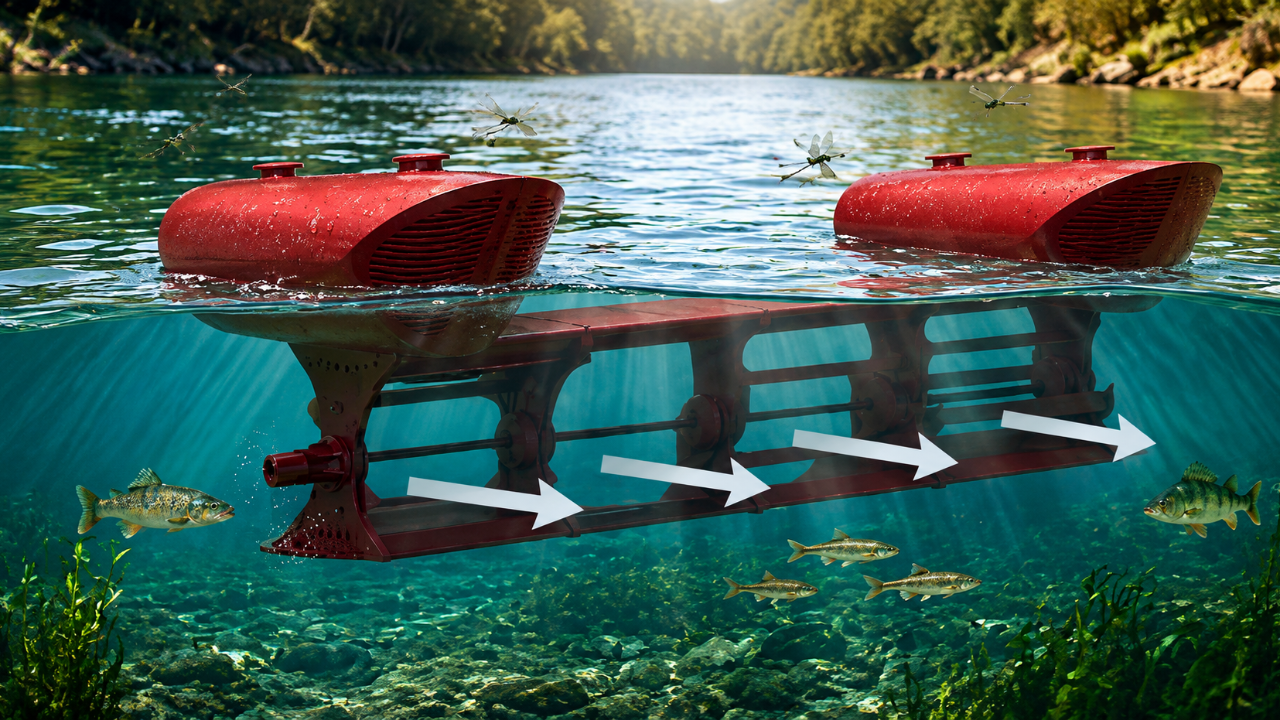
Brown’s latest enterprise is DynoRotor, which operates under the name AquaGen. It aims to disrupt the diesel generator market by replacing off-grid fuel setups with continuous micro-hydroelectricity produced by lightweight, carbon-fibre energy generators placed in slow-moving rivers.
According to Brown, the company’s technology recognizes that millions of people and businesses across the globe rely on noisy and expensive diesel generators for power. At the same time, transportation of fuel and delivery costs add more expense. Fuel logistics during military deployments are especially vulnerable to disruption.
“In many off-grid locations, diesel-generated electricity can cost approximately $1 per kWh or more,” Brown tells OBJ. “AquaGen projects that our system can produce electricity for around 10 cents per kWh, offering the potential for significant cost savings while reducing emissions and dependence on diesel fuel.”
In his latest initiative, Brown draws upon decades of experience and leadership in the Ottawa tech community. His leadership roles include founding and serving as CEO of Rebel.com, and founding Hardware Canada Computer that built systems for Sun Microsystems and Nortel.
He’s no stranger to clean-tech, having served as CEO of the high-altitude wind turbine venture Magenn Power. He believes that run-of-river hydrokinetic technology has the potential to become a primary renewable power source because it generates predictable energy day and night without requiring dams or flooded valleys.
With AquaGen, he’s joined forces with serial entrepreneur Chris Napior, who brings three decades of experience in real estate and government consulting and has worked with NASA, Tesla, Siemens and the U.S. Department of Defense.
The company was founded in Ottawa in 2022 and brings together experts and engineers from as far away as the U.K. Experts from the Canadian Hydro Kinetic Turbine Testing Centre in Manitoba also contributed.
The key failure of most hydrokinetic devices is deployment logistics, Brown says.
“The problem was always ease of deployment. Most run-of-river systems have higher power output, they are very heavy and need a crane or heavy equipment to deploy. AquaGen decided to design portable, rapid deployment low-cost systems that can be deployed by one or two people in a matter of hours.”
The resulting technology, the AquaGen Barracuda, is engineered as a micro-hydro turbine capable of generating energy in slow water. It operates continuously and a single unit can generate 4.2 kilowatts of continuous power, or 100 kilowatt hours a day.
The engineering team achieved 66 per cent weight reduction from the first model to the Barracuda. The carbon-fibre frame weighs only 50 kg.
“The technology is currently at TRL 7 (Technology Readiness Level), meaning a full-scale engineering prototype has been validated in an operational environment,” says Brown, who describes the Barracuda as “civilization in a box.” He adds, “The company has transitioned from R&D to commercialization and production.”
AquaGen has secured more than $2 million in grant funding and has multiple patents pending. The company has also secured commercial letters of intent with partners to deploy.
Meanwhile, the system has won awards and earned endorsements from around the world. The Barracuda won the Barclays Innovation in Climate Tech Award and was recognized by NATO’s Defence Innovation Accelerator. One of its first successful deployments was in Halik Reef at Gili Trawangan, Indonesia, where AquaGen partnered with the Gili Eco Trust to power bio-rock coral reef restoration.
The company is currently seeking investors for a capital raise of US$5 million, while continuing to build its global distribution network.
“We’re actively seeking accredited investors and strategic partners aimed at funding large-scale logistics and market penetration,” Napior says. “The company must now move from controlled initial prototype production to partnerships with experienced, scaled manufacturers.”