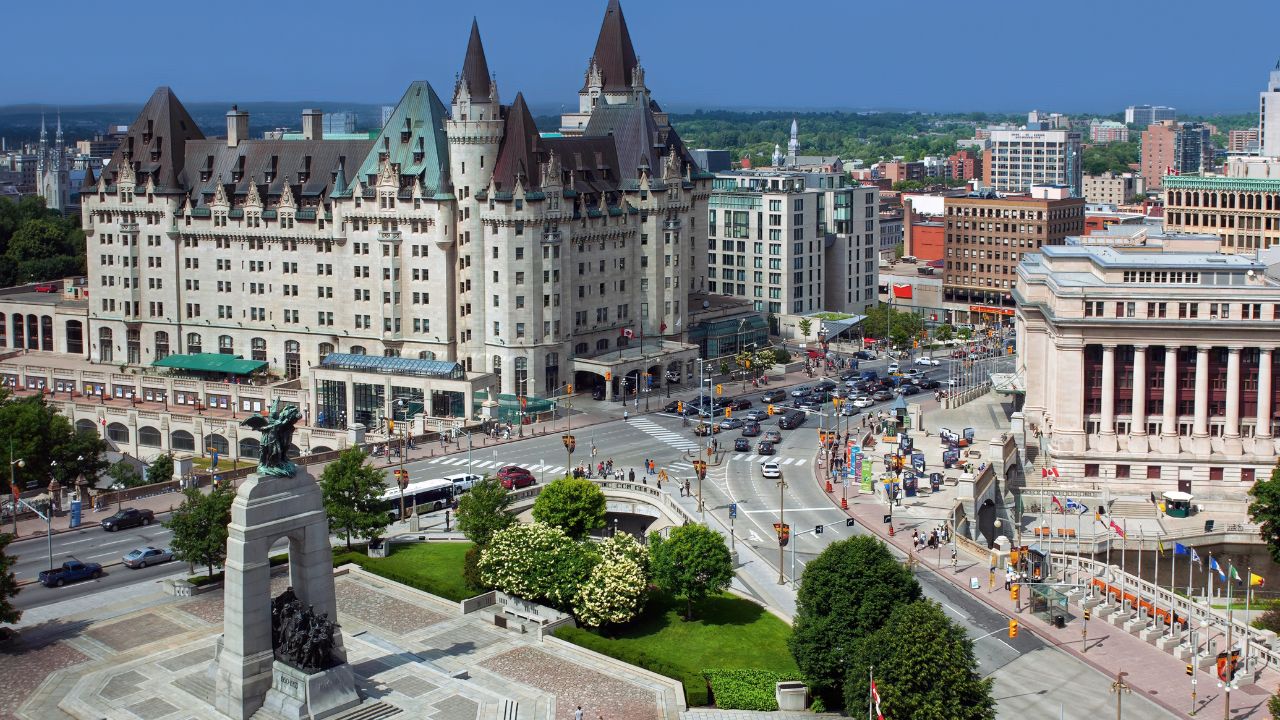
It’s been nearly 24 years since Ottawa amalgamated on Jan. 1, 2001, which means the city as we know it today is in its “young adulthood,” according to Greg Jodouin.
Get Instant Access to This Article
Become an Ottawa Business Journal Insider and get immediate access to all of our Insider-only content and much more.
It’s been nearly 24 years since Ottawa amalgamated on Jan. 1, 2001, which means the city as we know it today is in its “young adulthood,” according to Greg Jodouin.
The founder and president of PACE Public Affairs and Community Engagement, Jodouin has been advocating for local city-building projects on both sides of the river since 2002, just one year after Ottawa’s new boundaries came into effect.
PACE develops and implements stakeholder and community engagement programs, including strategic counsel, public affairs, communications, and project management services. It has played a role in many of the region’s most important projects, including The Ottawa Hospital’s new Civic Campus, the Ottawa Central Library, and the City of Ottawa’s Transportation Master Plan, which laid the foundation for the light rail transit project.
Amalgamation was a tumultuous time for the city, Jodouin says, but also one filled with opportunity – much like the situation it’s in today.
“The amalgamation was very, very confusing for people within the city and within the municipal government,” he told OBJ. “It was 11 municipalities and 11 cultures coming into one. Right now, I’m hearing a lot about city building, but 20 years ago, there was no notion of what it meant to be a big city. You know that expression, greater than the sum of its parts? We were just a whole bunch of parts.”
Almost a quarter-century removed from that period, Jodouin said the city, much like any young adult, has started to find its footing, and its identity. But the process is still plenty messy.
“In terms of the city culture and things happening in Ottawa, we’re really on the cusp of some real transformation. There’s a lot of really dynamic and exciting things happening, but it’s still kind of happening – I don’t want to say haphazardly, but almost ad hoc. Something pops up and we’ll get interested, it happens or it doesn’t, but it isn’t under some type of an overarching vision,” he said.
“That’s one of the biggest challenges in our current state of evolution. As a city, we don’t have a definition of what it is to be a mature city. We don’t know if we’re a capital city.”
Ottawa already has some key ingredients
City building is a relatively new concept for Ottawa, and one that has gained momentum in recent years as local stakeholders push to address issues heightened during the COVID-19 pandemic.
It’s something Jodouin has worked on throughout his career.
“There’s a science to city building,” he said. “There’s ingredients that go into what you’re building. I think, post-COVID, we’ve been forced to rethink those things.”
There are some ingredients, he said, that Ottawa already has: “A good international airport, which we do have. Academic institutions are another one. Good governance, good public service. Cultural diversity and representation. Prosperity is an important ingredient too, so that everybody can participate.”
But there are other key elements that he said the city still needs to reach its full potential.
The downtown core is one area that is missing key pieces. According to Jodouin, successful metropolitan areas, especially other G7 capitals, tend to have much higher density and higher residential populations, which kickstart retail and restaurants, helping to create activity and vibrancy.
There is also a need for activities, which often come from anchor destinations, something Ottawa could gain in the coming decade if the proposed LeBreton Flats arena project moves forward.
He added that it’s not just about downtown.
“We’re 80 per cent rural,” he said. “We have a huge agricultural economy and we’re co-dependent for a whole bunch of reasons. I think that ties in again to what I was saying about a lack of vision for Ottawa. We need a vision that isn’t just about the downtown. We need a vision that looks comprehensively at the whole.”
Lesson to be learned from post-amalgamation period
Just because city building is top of mind these days, doesn’t mean it’s easy to achieve.
Jodouin said one thing he’s noticed in conversations with stakeholders is that leaders of these efforts are not as effective at community engagement as they used to be.
“People are afraid, I think, to do community engagement,” he said. “Decision-makers are afraid of being boxed in by what the community tells them. They’re afraid they’re going to lose decision-making power. I think that’s a natural concern, but community engagement done well, in my experience, leads to better outcomes. I think that’s something people skip sometimes. But if I look at the work we do, there is a much better outcome because of public engagement.”
Jodouin said periods of upheaval also bring up lots of opportunities, if stakeholders are willing to take them. In the early 2000s, for example, he said the amalgamation of multiple smaller municipalities created a significant budget.
“It went from municipalities having really, really tiny budgets to a city corporation with a multibillion-dollar budget,” he said. “That allowed it to tackle much bigger infrastructure projects like light rail. The first light rail pilot project that we did was probably the most significant thing the city did as a newly amalgamated city and having that budget allowed it to do that.”
While Ottawa’s budget is much tighter these days, he said the emptying of the downtown core and potential for redevelopment post-COVID puts the city in another transformational period.
To do that, he said stakeholders can learn from the successes of the post-amalgamation period, even if they don’t have the same cash as they did back then.
“I think that the projects where the municipality worked well with the province and the feds and the NCC were very successful,” he said. “And I think that has to be replicated now. It goes back to my notion of, are we a capital city or not? We have a very town-versus-Crown relationship in Ottawa and I think we have to flip that to be town and Crown.”