Stéphane Brutus (left), dean of the Telfer School of Management at the University of Ottawa and Devin Fraser, assistant professor and academic director of MBA programs at the Sprott School of Business at Carleton University.
Get Our Email Newsletter Local news about the companies, people and issues that impact business in Ottawa and beyond delivered to your email inbox.
Amid financial pressures, societal shifts and changing industry requirements, the past few years have forced Ottawa’s business schools to reinvent themselves to respond to new market demands.
Amid financial pressures, societal shifts and changing industry requirements, the past few years have forced Ottawa’s business schools to reinvent themselves to respond to new market demands. Across the province, post-secondary institutions have been under pressure, from Laurentian University’s insolvency in 2021 to multimillion-dollar deficits at universities such as Waterloo and Wilfrid Laurier to Algonquin College making program cuts amid financial constraints. According to Devin Fraser at Carleton University’s Sprott School of Business, business schools haven’t been immune to the challenges. Policy changes at the federal level, such as caps on international student enrolment, and at the provincial level, such as the 2019 tuition freeze in Ontario, have been major stressors for all institutions. Between 2019 and 2026, Fraser said, inflation raised costs while funding stagnated. “The financial issues are there and it’s been challenging, I think, for Sprott to figure, how do we work?” he told OBJ. “How do we do the same or more with less?”As a result, Ottawa’s business schools are looking for new ways to approach their target markets. Sprott is shifting to an online-first approach, while the Telfer School of Management at the University of Ottawa is focusing on experiential learning. The province’s first independent, not-for-profit institution, International Business University, is targeting industries most in need of talent. Stéphane Brutus, dean at the Telfer business school, said the current moment is both “exciting and scary.” “The big, contextual movements that are affecting society right now — be it climate change, AI, housing, health care — all these big-ticket items that are affecting everybody have a significant element that pertains to the business schools," he said. “Business schools own a piece of all of these issues. That increases our responsibility to be an actor in trying to remedy these issues. I feel like our role is more visible and more important than ever.”
Experiential learning as key to success in business
Of the three Ottawa business schools — Sprott, Telfer and IBU — Telfer is sticking closest to the traditional graduate education model. According to Brutus, business schools typically focus on four core competencies, or the “four Cs,” as he calls them: communication, critical thinking, creativity and collaboration. It’s these skills that are needed by leaders across all disciplines and sectors, he said. But to develop those skills, Brutus said students should be learning in-person but also getting out of the classroom. “We need to grow these competencies and we have one or two years for the master’s programs,” he said. “How we maximize class time with that learner to develop those competencies is with experiential learning: learning by doing. You don’t learn critical thinking necessarily by reading a book. The way you develop the skillset is by practising in an environment that is as close to the real world as possible.”While the core of the program remains the same, Brutus said adjustments over the past few years have been made with growth in mind. “We’re not reinventing the wheel here,” he said. “(Experiential learning) is nothing new. Co-op is nothing new. However, we needed to find a way to scale. This type of hands-on learning is easy with two or three students, but we want to do it with 5,000 students. The system we’re building now, we’re doing it at scale.” In addition to its MBA program, Telfer offers a variety of specialized graduate programs, including a master of health administration and a master of science in management. It also offers two executive master's programs, in health administration and business administration. Brutus said these programs target mid- to senior-level professionals, allowing them to learn and apply leadership skills through hands-on classroom experience. For graduate students across the board, he said the feedback loop of in-person learning is essential. “You present in front of a live audience with little time to prepare with a real audience that is going to ask you tough questions,” said Brutus. “It’s going to be tough. It may be uncomfortable. You may fail, you may bomb. And then what? Then you debrief and reflect. You’re trying it out in a live setting, putting yourself in a vulnerable state in a learning environment, so it’s safe. You get out there and you don’t need to be afraid to fail.”Though adjustments have been made over the years, driven in large part by the pandemic and technological changes like artificial intelligence, Brutus said it’s important to keep up the habits that have made Telfer’s graduates successful. The biggest change, he said, has been the students themselves, who are more reticent to in-person learning. “The learner oftentimes doesn’t know they want it; they’re almost afraid of it,” he said. “Especially the new, contemporary learner who’s been through the pandemic, whose social development is different from the learner of 20 years ago. That learner is more apprehensive, so you need to meet him or her where they are.”Despite initial skepticism, Brutus said most of the school’s younger students have embraced the experiential learning model.“Once they touch it and they get the feedback, they get out there, they see it’s not the end of the world,” he said. “It’s just a matter of getting them to the first day, that first experience. Maybe not right away, but at the end of their first year, they’re like, this is great. They buy into it pretty quickly.”
Virtual learning taps into underserved markets
Carleton University’s Sprott School of Business has been watching students’ needs change over the past few years, a trend compounded by the pandemic. Fraser, an associate professor and director of the school’s MBA programs, told OBJ that more students are looking for programs that fit around their work and family lives. As a result, the school has shifted its programming. “At the graduate level, sometimes continuing education can be a lot more challenging for people,” Fraser said. “The traditional model where students attend school full-time with no other obligations doesn’t really reflect the reality of most people who want or need graduate education. So we felt that the institutions that are going to adapt successfully are the ones that meet people where they are.”The changes started prior to the pandemic, when the school launched its Professional MBA in 2019. According to Fraser, the program was designed for students with significant work experience, offering more flexibility than a typical MBA. Fraser describes the format as “highly condensed,” with students attending two full days of classes on Fridays and Saturdays twice a month for 16 months. “Our classes are very small, around 30 students,” he said. “The network is super-important. It’s not the traditional lecture and test. It’s a very different way of thinking about education. And it’s really drawing out the different expertise from everyone in the room.”A few years later, Sprott launched its fully online MBA program, which offers similar flexibility but can be completed anywhere in the country. “We’ve been seeing super-strong interest across Canada,” Fraser said. “The majority of our students are from the GTA, but we also see a lot of students from communities that may not have a local university. They might be in a small community somewhere, and they tell us, ‘If it wasn’t for this online MBA, there’s no way I’d be able to do education.’ So we’re really proud that we’re able to open up that accessibility.”In the three years since the program launched, Fraser said more than 1,000 students have started it, with the first cohort graduating this year. The success led Sprott to move away from its traditional weekday program starting this fall. “We won’t be taking applications into our original program,” he said. “We are shifting to that Professional MBA format as our flagship in-person option, alongside the online MBA.”Plus, Fraser said the school is rethinking the undergraduate level and working with partners to introduce specialized courses in response to employer needs. “I think the universities that will thrive through this period of disruption are those willing to ask those hard questions about who they’re serving and why they’re serving those people,” he said. “We’ve built programs that are removing structural barriers that have historically kept working adults and families out of graduate education. And the strong and growing interest we’re seeing from across Canada tells us that approach is working on the graduate side, and on the undergraduate side, we’re diving in.”
Specialized, tailored courses created quickly
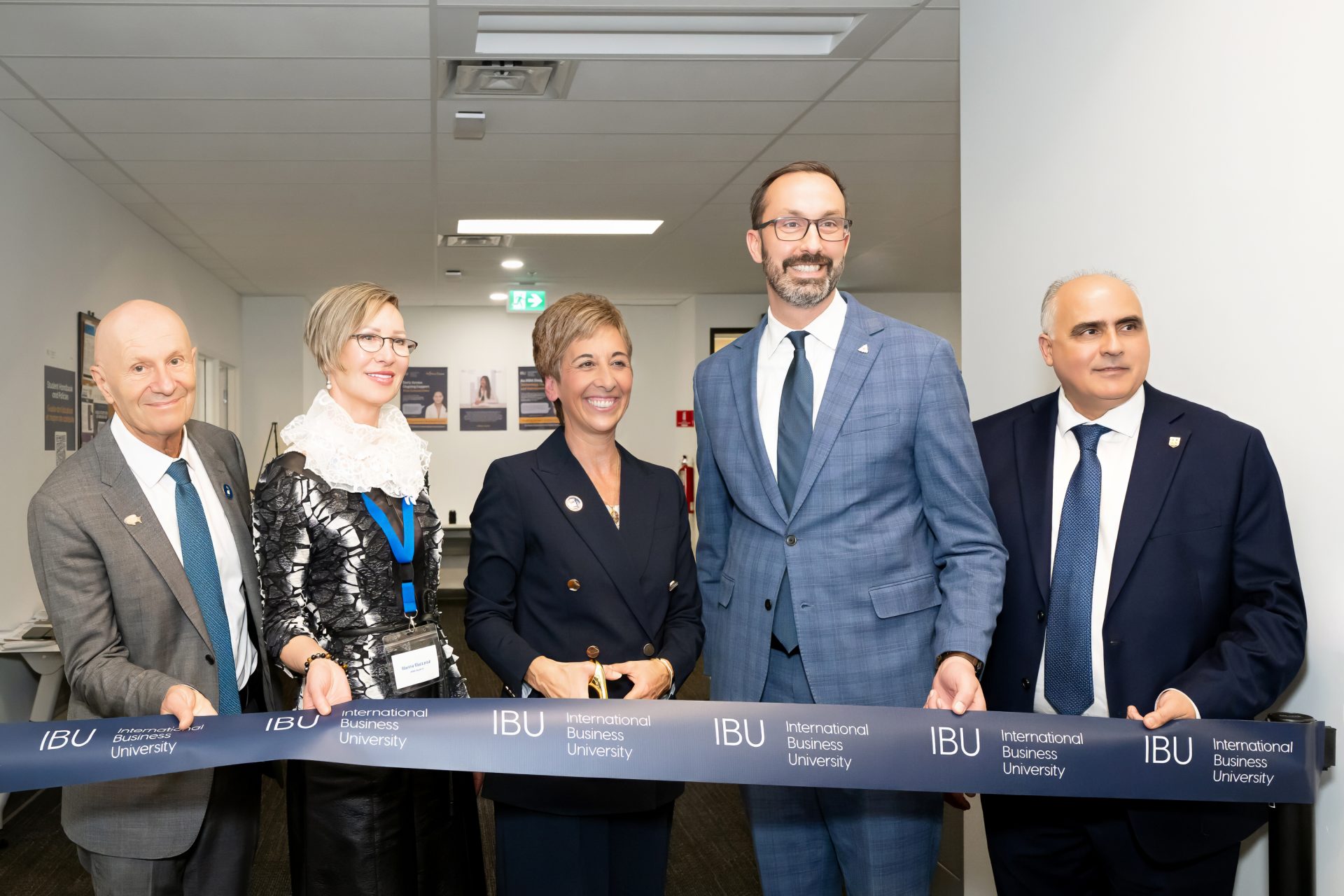
IBU president and vice-chancellor Dr. Asima Vezina (centre), with (from left) Dr. Alastair Summerlee (IBU Ottawa), Marina MacLeod (IBU Ottawa MBA student), Nolan Quinn (Ministry of Colleges, Universities, Research Excellence and Security), and MPP George Darouze (Carleton) at the grand opening of the International Business University Ottawa Campus, 979 Bank Street, Ottawa, April 30, 2026. Photo by Tetiana Dodonova.International Business University opened its Ottawa campus in April. Unlike Telfer and Sprott, IBU is a private, non-profit university. Planning began in 2015 and the school launched in 2020, with its founding campus in downtown Toronto. “We aren’t really interested in replicating what other business schools are doing,” president and vice-chancellor Asima Vezina told OBJ. “I think we want to complement them. We want to look at their strengths and contributions and say, okay, where do we carve a space out that makes sense for the city?”In Ottawa, Vezina said the school is starting small, launching with an initial cohort of 12 students. According to Vezina, IBU’s Toronto campus started with an inaugural class of the same size and now averages 30 students per cohort. Vezina said the program is of particular interest to entrepreneurs, in part because of the school’s MBA in technology, innovation and entrepreneurship. “I walked into the room and it’s a bunch of awesome entrepreneurs from Ottawa who are looking at this program and really challenging us,” Vezina said of her first local event. “They’re like, ‘We don’t want this kind of (traditional program), we want something new.’ We had an amazing conversation and three of them signed up within the week.”While its Toronto campus has become known for its MBA in finance, Vezina said the school sees other opportunities in Ottawa due to the strength of several local sectors. “Ottawa made perfect sense,” said Vezina. “The tech sector there is intriguing to us. There’s a lot of demand right now for graduates who have both business leadership backgrounds, but also tech skills to drive transformation forward in an ethical way. We’re talking with various community leaders and companies and we really felt quite welcomed into the conversation and the space. I think there is genuine excitement about what we’re talking about offering to the community.”In addition to the entrepreneurship MBA, IBU offers an MBA in global business management in Ottawa. Vezina said the school is most interested in developing courses and specialized programs that target industries in need of talent. For example, it’s in the process of gaining approval from the Postsecondary Education Quality Assessment Board (PEQAB) to offer a master of science in artificial intelligence. The health care and energy sectors are also areas of interest. In the short term, she said, defence is a major target. “We’re not hearing (that the defence sector) immediately wants an MBA with specialization in defence,” she said. “But they need courses now. We’re looking at very short-term solutions, where it might be six-week courses that can build on each other.”The advantage IBU has as a non-profit, she added, is that it doesn’t rely on provincial funding and can develop programming faster than public universities. “In two months, we can have something on the market,” she said. “That’s how fast and nimble we can move, as long as we have the professionals to teach it.” IBU is also looking at opportunities to partner with local business schools, as well as other academic institutions in the area. Earlier this month, the school announced it had signed a memorandum of understanding with Collège La Cité. Vezina said the goal is to develop an MBA program delivered in French. “I think we’re positioned to be innovators,” she said. “I think we’re really positioned to define what a next-generation university can look like and to be a really significant part of the Ottawa talent pipeline. We’re quite committed to doing so.”