
The University of Ottawa is the engine connecting discovery, commercialization, and improved patient care in the life sciences sector. Beyond its research output, uOttawa’s distinctive strength is its ability to bring together hospitals, researchers, entrepreneurs, investors, and government partners so that breakthroughs made anywhere in the network can maximize real-world impact.
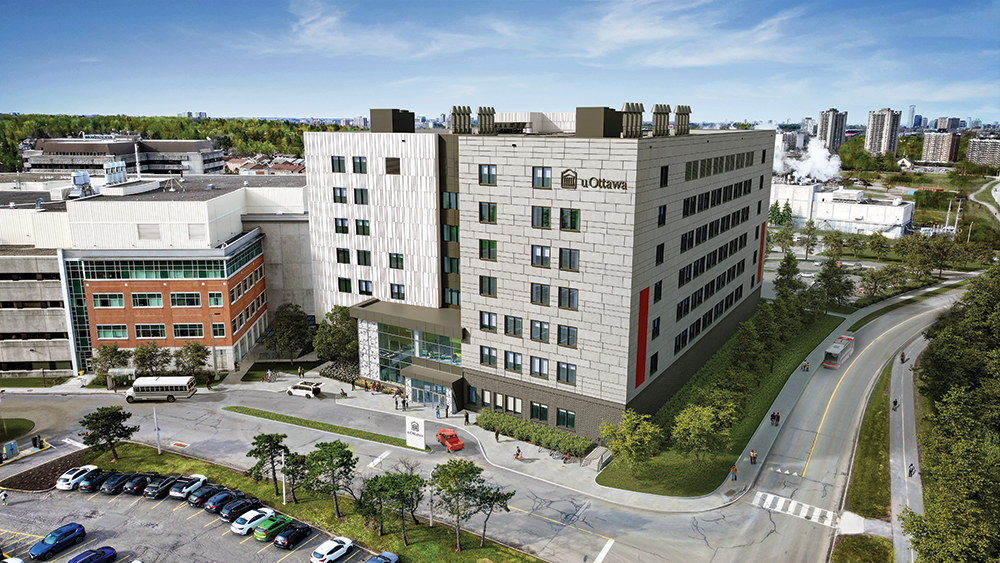
The cornerstone of this ecosystem is the Advanced Medical Research Centre (AMRC), the single largest capital investment in the university’s history. Steps from The Ottawa Hospital and CHEO, the seven-storey, 350,000-square-foot facility – situated on the Faculty of Medicine campus – will open by the end of 2026. It will also house the Ottawa Health Innovation Hub, a signature initiative designed to incubate startups, develop novel therapies, and accelerate the translation of research into real-world health-care solutions. According to Julie St-Pierre, vice-president, research and innovation, “The AMRC offers a unique value proposition of wet lab space, access to researchers, and core facilities, all under one roof. It’s a launchpad for Canadian health innovations.”
That momentum is amplified by the Ottawa Academic Health Network (OAHN), a partnership between uOttawa and its affiliated research institutes, to strengthen collaborations across academic hospitals, research institutes, and the University of Ottawa, transforming excellence in research and education into improved population health.
Technology as a connector
Technology is a key connector across the life sciences ecosystem, as shown by the launch of the Ottawa Medical AI Research Institute (OMARI) in 2025.
OMARI is housed within uOttawa’s Faculty of Medicine and coordinates collaboration across the university’s six affiliated hospitals to advance responsible AI in medicine. Tools are being developed to reduce clinician workload, accelerate diagnostics, and strengthen health systems, ensuring that innovation translates into better outcomes in emergency departments, outpatient clinics, and beyond.
Engineering real-world solutions
Engineering plays an equally critical role by turning clinical and scientific discovery into practical, scalable solutions through new devices, data-driven tools, and technologies designed for real-world use.
As an example, uOttawa professors Jean-Philippe St-Pierre and Thomas Uchida are leading projects in biomaterial-based osteoarthritis treatment and AI-powered mobility devices, each developed in close collaboration with clinicians and students. These projects reflect the broader, collaborative environment in which health innovation happens at uOttawa, where connections across faculties, hospitals, and industry help ideas move from proof of concept to practice – and where students are trained from the outset to contribute meaningfully to that work.
Innovation at scale
With its Kanata North Campus in Canada’s largest tech park, uOttawa is uniquely positioned to bridge health science with the region’s technology capacity. With 700-plus companies and deep expertise in AI, cybersecurity, and software, Kanata North is a natural partner for digital health and connected care.
“uOttawa’s health care innovation advantage goes beyond a single facility or initiative. It’s driven by the way we connect people, knowledge and purpose,” says uOttawa President and Vice-Chancellor Marie-Eve Sylvestre. “By convening partners across health care, research, and technology, we help ensure that innovation translates into meaningful impact for patients and communities.”
This article first appeared in the Executive Report on Health Innovation in the June Magazine produced by the Ottawa Business Journal. That publication is available in it’s digital format below: