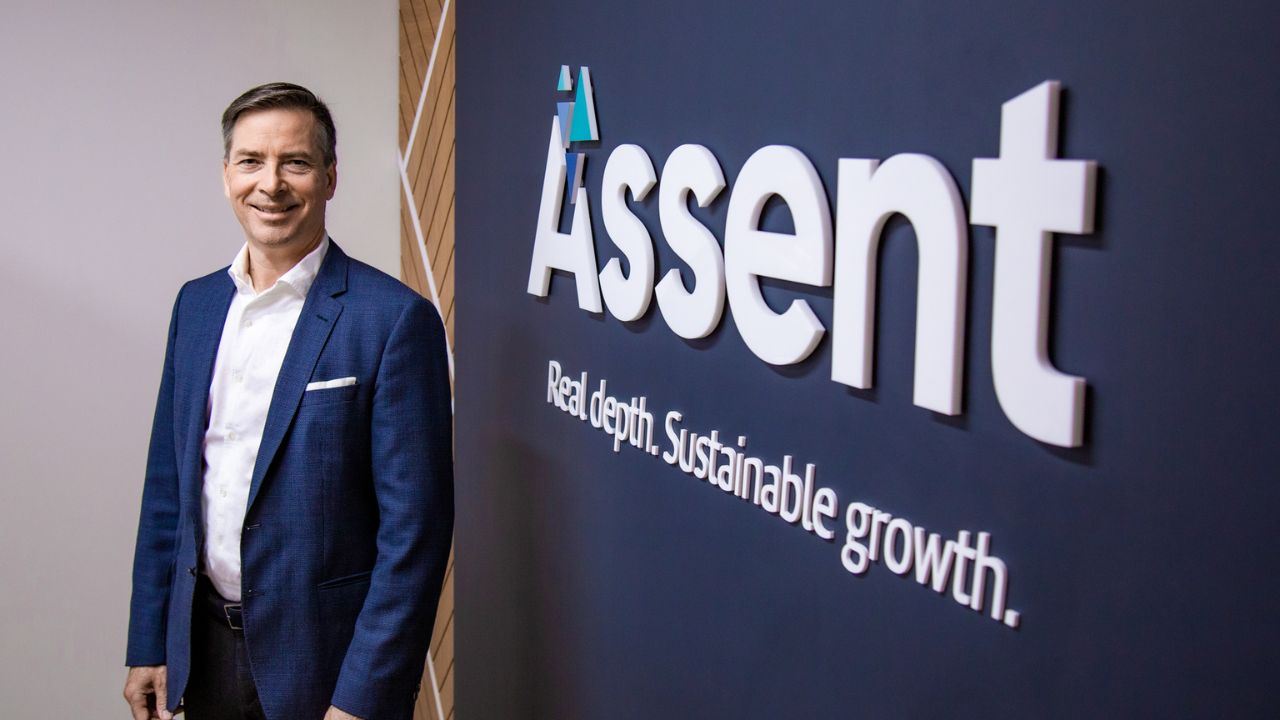
The job title on Andrew Waitman’s LinkedIn profile perfectly sums up the impact the veteran tech executive has had on Ottawa software giant Assent over the past 10 years. Waitman describes himself as a “Centarr CEO.” It’s a clever nod to Assent’s recent entry into the exclusive $100-million ARR club – that is, companies that […]
Get Instant Access to This Article
Become an Ottawa Business Journal Insider and get immediate access to all of our Insider-only content and much more.
The job title on Andrew Waitman’s LinkedIn profile perfectly sums up the impact the veteran tech executive has had on Ottawa software giant Assent over the past 10 years.
Waitman describes himself as a “Centarr CEO.” It’s a clever nod to Assent’s recent entry into the exclusive $100-million ARR club – that is, companies that have surpassed $100 million in annual recurring revenue.
Indeed, Assent has come a long way since Waitman came on board in 2014 following a six-year run as chief executive of Ottawa professional services firm Pythian and more than a decade as managing partner of Celtic House Venture Partners.
Back then, the company known as Assent Compliance was still a fledgling startup with 25 employees and annual revenues that barely cracked the seven-figure mark.
Today, Assent – which makes software that helps some of the world’s largest manufacturers ensure their suppliers are complying with an ever-growing list of government laws and regulations on everything from human rights to health and safety standards – is a global powerhouse.
Fuelled by hundreds of millions of dollars in venture capital, Assent now has a workforce of more than 1,000 people producing and selling software used by customers around the world.
But Waitman, who earned a bachelor’s degree in electrical engineering from the University of Waterloo in 1987 and an MBA from the University of Western Ontario’s Ivey Business School in 1992, hardly sounds like a man who feels his mission is accomplished.
Even before Assent hit the coveted $100-million milestone, Waitman was plotting the course to $200 million and beyond. Sustaining such growth is a complex puzzle, as he likes to put it, and Waitman knows the pieces don’t always fall neatly into place.
In this instalment of Top of Mind in Tech, Waitman discusses the challenges of scaling a maturing tech enterprise, growing a firm organically versus through acquisitions, and more.
The transcript has been edited for length and clarity.
Finding the right mix of talent to help the company scale
“The blue-collar economy is booming; the white-collar economy is not. You’re still seeing companies doing layoffs in the white-collar area as everybody is adjusting. And I would say (generative AI) is starting to (take hold) in that people are becoming more productive in white-collar (jobs) like sales and marketing, engineering, software development. And as such, we’re not hiring as quickly. For a company that has a great balance sheet like we do, we are now able to really benefit from a much larger (talent pool).
“We are in the business of sustainability for complex manufacturing. If you look at the broad spectrum of what we do, which covers a lot of areas – ESG, product sustainability, product compliance – those topics are not going away. We’re in an emerging market. It’s a tough f–ing business, and we’re just having to improve our execution chops every single quarter. We had a good, solid Q2. It’s about how you handle scale. It doesn’t keep me awake at night, but I’m not experienced in building a $200-million business.
“My new CFO, Jason (Cherry), he’s been with a number of very large companies (including General Electric). Tanya (Weston), who’s my general counsel, she was at Shopify. So I’m bringing in talent that has experience (at scaling up a company). We’ve got a VP of (revenue operations) that we’re hiring for right now. We’re looking at some other very senior positions. What we’re looking for is people that have been through the (scaleup) journey. That’s likely not going to be found in Ottawa. We just haven’t got those people, particularly in B-to-B SaaS. Kinaxis is here, and obviously they have done that, but that’s only one company.”
Fine-tuning a go-to-market strategy
“Once you’re close to a thousand customers, you have to start to specialize. Whereas before, you may just have had broad (account executive) teams who do everything, as you go to $200 million in revenue, maybe you say, we’ll have a vertical focus in electronics or aerospace or automotive or industrial. You have to always be in some sense redesigning, rethinking the structure of your organization and how you address customers in certain segments of certain sizes and looking at your processes.”
Growing organically vs. acquiring
“At this size, there’s always a build-versus-buy (question). You’ve got a lot to deliver, and the expectations are myriad with a thousand customers. So, are you better off acquiring that piece of tech where maybe you’ve got some weakness in your market and you want to pick up a certain (customer) segment that you don’t have? Where am I better off acquiring something to complement either technology or go-to-market (strategies)? Because sometimes it’s faster buying certain customer segments.
“We did look at acquisitions during the 2018-2021 period, but they were so expensive. Price is always an issue. You don’t want to overpay. I would say to my team, ‘Two dwarfs do not make a giant.’ We now have the size (to acquire). It’s more cost-effective to buy mom-and-pops today than it was even three, four years ago. There are plenty of companies in the $5-million to $15-million to $20-million (revenue) range that struggle to break out of that realm. Sometimes you can buy those companies and help them (grow) with your infrastructure and your go-to-market (expertise) and so on.
“I have a VP of corporate development (James Calder), and he has two focuses. One is partners. You’re always looking at companies that complement what you do – you can’t do everything. AWS is a partner of ours. We have partners in Europe and North America that are complementary to what we do. They bring us leads, we bring them leads. It’s very natural to move from a partner to a purchase if it becomes super strategic.
“In Europe and North America, there are quite a few mom-and-pops. You’re kissing a lot of frogs. Timing is an issue; engagement is an issue, meaning how naturally they’re interested in leveraging you. Sometimes it makes sense to go to the next step. We allocate a certain amount of time to assessing mom-and-pops either for their technology, their data or for other strategic reasons like customer acquisition. (Calder) is out on the road all the time going to various trade shows and he’s assessing constantly – is this a potential partner, is this a potential acquisition.
“In an emerging market, the landscape is always changing. And part of it is having a thesis of what the landscape is going to look like in five years. Assent is the dominant player in the area where we play. We have to have a view of what that’s going to look like in three to five years to maintain dominance. Gen AI is changing the landscape. There are capabilities and solutions that are arriving that are having an impact on both customers and suppliers to our customers. You’ve got to stay on top of that, so if you start to see a company that has been quite clever and creative and has developed some capability which you didn’t see and is germane to your business, (it could make sense to acquire it).
“It’s a constant vigilance to what’s out there, what’s evolving and when you have to exercise judgment to attempt to acquire. We put in a bid on a company recently. There were other bidders, and it didn’t get to where it needed to be. After all the strategic decisions, there is getting to the price they want versus where the market is. There's a lot to (making) acquisitions, and we’re definitely developing that muscle.”
Staying ahead of the curve in an ever-changing industry
“I ran Pythian and grew it. I’m going on 58 quarters of incremental quarterly growth. That type of performance is not easy to maintain, particularly in an emerging market where there is a lot of macroeconomic volatility. But it keeps you focused. You don’t want to go flat. The snowball gets bigger as you roll it up the hill. You really have to think three steps ahead and have a plan of how many outbound calls do we need to be doing, how many inbound leads do we need to generate. The whole thing is a very complex puzzle that you have to be attending to.
“Part of the reason we’re successful is that the complexity of this business is ridiculous. It truly is. We have our customers’ back with regards to where the European, where the North American rules and regulations are going. We have a 30-person subject-matter expert team. There’s no shortage of rules and regulations that are evolving. And how does the political environment change that in terms of enforcement and in terms of how seriously the companies will take it? It’s never a dull moment in my world.”