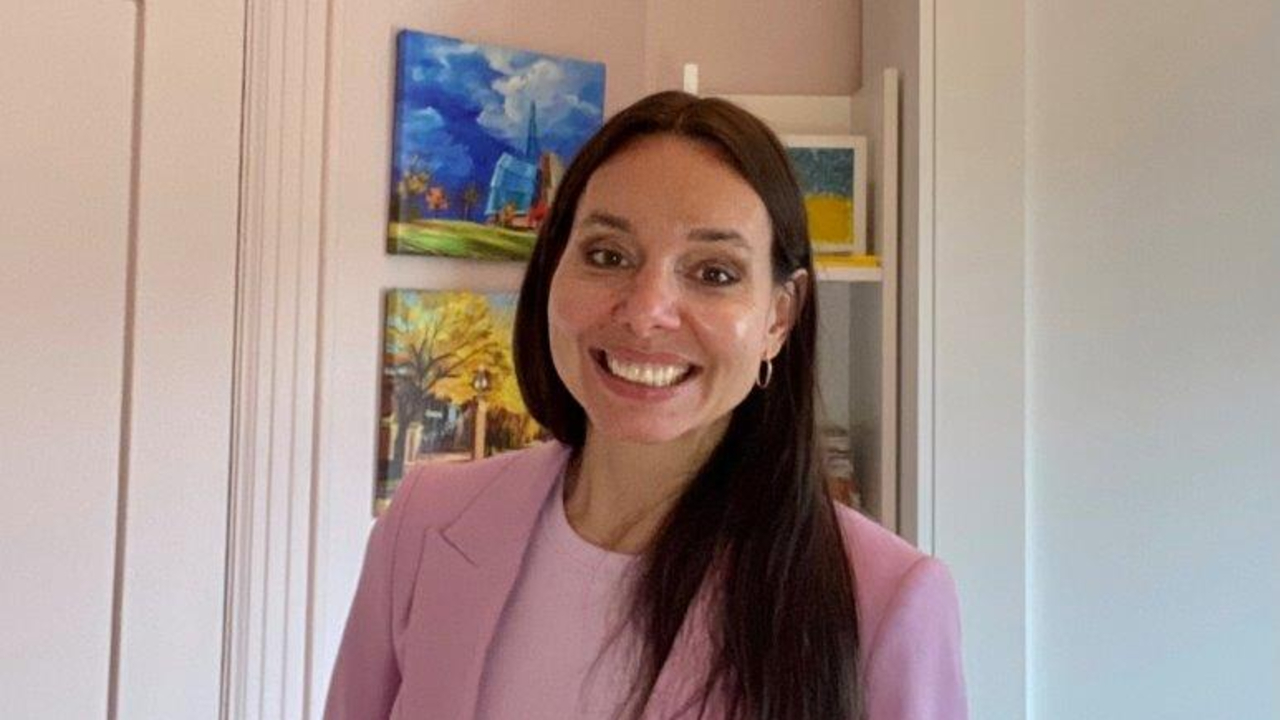
From professor to tech founder to banker, Lindy Ledohowski has worn many hats in her career. Starting out as an educator, she taught at the University of Waterloo as a literature professor. Ledohowski took her background in education into Ottawa’s tech space in 2015, crafting EssayJack, an online academic tool for students and educators. The […]
Get Instant Access to This Article
Become an Ottawa Business Journal Insider and get immediate access to all of our Insider-only content and much more.
From professor to tech founder to banker, Lindy Ledohowski has worn many hats in her career.
Starting out as an educator, she taught at the University of Waterloo as a literature professor. Ledohowski took her background in education into Ottawa’s tech space in 2015, crafting EssayJack, an online academic tool for students and educators. The platform was designed to help students put together essays and other academic papers while allowing educators to create and correct assignments. EssayJack was acquired by Wizeprep in 2021, where Ledohowski continued as chief operating officer until 2023.
Last year, Ledohowski took on a new role with RBCx as its vice-president of relationship management, helping to support tech companies in the National Capital Region.
OBJ spoke with Ledohowski about Ottawa’s tech sector, the use of artificial intelligence, and the projects she oversees at RBCx.
This transcript has been edited for length and clarity.
Q: What stands out to you about today’s tech sector?
I don't think you can have any kind of conversation about tech without talking about the importance of AI and where we're going with AI. It is changing the tech space. Within the bank, we've been working on AI, RBC Borealis, since 2016. It’s an AI hub for research and knowledge, which is central to the bank. There are some key AI principles that the bank takes very seriously, like privacy and security, accountability, fairness, responsibility and transparency in terms of disclosure, those things which are key to a bank's use of and development of AI tools. I think it applies to tech companies, broadly speaking. How do you create AI that doesn't expose companies to external undue risks? So, for example, in the bank, none of us can use ChatGPT, the risks are too great that proprietary data could be shared with a third party and a bank is never going to do anything like that. That's risky. I think tech companies in Ottawa broadly are making those kinds of choices. What are the risks and how do you protect your data and your customers' data in this world of AI?
There’s also financing and how the macroeconomic context changed. So, I sold my company in 2021. The fundraising and the economic situation in 2021 was very different than it is now. Things kind of crashed around 2022 or 2023, depending on your sector. It hasn't necessarily gotten back up to the same way. For tech companies, depending on where they were in their growth cycle, it means that if they raised money in 2021, they may have had a large valuation. In the tech sector, those venture capital investment funds were looking for growth metrics with the assumption that, as you hit growth metrics, there would be a time to then have another infusion of capital to continue growing. As the world changed, economically speaking, that had an impact on tech. The priorities shifted from growth metrics to path to profitability.
Q: What’s keeping you up at night?
Oh my goodness, so many things. As a tech founder, what I found is that traditional banking wasn't always great for tech companies since you’re typically dealing with complex IP, which is not an asset that can easily be sold off if a bank needs to recoup bad loans. RBCx was founded with the mission of doing tech banking differently, of figuring out how to support tech companies in a way that made better sense and didn't just apply traditional banking to tech companies. That mission was what drew me to RBCx and wanting to be part of that solution. In a few years, we've made so much progress in the way that we can help support tech companies. What keeps me up at night is the fact that we're still a work in progress. We're not at the end of our story. There's work to be done. Will we be able to deliver on that amazing opportunity and vision of doing tech banking differently and better?
Another thing is that Ottawa, in my view, is a very special tech context. So you'll see commentary coming out of Invest Ottawa that says Ottawa is a bootstrap city and, in many ways, it is. Many of the tech companies here develop not with that VC funding model all the way through, but with sweat equity and hard work and self-funding, which is really exciting and special. What you also have is when somebody exits a bigger company, they go and become an angel investor in new startups and support others. It's a very community-oriented tech ecosystem. So you have this really helpful tech community, but it is not as big as some of the other markets and so it is always hard to fight for some of the funding dollars. It’s one step harder than it is if you happen to be based in San Francisco, for instance. So how do we make sure that the whole world knows that there is this very special tech happening here.
Q: What’s on your mind when it comes to tech in Ottawa?
I am very excited by tech in Ottawa. The thing that Ottawa has really going for it is that it’s a very well-educated population. There’s a dedication to partnerships with institutions of higher learning. For example, I'm sitting at Hub350 in the Kanata Tech Park. RBCx is a partner, Carleton University is a partner, the University of Ottawa is a partner. You have a great connection between businesses and students.
Q: What projects are you working on right now?
In my current role, I am no longer in the kind of tech and development oversight role, but RBC, not just RBCx, has something called Nomi Insights. It’s a way to provide financial insights. The bank sees itself as a digitally enabled relationship bank. So we want our tech to be good, but we never want to lose sight of that personal connection.
With the companies I work with, I get to have a front row seat to see what they're building, the new and exciting things that they're bringing to market. It’s everything from microchips to software as a service, to AI robotics, to interventions in space or the construction industry. So there are all kinds of fields where the technological advances that Ottawa companies are doing are super exciting and I get to see that, but I get to support them as a tech banker, as opposed to supporting them as a tech developer myself.
I joined RBCx to try to do tech banking differently. RBCx has different kinds of lending products where we look at different metrics. So it might be, if you've done a venture capital raise in your tech company, we can lend against that. Or if you do have a subscription model business, we can lend against that. Or, if you are applying for a Scientific Research and Experimental Development (SR&ED) claim and, while you wait for your money from the government, we can finance. There are these kinds of ways in which RBCx is saying, hey, we understand how tech companies work and we can lend in that realm and that is kind of exciting to me.