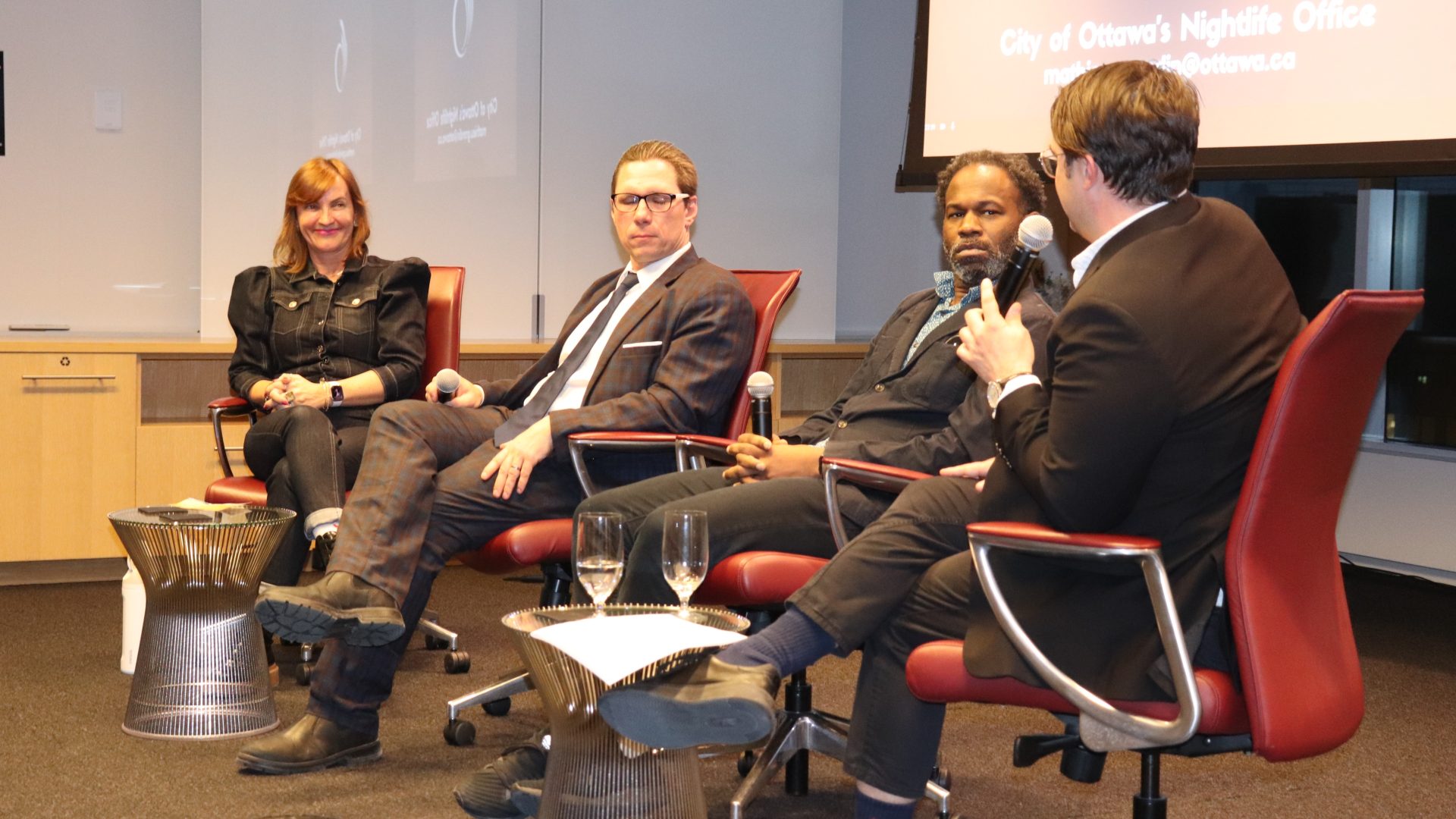
Nightlife can’t be improved without the support of all sectors, Ottawa’s nightlife commissioner Mathieu Grondin said at an event Tuesday evening.
Get Instant Access to This Article
Become an Ottawa Business Journal Insider and get immediate access to all of our Insider-only content and much more.
Like any aspect of the local economy, nightlife can’t be improved without the support of people and organizations across all sectors, Ottawa’s nightlife commissioner told members of the local real estate and land development sector at an event Tuesday evening.
Hosted by Urban Land Institute Ottawa at the offices of Borden Ladner Gervais LLP, the gathering allowed Mathieu Grondin to introduce himself and explain what the night economy is to a crowd he said he hasn’t had much chance to speak with.
It’s part of his mission to put nightlife at the forefront of everyone’s minds, he said.
“My job is to implement the Nightlife Economy Action Plan but it’s also to develop what I call the nightlife reflex inside the city administration,” he said. “And now, today, as I’m speaking with you, I’m hoping you can develop your own nightlife reflex for your own projects. If there’s a condominium tower being popped up, asking what’s going to happen after 6 p.m.? That is the reflex I’m speaking of.”
In Ottawa, Grondin said the nightlife economy accounts for $1.5 billion in annual spending and 38,000 jobs. And with more than 110,000 students across four post-secondary institutions, Grondin said it has the potential to reach thresholds seen in cities like Montreal.
“Sixteen per cent of spending comes from visitors (to Ottawa),” he said. “We get almost the same amount of people that visit Ottawa (as Montreal) and engage in nightlife activities. If we can bring that up to 33 per cent, like we see in other cities, this will have a significant impact on our economy.”
Micro-breweries and a new arena for the downtown core
Grondin was joined for the evening by other business leaders to discuss ideas for activating key areas of Ottawa after sunset. One area of interest was Sparks Street, which has had its challenges for decades.
Bill Leonard, vice-president of real estate development for the National Capital Commission, said there are a lot of factors at play when it comes to the success of Sparks Street.
“It’s been tough, coming out of COVID, with federal workers down,” he said. “A lot of people can't find staff to bring into new businesses or they’re scared of investing their money into (the area).”
Despite the challenges, there have also been opportunities, he added. For example, the NCC found unexpected success when it signed an agreement with Kichesippi Beer Co. to open up shop on Sparks Street at the end of 2023.
The brewer has done well in one of the empty storefronts that line the street. Its success sparked the possibility of bringing similar businesses to Sparks Street to re-activate the area.
The idea is inspired in part by the nearby Queen St. Fare, a food hall that houses six different eateries in one space.
“We’re trying to build more on that success,” Leonard said. “I sent over my leasing staff to talk to every micro-distillery and brewery in the region. We could create a district along Sparks Street where it’s all micro-breweries, micro-distillers. Add a few other services in there and you’ll create a destination.”
While the NCC considers that proposal, it has another even bigger destination to keep in mind: the possibility of a new arena to be built at LeBreton Flats.
“It’s a game-changer for Ottawa,” Leonard said. “It’s best in class, that’s important. This will be a best-in-class arena. One of the things we’ve thrown around in some of the negotiating meetings is, will this arena be able to attract Taylor Swift? And the answer is yes.”
Leonard said the new facility would draw much larger concerts into the downtown core after hours, bringing more foot traffic to nearby businesses and becoming a major draw for tourists who would typically travel to Toronto or Montreal for big shows. He also said it’s expected to bring more people from the Quebec side of the border, which is more difficult for the Canadian Tire Centre in Kanata.
While the Senators have come to an agreement in principle to buy 10 acres of land from the NCC for the new arena, the deal isn’t finalized.
But Leonard said that’s not unusual for a project of this magnitude. By comparison, he said the deal the NCC made with Live Nation to transform the former Rideau Street Chapters into an events space was relatively easy to negotiate, yet still took 21 months.
The new arena, he said, is a much bigger project and will bring in other partners such as restaurants, bars and smaller venues.
Despite the complexity, Leonard is confident the deal will get done.
“There’s so many people weighing in,” he said. “I can tell you everything’s going well. Every week we’re meeting at least once. (The NCC) does 100 deals a year; we know which ones are going to succeed. This one’s going to succeed. We’re going to hit the finish line. It’s just a matter of time.”
Taking inspiration from other countries
Grondin did not grow up with a strict bedtime. With a radio host and rocker for a father, he recalls falling asleep in the studio or at concerts during his childhood in Montreal.
Claudia Belladelli, executive director of Axe WorldFest and a member of Ottawa’s nightlife council, said Grondin’s childhood experience is similar to what she grew up with in Brazil. And it’s an experience that Ottawa could learn from.
“I don’t know why it has to be the separation,” she said. “My son is 19 years old now, but since day one, I’ve always wanted to take him from wonderful shows at the NAC to a pub to sit on the patio and have food. And how many times have I been told no after 9 p.m.”
In countries like Brazil, she said there are far more options for venues where multiple generations gather and mingle, even after hours. She said it isn’t unusual to go out at night and see babies and children accompanying their parents, asleep in their strollers. Older generations were active and up late as well.
“You grow up a better person because of it,” she said. “You’re used to being in every single situation.”
Researcher and creator Kwende Kefentse, who is with Memetic Media, saw similar trends growing up in Barbados. He mentioned that one example of space that achieves that diversity in Canada is Celebration Square in Mississauga.
“It works really, really well in multiple hours of the day, daytime, nighttime, whatever,” he said. “There are many communities that convene there. I’ve been there multiple times where you have lots of Muslim families there, celebrating traditions like Eid, and they’re levering the big screen and the big lawn to be together and hangout. It’s a really interesting use of space.”
Making nightlife worthwhile for developers
When it comes to development, one trend Kefentse has noticed is that too many residential developments like condos are being built along main streets. Without multi-use in mind, he said residential development can slow the activation of business-oriented streets, especially at night.
“I don’t know if there’s any thought about how to put them deeper in neighbourhoods so that you can create land uses on the front of the street that draw people away from residential land and create more space for a variety of land uses that actually engage people,” he said.
And even if there are things to do during the day, Kefentse said, “At night, you’re getting down to 10, 15 per cent of the space where people can actually go and engage.”
For Grondin, the issue goes back to the “nightlife reflex,” which he said developers could exercise by taking nightlife uses into consideration when planning their next project.
It’s something Leonard said has been top of mind at the NCC.
“It’s something my colleague has reinforced, this idea that when we’re building on LeBreton or Sussex, that ground floor is extremely important to make sure it’s activated,” he said.
But he added that multi-use elements like retail or restaurant spaces can be a hard sell for developers on their own. For nighttime uses, it’s even harder.
“Developers specifically (will ask), if I have nightlife down here, is it going to limit my market in my building? Do I really want an electronic venue on the ground floor?” he said.
To get developers to care about nightlife, Leonard said, “You have to make it worth their while. That’s the simplest way to look at it.”