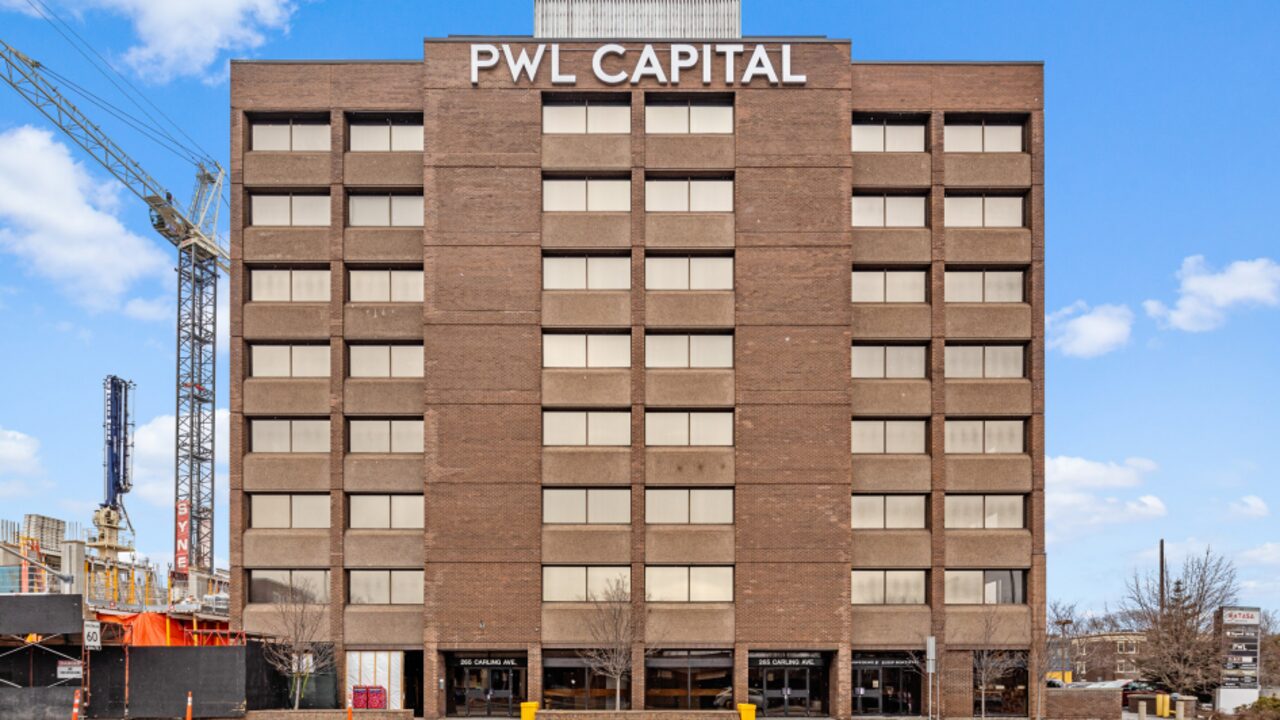
KTS Properties has filed an application to turn an eight-storey, 55,000-square-foot office building at the corner of Bronson and Carling avenues into a 70-unit rental complex with ground-floor retail space.
Get Instant Access to This Article
Become an Ottawa Business Journal Insider and get immediate access to all of our Insider-only content and much more.
The Ottawa company that’s turning a Slater Street office tower into apartments is targeting a building on a busy corridor just south of downtown for its next conversion project.
KTS Properties has filed an application to turn an eight-storey, 55,000-square-foot office building at the corner of Bronson and Carling avenues into a 70-unit rental complex with ground-floor retail space.
Constructed in 1976, the building at 265 Carling Ave. is currently occupied by a number of commercial tenants but is about 60 per cent vacant.
KTS Properties partner Tanya Chowieri said the structure’s rectangular shape lends itself well to residential apartments and its prime location just west of the Glebe near Carleton University, Dow’s Lake and the future Civic campus of the Ottawa Hospital makes it a natural candidate for a conversion.
“The building has great bones, similar to 130 Slater,” she told OBJ on Tuesday. “It has a good layout, good structure.”
Chowieri, who’s hoping the project gets the go-ahead from the city by early next year, said it will likely be completed in two stages.
Floors two to five will be converted to apartments first. Any remaining businesses on those floors will be relocated to the top three levels, where several tenants still have as many as six years remaining on their leases.
The second phase – converting floors six through eight into apartments as well as adding two new commercial units on the ground floor – will be launched once those rent deals expire.
Chowieri said KTS is in talks with tenants about relocating them to other buildings in a bid to get the project finished faster. She’s hoping the first converted apartments will be ready for occupancy within 12 months of the project’s launch.
Transforming the Carling Avenue office into apartments has been in the company’s sights for some time.
Gatineau-based Katasa Group, KTS’s sister company, partnered with the Taggart Group to buy the building in 2017. The firm eventually bought out Taggart’s share and purchased the Taggart-owned land next door at 275 Carling, where KTS Properties – which was incorporated in 2023 to lead Katasa’s developments in Ottawa – recently opened The Clemow, a 16-storey, 158-unit apartment complex aimed at residents aged 55 and up.
Chowieri said the firm always planned to turn 265 Carling into apartments once The Clemow was complete. The 50-year-old building was never fully leased even before the pandemic, she explained, and the mass office exodus during COVID further eroded its tenant base.
“Our intention was always to convert,” Chowieri said.
Indeed, the project is a natural fit for the folks at KTS, who are no stranger to office-to-residential conversions.
Unexpected challenges
Its sister company has overseen a number of conversion projects in Montreal and Ottawa, including the Theo building, a 12-storey office-turned-student residence at the corner of Rideau Street and King Edward Avenue.
And KTS is currently in the midst of the companies’ most ambitious conversion project yet – turning an office highrise at 130 Slater St. into a 204-unit apartment complex.
The developer bought the 13-storey, 123,000-square-foot building in partnership with Sudbury-based ARG Devco two years ago. The firms began the painstaking process of ripping out the structure’s guts about six months ago and expect it to be ready for occupancy by the middle of 2026.
Chowieri called 130 Slater a “great building,” noting the previous owners, Toronto’s KingSett Capital, had installed new elevators not long before the sale and also restored the exterior brickwork.
“It’s one of my favourite projects,” Chowieri said of Slater Street. “You learn every day on site. Every conversion is always different.”
In the case of Slater Street, Chowieri said swapping out the building’s aging windows for new, more energy-efficient models has been among the biggest challenges so far.
The developers wanted to insert the new windows into the existing slots, but ensuring the state-of-the-art replacements were a snug, weatherproof fit took some doing, Chowieri explained.
“If you get it wrong, you get it wrong for 950 windows, which is not a good thing,” she said with a chuckle. “We found a good installer … and we solved that problem. Every day is always something different.”
Another fly in the ointment might not have been obvious – figuring out where to put the remodelled building’s garbage chute.
“It was finding a spot where it would land in our garage space, which is not big,” Chowieri said with a smile. “It took us a few tries, but we found a great spot for it.”
In spite of such head-scratching problems, conversions have become an increasingly popular option in recent years for developers looking to repurpose obsolete offices into a more viable source of revenue. Proponents say the process is less wasteful, more environmentally friendly and generally takes less time than tearing down a building and constructing a new one from scratch.
“Demoptions and rebuilding usually takes years,” Chowieri noted. “Our conversions, whether it’s 130 Slater or 265 (Carling), get units on the market way faster.”
In a bid to help encourage more developers to take the conversion plunge, the City of Ottawa piloted a plan in 2023 to streamline the approval process for conversions and lower planning application fees for projects in which the building envelope remains unchanged.
Chowieri said the moves helped get the Slater Street project off the ground faster and made it a bit more cost-effective.
“I think they’re trying their best to make (the approval process) as speedy as they can,” she said of the city. “There’s work to do, but it was definitely an easier and faster process than a regular (planning) application.”
Meanwhile, Chowieri said construction costs have stabilized, adding the company has yet to feel any significant impact of the Canada-U.S. trade war on material prices – though she cautioned that could change at any time.
And even though the company's second conversion project is still in the approval pipeline, KTS is already seeking out more opportunities to reimagine other tired office buildings as shiny new multi-residential developments.
“I think for now our obsession is retrofitting,” Chowieri said. “It’s just finding a good building – finding a building whose footprint makes sense for residential use. I think that’s the challenging part. We’re still looking at the market. There are still a lot of availabilities, but we haven’t found the right project just yet for that. We’re still looking patiently.”