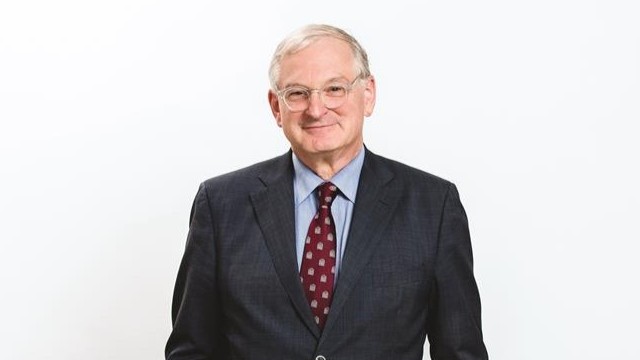
From a global pandemic to the advent of artificial intelligence, Jacques Frémont has weathered more than one unprecedented situation in his nine years as president and vice-chancellor of the University of Ottawa.
Get Instant Access to This Article
Become an Ottawa Business Journal Insider and get immediate access to all of our Insider-only content and much more.
From a global pandemic to the advent of artificial intelligence, Jacques Frémont has weathered more than one unprecedented situation in his nine years as president and vice-chancellor of the University of Ottawa.
Now, Frémont is ready to kick back for a long-awaited break when he leaves his post on the last day of June.
“I don't want to work for the next two-and-a-half months,” Frémont said in an interview this week. “I will do nothing, like a plant. And after that, I'll see. I will certainly keep busy.”
His successor, Marie-Eve Sylvestre, will be the first woman to hold the position since the university’s inception in 1849. Her five-year term is set to begin July 1.
But before she takes over, Frémont sat down with OBJ to look back on nearly a decade at the head of the university, while also looking ahead to how AI is shaping post-secondary education, the relationship between institutions and local businesses, and the impact of the pullback on international students.
This interview has been edited for length and clarity.
When you first joined the University of Ottawa, what did you learn about it that set it apart from other institutions?
JF: Well, you never really know what you’re going to get. I was not familiar with the University of Ottawa, so I didn’t know what to expect. The first thing you need to do is really understand how the institution functions and how it fits in the Ottawa landscape and the Canadian landscape.
The bilingual mandate is extremely distinctive. We are, certainly in Canada, the most distinctive university in that respect. And that comes out very, very strongly when you arrive at the University of Ottawa.
What are some of your proudest accomplishments during your term as president?
There are many, many points. I think we’ve progressed enormously.
One interesting point which struck me when I arrived was — people took me to Kanata. I realized the huge importance of Kanata and I said, where are we? And the answer was, well, we're not really there; we're not present. How come we're not present? We started a conversation within the university and a couple of years later we established a satellite campus in Kanata, which has grown since with labs and so on.
I've always argued that for a university, if you want to have an imprint globally, you have to be extremely relevant locally. That is certainly something we've taken care of so far and I think we're better for it.
We’re smaller than the big research machines of UBC and the University of Toronto, but right now we’re number four nationally in terms of research intensity per faculty member. In terms of ranking as a medical school, we went from number 14 to number five. And another thing I’m very proud of is that the number of francophone students climbed to 15,000, rising to 34 per cent of our student population. We’ve also built $1.6 billion in new buildings over the last few years and we’ve been on budget and on time for each one. I could go on, but all this combined, we’ve worked hard and delivered. It’s very rewarding.
What’s the current relationship between the university and the local business community, and how do you see that continuing to progress?
Certainly in terms of the relationship with the local tech industry, we all know that the absolute priority for the local tech industry is talent and the talent we produce. We have the second largest co-op program in Ontario, which means that every year thousands of our students are spending some time working with the local companies. That is striking and it is certainly a good source of talent for the local industries. Just a statistic, if I may: six months after graduation, the rate of placement of our students in their field of study, not flipping hamburgers at McDonald's, is 93 per cent. The chances that you'll get a relevant job are very high. I think that's our first contribution to local industries.
The second, which will emerge in a year’s time, is the Advanced Medical Research Centre, which we’re building. There will be a floor dedicated to incubating and accelerating local startups in the life sciences field. Before that, they had to move to Toronto or Montreal, which made no sense for the Ottawa region. Having that up and running will help build a bridge between what is being done in the IT sector in Kanata and the life sciences. It will develop a sort of ecosystem and everyone will benefit.
Another point I want to raise is, of course, that we’ve heard the new Canadian government’s plans to reinvest in defence. That’s not only buying planes, it’s developing the new generation of technology, and the headquarters of national defence are here. We have expertise in photonics and sensors, which are becoming the absolute sensor of the emerging technologies in defence matters. We really think that the investment will make a huge difference, where we’ll be able to produce talent, but also produce all the labs which come with these technologies.
With changes in tech, including AI, companies have different needs when it comes to talent. How do you foresee universities adjusting to produce the right talent for the local pool in the coming years?
It’s an interesting question and I would say a challenging one. Very clearly, AI is a game-changer and one of the challenges with AI is to keep developing persons who can function, I would say, despite AI. If you are used to using your GPS to go from point A to point B, at some point you will not have the knowledge. You will depend on your GPS to go wherever you go. We all know it makes no sense and so we will, and already are, teaching in a very skills-oriented way. The knowledge is becoming trivial with AI.
What you need is the critical thinking which comes with that, the critical analysis, the independent thinking skills. We need the communication skills to be able to communicate efficiently, to recognize when there's important information and to become creative. The challenge really will not be so much that students learn to use AI for their purposes, but to go well beyond AI and adapt it. We’re just at the beginning of AI. In 30 years, 40 years time, it will be something completely different. Our students will have to adapt and the talent will have to adapt. Employers will be looking for real talent, not people who can push the right button.
Many post-secondary institutions are experiencing financial difficulties, especially with the after-effects of COVID-19 and the pullback on international students. How will they need to adapt to navigate financial hardships?
In my nine years, we’ve always believed that, at some point, the governments would realize that they’re heading in the wrong direction and change their minds. In the last three years, honestly, I’ve given up. We cannot rely on governments, either provincial or federal, to support higher education appropriately. The provincial government has given up its responsibilities, very clearly so. There’s little money provincially, but higher education isn’t a line of expenses, it’s a line of investment. When 93 per cent of their students are earning money and paying taxes, we don’t have anything wrong. Quite the contrary; the future of wealth in this province is dependent on the proper investment in higher education.
But don’t count on this. The feds have destroyed the Canada brand in the last two or three years as far as foreign students are concerned, smashing anybody who would dream of immigration. That’s how it’s understood. Employers need that talent, the people who are educated and willing to work very, very hard to earn a living. They’ve destroyed that now. The Canada brand has disappeared and it’s getting extremely difficult to attract these students. My advice to my successors is, don’t count on governments, but try to restrict the harm they can do, because they can do a lot of harm.
For instance, there’s talk that we could attract scholars from the United States, but the government right now cannot even be bothered to issue visas in a reasonable time to foreign workers who are coming to Canada. We want to hire stars from the United States and it will take months and lots of work, but when they accept, will they get their visa from the government? What sort of country are we? Are we that disorganized? If we want to attract talent, to make talent, we need to attract the best minds from outside. We need to be able to let them in.
So don’t rely on governments and try to avoid them causing too much harm. That will require a lot of imagination. Budgetary approaches are shifting. We are focusing a lot on revenue-generation. Alternative programs, alternative missions for upskilling in the private sector, we can do that very successfully. There’s a demand worldwide for all sorts of advanced programs, upskilling and reskilling, and we’re getting into that. We just have to hope the governments don’t cause too much harm.
Why did you decide now is the best time to step away and what’s next for you?
It will have been nine years (since I started). We've navigated from crisis to crisis, including COVID, and for most of these crises there was no book on how to fly the plane while building forward. Being a university president these days is challenging. There are challenges, all sorts of challenges, left and right. And after nine years, if you've not done as a leader what you're there to do, then you won't do it in the tenth year or after that. So it's time to go. It's time to let other people with more energy come in and continue the vision. That's precisely what will happen. I mean, my successor, (Marie-Eve Sylvestre), she has a vision. She will be great to write the next chapter.
As for myself, well, first I don't want to work for the next two-and-a-half months. I will do nothing, like a plant. And after that, I'll see. I will certainly keep busy. My wife said, I don't know what you're going to do, but keep yourself busy or you'll be unbearable!