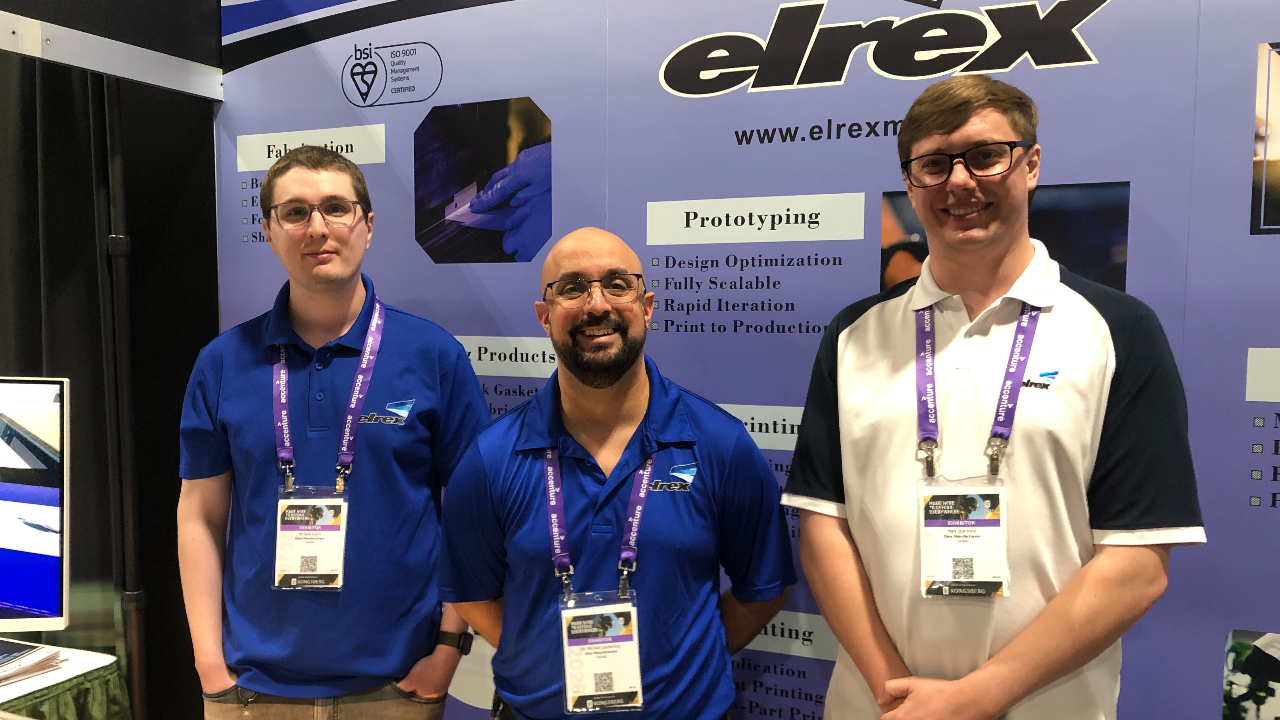
As crowds milled around the Airbus helicopters and Saab fighter jets at last week’s CANSEC trade show, Michael Lambersky wore a wide grin at his small booth on “first-timers” row a few hundred metres away.
For Lambersky, the owner and president of Ottawa-based Elrex Manufacturers, it was like being a minor leaguer called up to the bigs.
“It’s been fantastic,” he told OBJ last Thursday in between chats with curious delegates looking to learn more about his business. “I’m definitely excited to do it again next year.”
Lambersky was one of 50 new exhibitors at this year’s CANSEC, which drew a record total of more than 21,000 registered attendees to Ottawa’s Cohere Centre, up from approximately 14,000 in 2025. He was joined by founders and executives from about 325 other companies at the two-day event, which is hosted by the Canadian Association of Defence and Security Industries (CADSI).
Founded in 1963, Elrex specializes in custom design and manufacturing for clients in a range of industries. Until recently, customers from the defence sector made up only a tiny fraction of the firm’s revenues.
Over the past 12 months, however, that’s changed significantly.
Since Prime Minister Mark Carney pledged to boost defence spending from less than two per cent of Canada’s gross domestic product to five per cent by 2035, enterprises catering to the Canadian Armed Forces and defence primes have been on a tear as the feds announced tens of billions of dollars in new investments for programs such as infrastructure to protect the Arctic.
The spending bonanza has also prompted companies like Elrex that traditionally didn’t target defence customers to put more time, money and effort into growing that side of the business.
Lambersky says defence-related contracts now account for roughly 10 per cent of Elrex’s revenues, up from about three per cent a year ago. Components for data centres remain the company’s bread and butter, but he’s getting more requests to manufacture products for military equipment such as fighter jets, including heavy-duty rubber and silicone seal gaskets and shatterproof polycarbonate windows coated with special foam and metallized fabrics designed to prevent electromagnetic signals from disrupting sensitive electronics.
“It’s growing tremendously,” he said of Elrex’s defence business. “I never say no to an opportunity. If someone comes to me and says, ‘Can you do that?’ It’s, ‘Not yet. I will find a way to get it done.’”
Lambersky bought the company, then headquartered in Montreal, and moved it to Ottawa in 2023. He set up shop in a 10,000-square-foot facility on Stevenage Drive, where he initially employed about a dozen people.
Today, Elrex has a headcount of more than 65, with most of those hires made this year. The firm has taken over several adjoining units in the building on Stevenage, and now occupies 35,000 square feet of office and manufacturing space.
Lambersky is hoping those trends continue as protecting Canada’s sovereignty remains a top priority for the federal government.
“The sky’s the limit,” he said. “I would love to get (defence-related revenues) to 20 to 30 per cent.”
A few booths away, Phil Locker was wooing potential buyers for his company’s radomes — dome-shaped enclosures made of fibreglass, Kevlar and other protective materials that are designed to shield antennas and sensitive electronic equipment from the elements without interfering with radio-frequency signals.
It’s a growing product line for Locker, a former Nortel employee who took a buyout in 2002 and launched a business in the basement of his Ottawa home to make rudders and other components for sailboats out of fibreglass, Kevlar and carbon fibre.
Five years later, he incorporated as Competition Composites and began adding other products to his repertoire. In 2016, he moved the company to Arnprior, where it now operates a 20,000-square-foot manufacturing plant.
Competition Composites started building radomes more than a decade ago. Initially, the structures were targeted at customers in the telecommunications space such as Honeywell, which used them to protect antennas for search-and-rescue operations.
In recent years, however, Locker’s firm is getting more work from customers in the defence space. Now at 15 employees, Competition Composites is building components for drones and was chosen to design and manufacture a composite fibreglass radome for the Master Time Clocks Facility at the United States Naval Observatory in Washington, D.C.
Following a few years of slow growth, Competition Composites posted a 20 per cent increase in revenues in fiscal 2025, and Locker is expecting an even bigger jump this year.
“Everybody’s looking at the opportunities in the defence (sector) right now,” he said, noting the domestic industry seems to be experiencing tailwinds from the federal government’s push to boost the number of Canadian-owned firms that land contracts with the Department of National Defence and its suppliers.
“It only makes sense,” Locker said of the Liberal government’s made-in-Canada procurement campaign. “Why are we outsourcing everything? Why are we buying American all the time when we can make it in Canada?”
Locker’s products are sold around the world, and about 40 per cent of the firm’s revenues come from foreign customers. But he says it’s been a struggle to gain traction with DND and big defence companies here at home, and he’s crossing his fingers that federal initiatives such as the new multibillion-dollar Defence Industrial Strategy will make it easier for businesses like his to tap that market.
“It’s hard to get into the supply chain, especially as a small (company),” he explained. “You’re not tier one. You’re probably tier three or four, realistically. There are all these companies out there that have obligations to buy Canadian. You go to their contacts and they don’t even return the call.”
'Exciting times'
More established players, too, are eyeing new opportunities in the defence space.
John Jastremski, the president and CEO of Ottawa-based MDS Aero Support, has been coming to CANSEC for years. But even he could barely believe his eyes when scanning the sea of delegates on the grounds in front of the Cohere Centre last week.
According to CADSI, this year’s show attracted 100 delegations from more than 60 countries. Noting he’d met a “ton” of international visitors, Jastremski said more foreign customers are turning to his company — which builds facilities that test complex machinery such as gas-turbine aircraft engines — because they don’t want to rely solely on U.S.-based firms.
“Everybody is ready to work with the Canadians,” he said. “For us, it’s exciting times.”
MDS has spearheaded the construction of engine test facilities in more than 20 countries, partnering with big-name manufacturers such as Rolls-Royce and Pratt & Whitney. The company, which has about 190 employees, is in the process of hiring another 20 workers to keep up with the expected surge in demand as militaries across the Western world scramble to modernize their fleets of fighter jets and other equipment.
Jastremski says the federal government’s push to repatriate the production of defence-related products could be a boon to his firm and hundreds of others across the country.
“We all love to hear that,” he said. “It’ll be interesting to see how that manifests itself. It’s a tremendous opportunity for (tier-one manufacturers) to look at (the) supply chain and use Ontario and some of the other agencies that are there to support SMEs to help create an environment where we can grow the supply chain.
“Hopefully we don’t squander the opportunity. It’s not wrong to say, ‘Hey, we’re going to use our taxpayers' money to reinvest in our country.’ It is really the right thing to do.”
Over at the Elrex booth, Lambersky agreed that “Canada first” seemed to be the mantra of the day.
“The first question people ask us is, ‘Where are you located?’ They don’t even care what we do.”