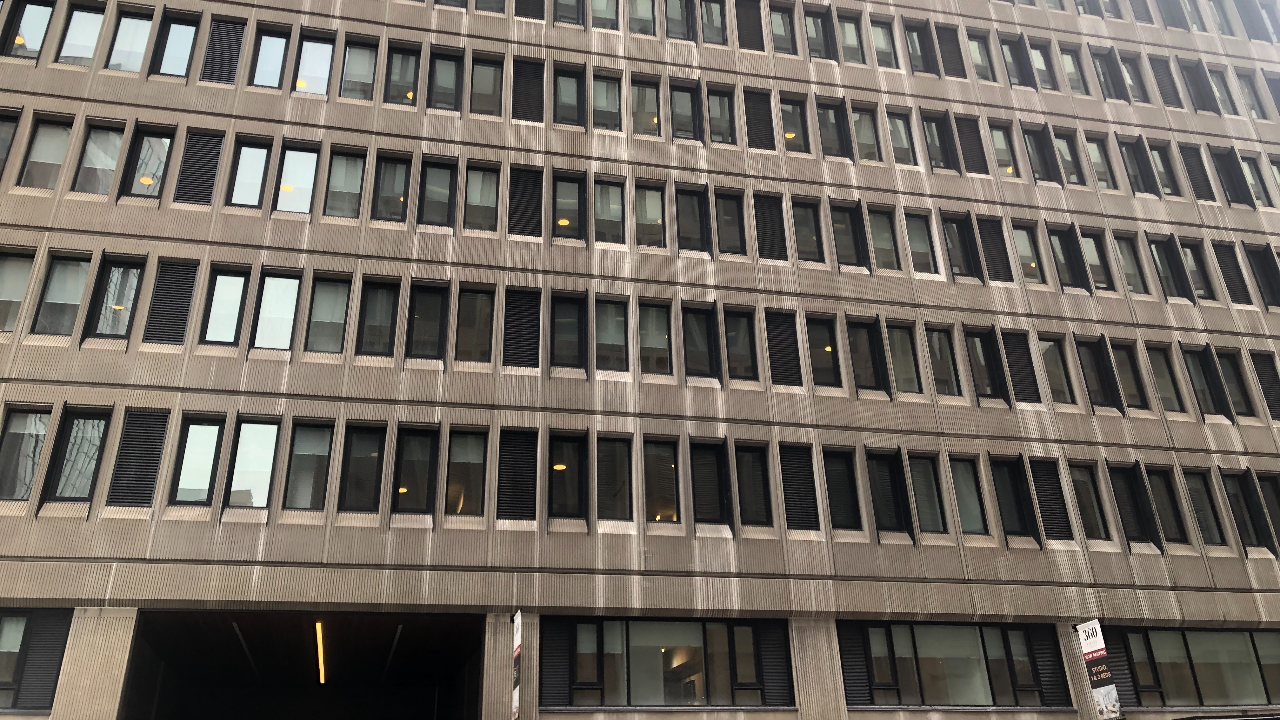
Ottawa’s office leasing market is tightening as a wave of conversions has shrunk the inventory of lower-tier buildings in the city’s core by nearly 10 per cent since 2020, a major real estate brokerage says. Six downtown office properties totalling nearly 750,000 square feet have been turned into residential complexes in the past five years, […]
Get Instant Access to This Article
Become an Ottawa Business Journal Insider and get immediate access to all of our Insider-only content and much more.
Ottawa’s office leasing market is tightening as a wave of conversions has shrunk the inventory of lower-tier buildings in the city’s core by nearly 10 per cent since 2020, a major real estate brokerage says.
Six downtown office properties totalling nearly 750,000 square feet have been turned into residential complexes in the past five years, Avison Young reported in a research note last week.
That represents nine per cent of the total stock of downtown class-B and -C office properties, Avison Young’s Montreal-based director of market intelligence, Marie-France Benoit, told OBJ in an interview on Tuesday.
“Ottawa is quite interesting in the sense that (conversions are) having a material impact on the overall inventory,” Benoit explained.
If four more buildings that have been floated as potential conversion sites — 77 Metcalfe St., 84 and 116 Albert St. and 240 Bank St. — are also redeveloped for multi-residential use, it would take an additional 370,000 square feet of aging, less competitive office space off the market, Avison Young said.
That would reduce the total inventory of B- and C-class space by more than 1.1 million square feet, or 13.5 per cent. By comparison, conversion-friendly Calgary — which has invested hundreds of millions of dollars in an incentive program to encourage developers to turn empty office space into apartments — has seen 11 per cent of its class-B and -C office inventory removed from the market in recent years.
Benoit says Ottawa developers pounced on the opportunity to find new uses for real estate that was past its prime when offices began to hollow out during the pandemic.
“Multi-res made more sense at the time for the buildings that were converted,” she said. “There was a need for multi-residential (space).”
Buildings in the city’s conversion pipeline tend to have smaller, rectangular-shaped floorplates of about 11,000 square feet on average that lend themselves well to apartments, Benoit explained. They are also on the older side, constructed between 1954 and 1976.
“The buildings in Ottawa that were converted and the ones that are planned to be converted fit the profile of office-to-residential conversions,” she said. “These are already buildings that, if they haven't been maintained well, they’re borderline or flat-out obsolete.”
With no new downtown office projects on the horizon, the effect of conversions on vacancy rates in the core has been “substantial,” Avison Young says.
If no downtown buildings had been converted, downtown Ottawa’s class-B and -C vacancy rate would be 21.4 per cent by 2028, the brokerage estimates, assuming overall absorption stayed flat and all the buildings that have been converted or are being considered for conversion operated at 50 per cent occupancy as office space.
But if all four potential conversion projects happen, Avison Young predicts the vacancy rate for class-B and -C properties in the core will drop to 15.7 per cent — a difference of 5.7 points.
New residents in the core
By taking less competitive office space off the books, conversions could “condense” the leasing market and drive up demand for space in higher-tier B-class buildings, said Ian Woodhead, a commercial broker at Colliers Ottawa.
However, owners of lower-quality class-B and -C buildings would still likely face an uphill battle to attract new tenants, even if the pool of available space is shallower, he added.
“We have to take a wait-and-see approach after that,” Woodhead said.
Conversions also entice new residents to the core, boosting efforts to revitalize Ottawa’s downtown, Avison Young said. The six office buildings that have been turned into apartments have created about 1,400 housing units, the company says, and another 500 units could be added if the other four buildings are converted.
“Although the office market is contracting, you’re going to see more people coming downtown and living downtown when these projects get completed, which will have spinoff revenues for retail and grocery and maybe (result in) some other development,” said Jordan Lovett, the managing director of Avison Young’s Ottawa office.
Lovett pointed to the Food Basics supermarket on Queen Street, which opened in August 2025 on the ground floor of a condo building near the Lyon LRT station, as an example of a business that responded to market demand from an influx of new residents in the neighbourhood.
“A few years ago, there was nowhere to get groceries in that part of town,” he said. “You’re starting to see (development like) that happen.”
Still, while Avison Young says conversions “have placed Ottawa’s remaining office inventory on firmer footing,” the company also notes that some developers are thinking twice about turning offices into apartments due to the recent upswing in commercial leasing activity and the lack of new office construction in the pipeline.
“We’ve seen some projects re-pivot to an office redevelopment now that the outlook for office seems more positive and the demand for multi-res is slowing a little bit,” Benoit said. “In either case, repositioning a building is a big effort, and it’s just looking at the highest and best use of these buildings.”
Victoria Scott, a commercial broker at CBRE, said companies like Devcore and Regional Group are pressing pause on potential conversions so they can assess the impact of expanded work-from-office mandates from major employers such as the federal government.
“While I think we will see (more conversions) over time, at the moment we’re actually seeing a little bit of a pause or a rethink for a couple of landlords,” Scott said.
“I think the idea that the federal government is now back in the market looking at big blocks of space (means) some of those landlords are reconsidering their office use and pausing their conversion plans just to wait and see.”