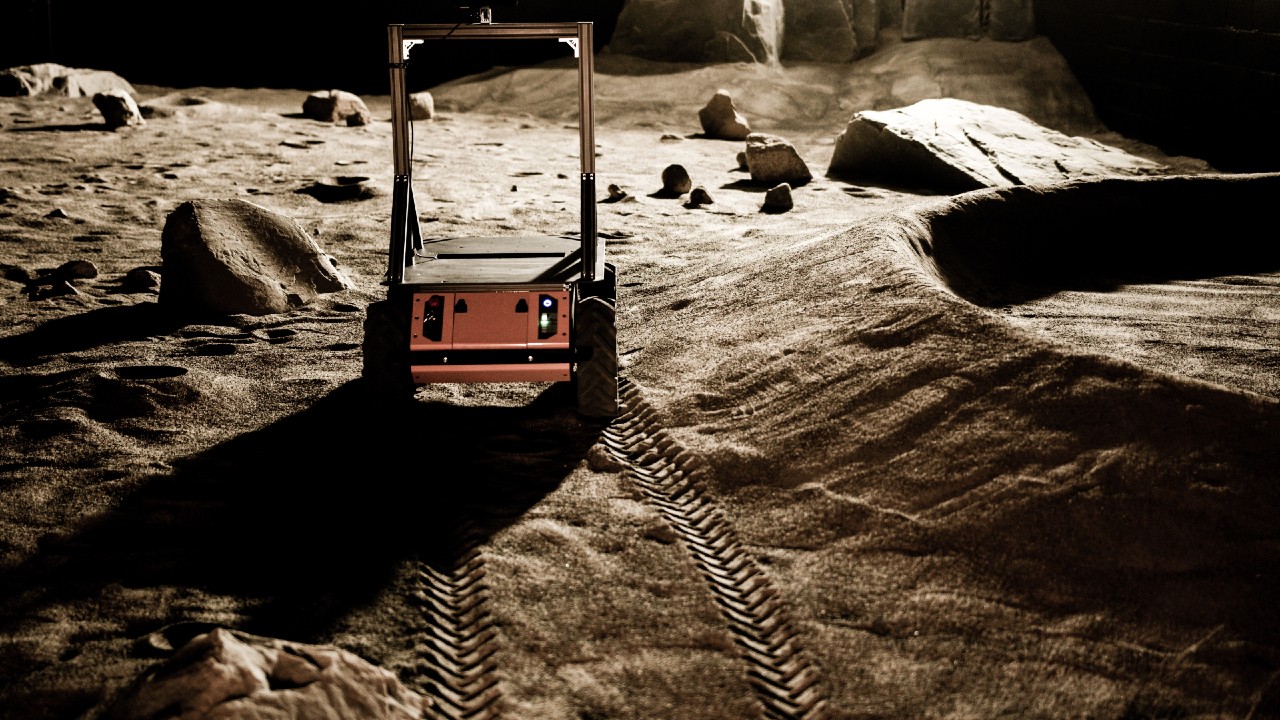
I drove down a quiet street in Ottawa and parked beside an unassuming commercial building. From the curb, there was nothing to suggest a space test operation was underway inside. I walked into the office and was guided past the desks and workstations of Mission Control Space Services before the landscape suddenly changed.
Get Instant Access to This Article
Become an Ottawa Business Journal Insider and get immediate access to all of our Insider-only content and much more.
I drove down a quiet street in Ottawa and parked beside an unassuming commercial building. From the curb, there was nothing to suggest a space test operation was underway inside. I walked into the office and was guided past the desks and workstations of Mission Control Space Services before the landscape suddenly changed. The Moon Yard opened up ahead, and we stepped onto the terrain designed to mimic the geological features of the lunar surface.
Bright lights shone on grainy groundcover and moon rocks as lunar test vehicles sat on a 30-by-20-metre lunar analogue test bed built inside the company’s Ottawa headquarters. Some time later, when I stepped out of the simulated lunar surface, there was sand in my business shoes and dust dulling their shine. It was a simple, almost ridiculous reminder that something extraordinary is happening in this otherwise unremarkable corner of the city.
Mission Control is at the forefront of developing and deploying artificial intelligence for spaceflight. In June 2025, the company launched Persistence, a small satellite designed to test AI flight software in orbit and give machine-learning models experience operating in space.
Now the company is planning to expand its footprint in Ottawa, taking over additional square footage in its building and potentially doubling the size of its office.
“Ottawa is a great place for us to be doing this,” said Ewan Reid, Mission Control’s founder and CEO. “This is where we need to be as a space company. We receive government funding, work with the government as customers and stakeholders, so it’s a really nice place for us to be headquartered.”
Mission Control is not alone in Ottawa. Elsewhere in the city, Telesat is scaling up the size of its Lightspeed constellation following a new federal funding agreement, while Obruta and 3 Canadian Space are developing new capabilities in space and defence.
The businesses are distinct, but their growth points to a common shift, which is that Ottawa is increasingly becoming a place where the infrastructure of the next space economy is being built.
The local space ecosystem
Canada’s space ambitions go back to Alouette I in 1962 and through decades of leadership in satellite communications and robotics, including Canadarm and Dextre. That legacy helped establish the expertise and institutions in today’s industry.
Nowadays, the planet is encircled by a growing network of satellites and spacecraft that has become as essential as roads, power grids and fibre-optic cables. The satellites guide aircraft through crowded skies, synchronize financial markets, monitor wildfires and crops, connect remote communities, and provide the timing and positioning signals that make everything from smartphone navigation to emergency response possible.
The global space economy is entering a period of rapid growth. The World Economic Forum projects it will reach US$1.8 trillion by 2035.
Canada’s space sector contributed $3.8 billion to GDP, up 15 per cent over five years, according to the Canadian Space Agency’s latest State of the Space Sector report.
For Ottawa — already home to some of the country’s largest space technology companies — that shift is creating new commercial opportunities.
Among those involved is Telesat, one Canada’s longest-established satellite operators, which is building its next-generation low Earth orbit constellation to deliver secure, high-speed broadband connectivity for commercial, government and defence customers.
The low Earth orbit satellites are nicknamed LEO and Stephen Hampton, Telesat’s head of global government relations, strategic accounts and business development, said they are “building the capacity to bring reliable, secure broadband connectivity to every square metre of the planet.”
Telesat has been working with MDA Space to grow its manufacturing capability with a new facility in Montreal that will double the capacity of high-volume satellite production.
“Manufacturing used to take us several years to build a satellite,” Hampton explained. “Now we can produce one a day.”
The company is planning to launch two Lightspeed pathfinder satellites later this year to validate performance before broader deployment. Once those tests are complete, Telesat will start launching 156 satellites into operation by the end of 2027.
A new technical operations centre is being built in Gatineau, which will serve as the nerve centre of Lightspeed, where engineers, network and satellite operators and cybersecurity experts will work.
Obruta Space Solutions is also expanding in Ottawa, moving into a larger facility in the St. Laurent Industrial Park. CEO Kevin Stadnyk said the location’s proximity to federal policy-makers and the Canadian Space Agency in Montreal is attractive, while the industrial bay was an important selling point for the company’s operations.
Obruta is part of a new generation of companies tackling a question that didn’t exist in the early days of space exploration: what happens to spacecraft once they’re already in orbit?
As spacecraft become more numerous and increasingly designed for longer missions, the industry is developing new capabilities to refuel, maintain and upgrade them in space, extending their use and reducing the amount of hardware that becomes orbital debris.
“Launches are no longer cost-prohibitive in the way they were before,” Stadnyk said. “And those prices will continue to fall over the next few years.”
Servicing one spacecraft with another requires highly specialized technology and expertise. For Stadnyk, the emerging market represents an unusual opportunity for Canadian companies and investors.
“You only get so many opportunities and the timing is the best in our lives,” he said.
A space-faring nation
The ambitions for Canada’s space sector extend beyond building a healthier commercial ecosystem. They reach all the way to the moon.
Canada’s long-standing contributions to space helped earn the country a place on NASA’s Artemis II mission, where astronaut Col. Jeremy Hansen made history as the first Canadian — and first non-American — to fly around the moon.
For Christopher Horner, commander of the 3 Canadian Space Division headquartered at National Defence in Ottawa, the sense of wonder from the mission around the moon is as powerful today as it was in the earliest days of space exploration.
“This is what gets kids out of bed in the morning wanting to put helmets on to be an astronaut,” he said. “It’s what drives people to dress up as astronauts at Halloween and it’s what inspires high school graduates to enter STEM programs in Canadian universities to become astrophysicists and aerospace engineers, because they truly want to be rocket scientists and send things into space.”
Canadians should feel inspired and proud of what has been accomplished, Horner said, but cautioned that space is also an arena of economic rivalry, technological competition and national defence.
“I don’t really want Canadians to worry about that,” Horner said. “I worry about it every day and it’s the reason I haven’t slept particularly well in two years because there are adversaries with capabilities that would preclude the society we’ve come to enjoy in Canada.”
So what does sovereignty look like in 2026?
“We have decided as a country — a sovereign G7, space-faring nation — that Canada needs to be able to protect and defend its critical national pieces of infrastructure and assets in space,” Horner said.
“We have to continue to use the systems to make this country prosperous, while also supporting our troops in the face of adversaries who may see the world and the responsible use of space differently.
“It’s a really tough business that takes billions of dollars,” he added. “Two years ago, no one who went through university in Canada looked for a Canadian company to build rockets and launch them from because they didn’t exist.”
So new grads looked for work elsewhere and relocated to the United States or Europe.
“Companies are building rockets in Canada, so now there’s a pathway where you can be a rocket scientist. We’re actually doing rocket science in this country,” Horner said. “CEOs are now repatriating Canadians who have worked with SpaceX or Rocket Lab and other companies globally to become very skilled propulsion engineers, satellite communications experts and launch infrastructure developers and many are excited to be able to come and work for Canadian companies because the ecosystem is beginning to exist.”
“We always joke that Canadians are so humble that you won’t find them shouting from the rooftops about our world-class capability,” said Hampton at Telesat. “But we’ve always punched above our weight as a country.”
At Mission Control, Reid said he often hears this about Canada. “I don’t mind the expression, but we have to be careful because if we are punching above our weight because we aren’t funding our space program properly, no featherweight can beat a heavyweight in a fight. They can punch above their weight a few rounds before they get punched out.”
Reid says he’s seen numbers that show that the Canadian economy would lose a billion dollars a day if someone attacked American GPS satellites.
“And every dollar spent in space brings something like four to five dollars into our economy,” he said. “You can’t play catch-up, so we as Canadians need to recognize that and be making moves now.”