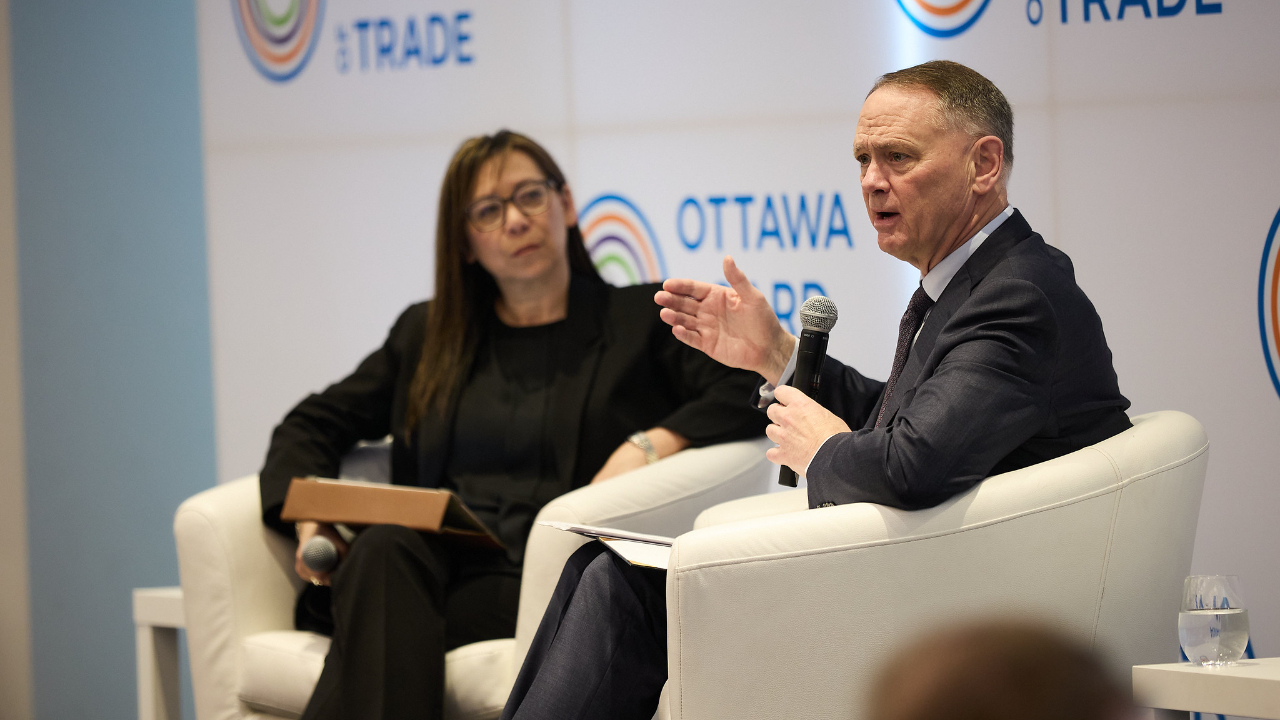
Canadian entrepreneurs must take risks if they want to cash in on billions of dollars in business opportunities as the federal government ramps up military spending, defence minister David McGuinty said Tuesday.
Already a Subscriber? Log in
Get Instant Access to This Article
Become an Ottawa Business Journal Insider and get immediate access to all of our Insider-only content and much more.
Canadian entrepreneurs must take risks if they want to cash in on billions of dollars in business opportunities as the federal government ramps up military spending, Defence Minister David McGuinty said Tuesday.
Appearing at the Ottawa Board of Trade’s Defence Forum, the Ottawa South MP said the federal government is “beginning to streamline and remove some of the systemic barriers” that have traditionally plagued Canada’s defence procurement system.
In a question-and-answer session with board of trade CEO Sueling Ching, McGuinty told an audience of more than 300 business leaders at the National Arts Centre that the government is cutting red tape “right across the system” in an effort to smooth the path for more small and medium-sized businesses to get a bigger piece of the growing defence spending pie.
As an example, he said Innovation, Science and Economic Development Canada is opening a new “concierge service” on its website designed to make it easier for SMEs to access requests for proposals and other information about government defence contracts.
McGuinty said the federal government, which has pledged to raise the share of defence-related contracts awarded to Canadian-owned firms to 70 per cent from its current level of less than 50 per cent, needs domestic defence-tech enterprises to “step up” as the feds aim to boost defence spending from two per cent of the country’s gross domestic product today to five per cent by 2035.
Committing that much money to defending the country’s sovereignty is a “new phenomenon for Canada,” McGuinty added. “We haven’t been this overt. We are now.”
The defence minister called on entrepreneurs to “get involved” with federal organizations such as Export Development Canada and the Business Development Bank of Canada that can provide funding and advice for businesses looking to bring new products to market.
“We’re just beginning, and we need your help to be able to pull this together,” he said. “Take your risks. Get in the game. We can compete, we can win. We’ll provide support, but it’ll be up to you to run with the ball.”
Describing Ottawa’s defence-tech talent pool as “unbelievable,” McGuinty said the federal government already has 323 active defence contracts with companies based in the National Capital Region.
The deals will keep flowing, he added, noting the federal government is “investing very heavily” in the region with projects such as the $1.4-billion modernization of the Canadian military’s special forces base at Dwyer Hill.
Pointing out that 60 per cent of government purchases for the Canadian Armed Forces and the Department of National Defence aren’t for sophisticated technology such as drones and cybersecurity but rather for everyday items such as shoes, backpacks and uniforms, McGuinty urged companies to pursue “plug-and-play” opportunities to tap into the defence supply chain.
Defence primes — the massive, tier-one contractors such as Lockheed Martin that design weapons platforms and manage the network of subcontractors that build the components — are also valuable sources of potential business for local companies, he added.
“I would implore SMEs who are here — yes, drive your technologies … but don’t be afraid to also approach the primes, to find a way to partner, grow,” he said.
McGuinty also said the feds are investing $250 million in new training programs for Canadian Armed Forces recruits and are working with local post-secondary institutions such as Algonquin College to help deliver those programs.
“We’re reaching out to colleges across the country to say, ‘Can you help us quickly turn around the needs that we (have)?’” he said, adding new CAF members often face a wait of six months to two years to access the training necessary to become specialists in their fields.
“There’s a gap there. We are looking to accelerate the speed with which someone leaves the nine-week basic training and starts getting trained in their aeronautical technology program, for example.”
Other speakers at Tuesday’s event echoed McGuinty’s call for entrepreneurs to be bold in their pursuit of defence business.
“People need to feel comfortable failing,” said Josh Ogden, CEO and co-founder of Aerial Vehicle Safety Solutions, a New Brunswick-based company that makes safety products such as parachute recovery systems for drones and operates a facility in Carp.
“As a culture, if we want to innovate, we have to be willing to accept failure. If we want to play in (this field), we’ve got to have that tolerance.
“I supply components to the largest drone companies in the world. Unfortunately, I don’t supply them to any Canadian company because no one produces volume. In Canada, we’ve chosen a path of licensing foreign technology and assembly. We need to start being vertically integrated. That’s where we get prosperous. The gross margins are better, the overall scale of economic impact is greater.”
Sam Witherspoon, chief executive of Ottawa-based Anvil Intelligence, said government procurement officials are often reluctant to approve spending on technology that isn’t tried and true for fear of public backlash.
“We crucify the government when something goes wrong, when a program doesn’t work,” said Witherspoon, whose firm specializes in a platform that uses artificial intelligence to help analyze data for defence organizations.
“It is a persistent problem. Innovation necessarily has a bunch of risk attached to it. It is going to waste taxpayers' dollars. We as a society have to be comfortable with not complaining when things go wrong, when money gets spent that doesn’t yield a very clear ROI. We need to change our mentality and stop yapping in the newspapers when things go wrong. That's a mindset shift that has to occur quickly.”