
Defence and security may dominate headlines in the national capital today, but for the University of Ottawa, the work has been underway for years.
“This is nothing new for us,” says Muralee Murugesu, associate vice-president, innovation, partnership and entrepreneurship in the Office of the Vice-President, Research and Innovation (OVPRI). Murugesu, who is also a professor in the Faculty of Science, has partnered with Defence Research and Development Canada (DRDC) for more than a decade and is currently engaged in projects with aviation and defence firm General Dynamics.
“This is something we’ve already been doing for a while.”
As a research and innovation-intensive university – ranked among Canada’s top institutions for research intensity and revenue – uOttawa has built a broad base of defence-relevant expertise across its 10 faculties. As the only U15 university in the National Capital Region, it operates at the intersection of federal decision-making, industry, and international partners.
That positioning is increasingly important as Canada seeks to strengthen domestic defence capabilities and modernize supply chains.
Scaling mission-driven research
Murugesu’s work focuses on designing and synthesizing novel nanoscale inorganic materials to study their physical characteristics, including magnetism, electrical conductivity and optical behaviour.
His current research explores environmentally friendly energetic materials with dual-use potential in defence and security, mining and related industries.
While university research often centres on experimental deep technologies, he says the current environment is accelerating expectations.
“There’s a clear need for certain technologies that need to be delivered at a faster pace.”
Mission-driven research, he explains, depends on coordinated expertise across disciplines.
“Take a radar system, for example,” Murugesu says. “What do you need for that? You need advanced sensing technology. You need quantum AI. You need semiconductors. And for semiconductors, you need minerals. It’s a value chain that requires contributions from everything.”
That systems-level thinking is reflected across the university. The Faculty of Engineering plays a central role in national security, defence, and aerospace research, with researchers working in quantum technologies, artificial intelligence, cybersecurity, semiconductors and secure communications.
Under the leadership of Professor Caroline Cao, dean of the Faculty of Engineering, the faculty has strengthened its industry engagement to ensure programs reflect evolving sector needs and prepare graduates for direct entry into technical roles.
“Canada’s defence and aerospace sectors need engineers and computer scientists who can solve problems that don’t exist yet,” Cao says. “That means training people who can move across technical disciplines like quantum, AI, and cybersecurity. It also means working closely with industry to ensure our students graduate with the real-world experience and professional skills the sector demands.”
Leadership, talent, and workforce development
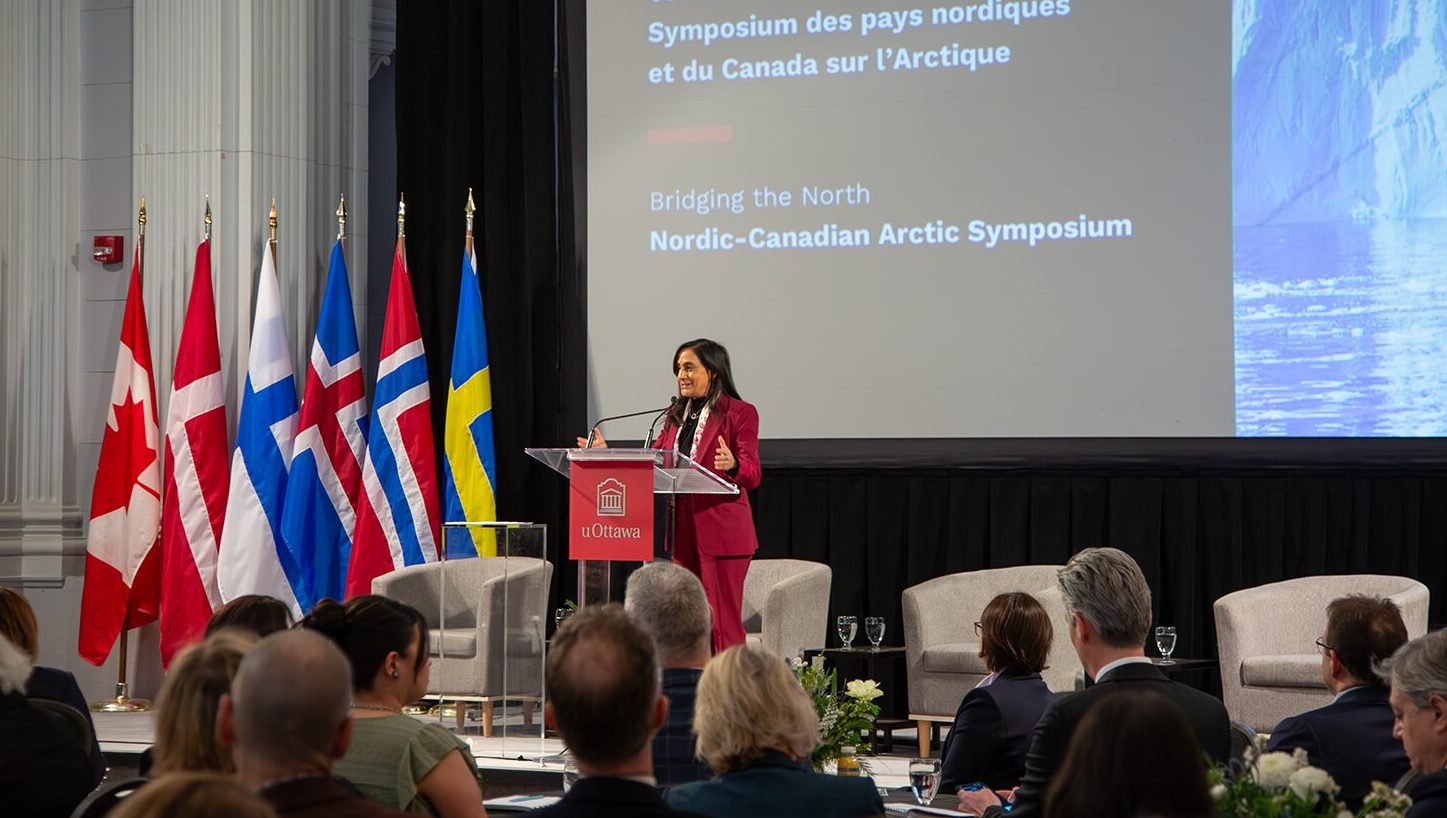
Beyond research execution, uOttawa also plays a leadership role in convening stakeholders shaping Canada’s defence innovation agenda. Through initiatives such as the Arctic Symposium and the National Security Innovation Forum (NSIF), including its Canada–Europe edition focused on strengthening defence and technology collaboration, the university brings together government, the Canadian Armed Forces, academia, and industry.
The institution has also aligned training with sector needs. Program modernization efforts across faculties have integrated industry perspectives to ensure graduates develop in-demand technical skills. Experiential learning through co-op placements and research internships provides applied experience before graduation.
Through its Professional Development Institute (PDI), uOttawa offers a series of defence-aligned programs, including entrepreneurship and coding programs for veterans transitioning into technology and cybersecurity careers.
“By knowing what industry and government needs, we can prepare our graduates to contribute immediately,” Murugesu says.
“These students can slot in very quickly – the ramp up is almost negligible.”
Strategic location and industry proximity
uOttawa’s location in the National Capital Region enables close collaboration with the Department of National Defence, intelligence agencies, and allied embassies, supporting more direct connections between research and operational priorities.
That advantage is reinforced by the university’s Kanata North campus, located in Canada’s largest technology park, where proximity to startups, defence primes, and multinational technology firms facilitates applied research partnerships.
“It’s often assumed that collaborating with the university requires a long lead time. But that’s not the case. We’re ready to go,” Murugesu says.
“Because of all the work the University of Ottawa has been doing for all these years, we’re ready to partner with industry.”