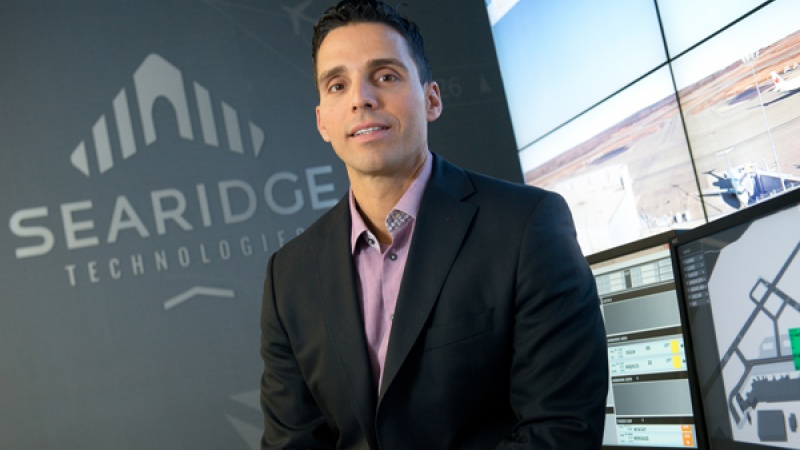

With airports around the world pushing to upgrade and digitize outdated systems, they’re turning to Canadian companies such as Ottawa-based Searidge Technologies.
But as his company expands internationally, Searidge’s CEO says he’d like to see more Canadian airports following the trend.
Already a Subscriber? Log in
Get Instant Access to This Article
Become an Ottawa Business Journal Insider and get immediate access to all of our Insider-only content and much more.
With airports around the world pushing to upgrade and digitize outdated systems, they're turning to Canadian companies such as Ottawa-based Searidge Technologies.
But as his company expands internationally, Searidge’s CEO says he’d like to see more Canadian airports following the trend.
“Over the last year there’s been a lot of talk about Canadian businesses supporting Canadian organizations and I like the thought but, frankly speaking, we’ve seen a lot more growth with airports in the international communities,” Searidge CEO and co-founder Moodie Cheikh told OBJ on Monday.
“I still don’t think this idea of supporting Canadian businesses is something that’s penetrated the Canadian airport market segment, so I would really like to see a little bit more support domestically of companies that deliver useful technology into airport ecosystems.”
One Canadian airport that’s already on board is the Ottawa International Airport, which has become a testing ground for Searidge’s first foray into the SaaS space.
Last July, Searidge announced that it was partnering with YOW to conduct a nine-month demonstration of Smart Stand, a program that uses cameras and sensors to monitor real-time activity at the gates and on the ground to identify safety concerns and predict potential delays.
More than a year later, the partnership is ongoing.
“Ottawa is a little bit smaller than is typical for us,” said Cheikh. “Our broader portfolio is really based around high-intensity runway operations airports. The interesting thing about Ottawa is that it’s actually super busy in peak hours, like six to eight in the morning. We’re always learning when we’re doing projects like this one in Ottawa. This was the first implementation of this analytics capability and it uncovered a lot of different areas that we can be helping airports with.”
In recent years, Cheikh said, many airports have become more determined to modernize. As a result, more are investing in partnerships to bring their systems online. That’s what Cheikh said his company is doing at YOW and at other airports around the world, including in cities like Dubai, Abu Dhabi and Hong Kong, as well as at London Heathrow and the new terminal of John F. Kennedy International Airport in New York.
“The biggest thing is that airports today are a lot more technology-savvy than they were 20 years ago,” he said. “You look across an airport today and they’re the ones driving things like AI, they’re the ones driving technology for efficiency and safety. There was a joke back in the day that airports would spend more on toilet paper than they did on technology. And I think today that equation is reversed.”
Searidge, which was founded in 2006, originally focused on what Cheikh calls “conventional products,” which included hardware and large-scale technology sales that could take up to 24 months to deliver.
But as more airports look to digitize and connect their extensive web of systems, Cheikh said Searidge has moved toward SaaS products. That decision, he said, has allowed the company to grow its customer base, increase sales and generate more consistent revenue.
“The whole idea is to get to a point where a percentage of our revenues is based on recurring revenue from SaaS products,” he said. “That just gives us a bit more foundational revenue, where we don’t have to rely on the peaks and valleys that large systems, integrations-type projects deliver.”
Partnering with YOW, he added, has helped the company fine-tune its products and its strategy.
“We still (sell conventional products) and it’s still the majority of our business, but learning how to evolve from that to selling Saas-type products, that was a really heavy lift for us,” he said. “We didn’t have the resources internally, so it took a pretty significant investment. Ottawa was the perfect partner for us: smaller and it’s local. And just their desire to participate in the local economy and support local tech businesses, it uncovered a lot for us.”
Once airports are fully digitized, Cheikh said the next step is to lean into artificial intelligence. With products like Aimee AI framework for airports and Chorus Digital Platform, which has AI built-in, Cheikh said his company is eager to explore possibilities in the airport space.
“Digitization is really the first step towards the application of AI and that’s one of the big things we’re focused on,” he said. “Before you can do anything with AI, everything has got to be plugged into your wider ecosystem so you can access the data and do something clever.”
In addition to the work it’s doing at JFK, Cheikh said Searidge has plans to expand its offering and its reach with two new partnerships with U.S. airports to be announced in the coming weeks.
“This is beyond my wildest dreams,” he said. “When we first started out, our No. 1 goal at the time was, ‘Can you imagine if we ever got into Heathrow?’ Now, not only are we at Heathrow, but we’re in some of the biggest, most complex airports in the world.”