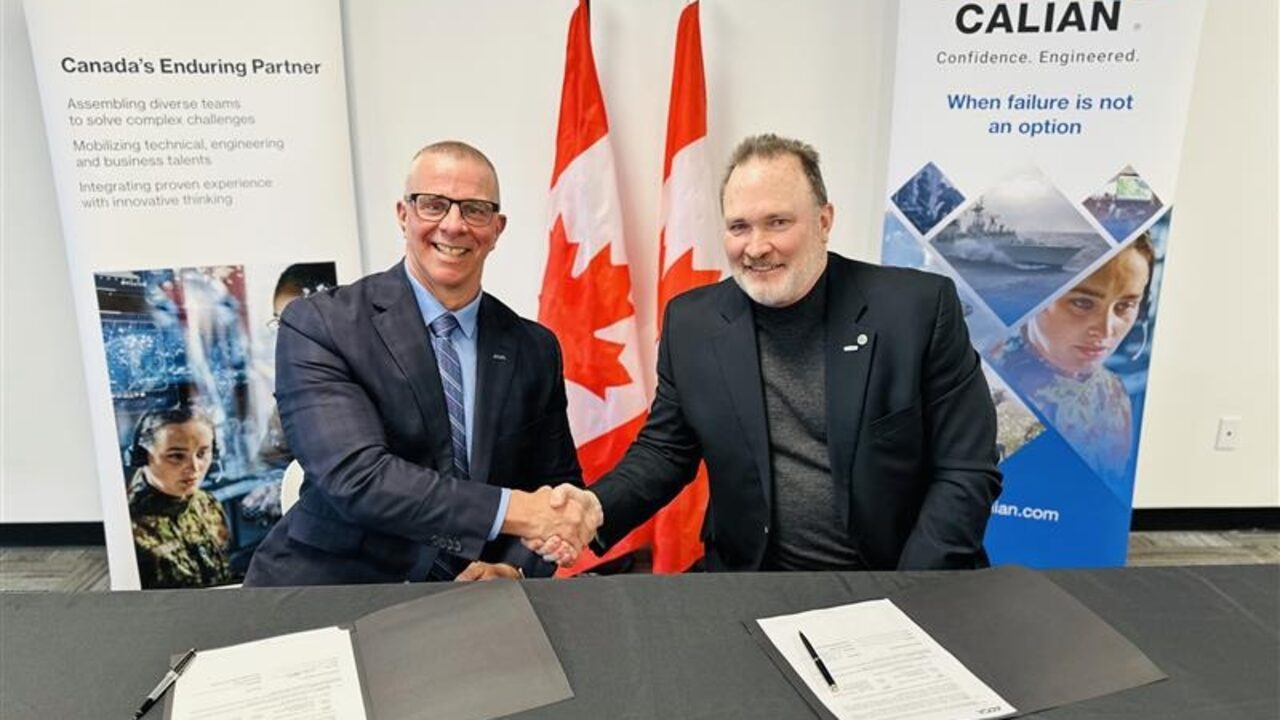
Calian Group and ADGA Group announced Thursday they have signed a three-year agreement to “explore the development of next-generation integrated land training and simulation” tools for the Canadian Army.
Already a Subscriber? Log in
Get Instant Access to This Article
Become an Ottawa Business Journal Insider and get immediate access to all of our Insider-only content and much more.
Two of Ottawa’s most prominent defence and security companies are working together to develop new training technology for the Canadian military in what the firms say could be the first of more partnerships to come as Canada looks to shore up its domestic defence capabilities.
Calian Group and ADGA Group announced Thursday they have signed a three-year agreement to “explore the development of next-generation integrated land training and simulation” tools for the Canadian Army.
The deal follows the unveiling of the federal government’s new defence industrial strategy on Feb. 17. The program aims to pump billions of dollars into Canadian small- and medium-sized businesses by identifying areas where homegrown firms can provide innovative solutions to the Canadian Armed Forces.
Chris Pogue, president of Calian’s defence and space division, described the DIS as “a call to action” for Canadian defence companies.
The new strategy “will take time to evolve and become fully mobilized,” Pogue said in an interview with OBJ on Thursday. “But I think Canadian industry needs to act differently than we would have historically, and this (partnership with ADGA) is a great example of that behaviour in action.”
So far, Pogue said, the two companies have come up with a “partner framework” that outlines how they’ll collaborate to create training simulation software and tools that replicate real-world battlefield environments as closely as possible.
“A lot of that will get defined as we work together,” he explained. “We see the potential for ADGA and Calian to build capability that will be increasingly deployed in the field.”
ADGA president and CEO Jean-Marc Lanthier said military combatants are faced with increasingly sophisticated technologies such as drones that are changing the way warfare is conducted.
He said ADGA and Calian want to “close the gap between simulation and real life” so that soldiers will be better prepared to deal with such threats in the future.
The two companies have different strengths, and by joining forces they can create better training equipment than either firm could build on its own, Lanthier explained.
Calian brings a “wealth of expertise” in training simulation software and technology to the table, he said, while ADGA specializes in cybersecurity tools as well as systems that form the backbone of command-and-control platforms that help soldiers communicate with each other and share data in the field.
“It’s combining that complementary expertise into trying to develop the best, most effective and affordable solutions for the Canadian Army,” Lanthier added.
Pogue said there “isn’t much of a dividing line” between training and operations in the modern military, adding he believes the two companies can develop solutions that will quickly prepare soldiers to work in harsh environments such as Canada’s Arctic.
“If we accept the fact that the training world and the operational world are no longer really separable, I think that combination means that we will develop capability that will allow us to fight as we train, and train as we will fight in the future,” he said.
Calian now provides training solutions to some of Canada’s other NATO partners in Europe, giving the company a first-hand look at how cutting-edge technologies such as drones are being deployed in conflicts in Ukraine and other areas, Pogue said.
“Those kinds of concepts need to be brought back to Canada to develop how the army will operate in the future,” he explained. “We’re really well-positioned to do that because we’re in that theatre today.”
The agreement is the latest sign of growing co-ordination between Canadian defence firms as the country looks to lessen its dependence on U.S.-based defence firms for military technology.
Earlier this week, for example, a new Ottawa-based association officially launched with the aim of giving domestic defence builders and suppliers a bigger voice in how the government spends on defence.
Dubbed the Alliance of Canadian Defence Companies, the new group bills itself as “an industry-led trade association” that will lobby government and “foster deeper co-ordination across the defence supply chain” as Canada looks to beef up its domestic defence capabilities.
Pogue said companies that have traditionally competed against each other for government contracts are now realizing it’s sometimes better to put their heads together for the betterment of the Canadian defence industry as a whole.
“I think we'll see more of these kinds of relationships, not less, in the future,” he said. “There will be other partnerships with other parts of the Canadian defence ecosystem to deliver other pieces of the capability that Canada needs.”
Lanthier agreed Canadian defence firms need to look at new ways of confronting the challenges of modern warfare, including partnering on projects when it makes sense.
“There is now a renewed interest in what defence brings to the economy of this nation,” he said. “We’re still competitors, but there are areas where our capabilities complement each other. The industry sometimes has gone its own way. I think what we’re demonstrating here is that industry can work together to deliver what the Canadian Armed Forces need and the government of Canada is trying to do.”
Defence spending is poised to jump dramatically in Canada over the next decade, and Prime Minister Mark Carney has pledged to ensure domestic firms get the lion’s share of lucrative new contracts to supply equipment and services to the military.
Carney has said about 75 per cent of Canada’s defence budget currently goes to purchase U.S.-built equipment. But Pogue said he doesn’t see the push to bolster the Canadian defence industry as an us-versus-them situation.
“I don’t think it’s about competing against the U.S.,” he said. “What I think this is about is building Canadian capability that makes us an even more valuable ally to the U.S. and to our NATO partners. I think that we are uniquely positioned in certain areas where Canada could lead the world.”