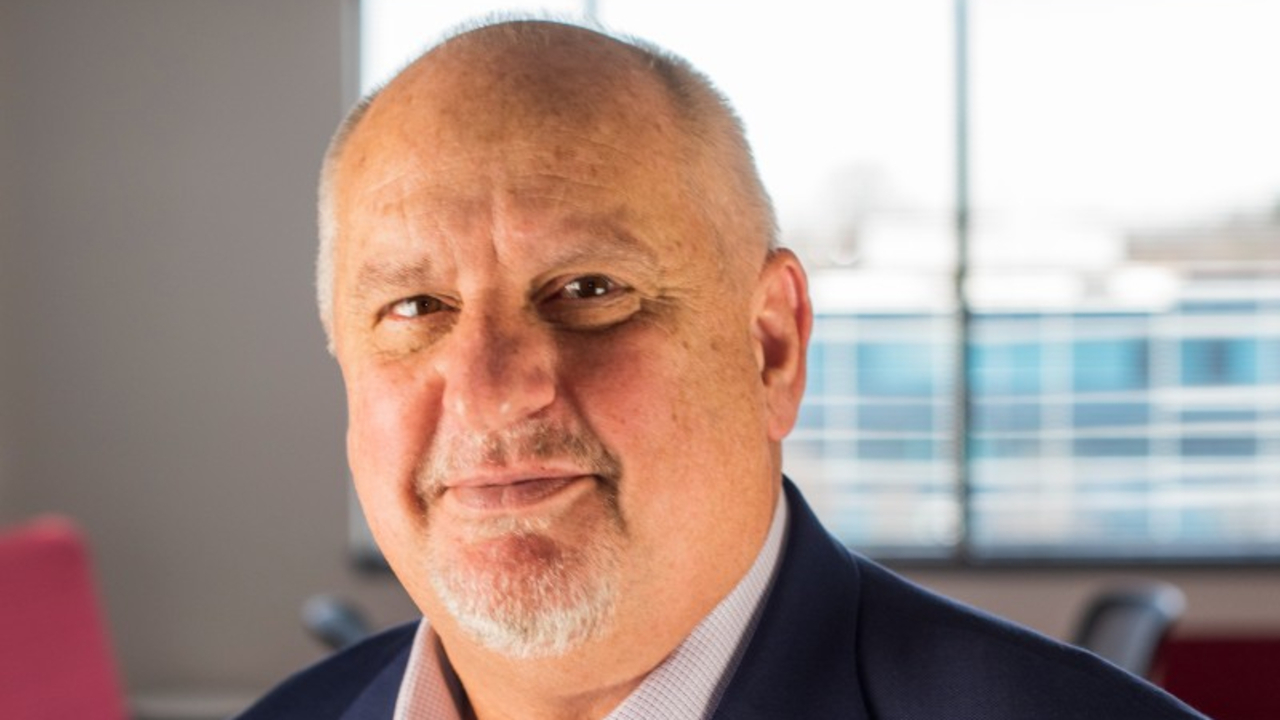

Mike Robinson might still be getting his feet wet as Mitel’s CEO, but his new employer’s home base of Kanata is familiar ground for the veteran U.S.-based telecom executive. Robinson, who assumed the top job at Mitel earlier this month, previously spent a dozen years as CEO at Broadview Networks, where he spearheaded the New […]
Already a Subscriber? Log in
Get Instant Access to This Article
Become an Ottawa Business Journal Insider and get immediate access to all of our Insider-only content and much more.
Mike Robinson might still be getting his feet wet as Mitel’s CEO, but his new employer’s home base of Kanata is familiar ground for the veteran U.S.-based telecom executive.
Robinson, who assumed the top job at Mitel earlier this month, previously spent a dozen years as CEO at Broadview Networks, where he spearheaded the New York-headquartered company’s transformation from a local telecom service provider to cloud-based unified communications-as-a-service company before exiting in 2017.
While at Broadview, he was a “fairly large” customer of Mitel, buying handsets from the global provider of unified communications products and licensing some of its technology. Later, Broadview had a core of developers based in Ottawa that built its own communications products, and Robinson was a regular visitor to the nation’s capital.
Now, Robinson is getting reacquainted with both Mitel and Ottawa.
He’s taking the helm of a venerable name in telecom, but Mitel has gone through some tough times of late. The firm recently emerged from creditor protection and is now getting back on its feet under new ownership after signing off on a financial restructuring plan that slashed its debt and provided the company with US$125 million in new funding.
Still, Robinson – who holds a degree in business and economics and describes himself as a “business generalist” – seems eager to embrace the challenge. He recently spoke with OBJ reporter David Sali about the task ahead and why he believes Mitel will emerge from its “do-over” stronger than ever. This is an edited transcript of that conversation.
OBJ: You’ve worked at other companies that have gone through restructuring. How do you think that experience will help you in your new job?
MR: Nobody jumps into being in the restructuring world – sometimes it happens around you. It just becomes part of the task that you’re dealing with. We were fortunate in this case that we had a lot of support from our largest prior debtholder, now shareholder, who sits on the board. Unlike some boards that get staffed with people who are all post-restructuring people, we had, prior to me taking the CEO role, five of us that were all operators by nature. Everybody has kind of a role and a skillset. There’s go-to-market, there’s finance, there’s product. So there’s people that have a niche expertise that we can bring to the management team. That way, everybody is kind of rowing the same boat but with a different oar, is the best way to put it.
OBJ: In some ways, Mitel is getting a new life. How do you hope to take advantage of that?
MR: We did a town hall yesterday and one of the words I used is, it’s a do-over. One of the good things that comes out of a restructuring if you take advantage of it is, you get a breath, you get a new balance sheet, you get new partners. And the key is, don’t squander that opportunity. Move with some reasonable haste, revisit not everything, but take a clean look at what you’re trying to do. And sometimes skinny back the number of challenges. Companies like Mitel that have been around decades, you’re in everything. You have to back up at the right time and say, ‘Let’s make sure we focus on doing the things we do the best.’ We’re in that assessment period right now and looking at what we do with this do-over that we’re in the middle of.
OBJ: Are there any areas where you feel Mitel should really focus on and become a global leader in the hybrid communications space?
MR: There’s no hard right turn here. There might be some tilts on things, but nothing that says, ‘Stop doing something completely.’ We need to find where we can be successful, and that’s part of what we’re doing is finding out where we make money, where we don’t make money. I had a director a long time ago who said, ‘Have we earned the right to win people's business?’ In the legacy Mitel world, that’s a hard yes, for sure. Anything new, anything that’s outside our control – the cloud world, the hybrid world, the collaboration world – we’re all feeling our way through this next universe. I think we have to, like any good company, make sure we are prepared to win. Can we go to a customer and prove to them, day in, day out, that we have the right to win their business? And then you have to earn it every day, particularly when we go from more of a one-time perpetual licence kind of world to recurring revenue. I think we are confident on all fronts. The post-restructuring world is a little bit different than running a steady-state, start-from-scratch growth thing, but fundamentally nothing changes inside the business, other than you’ve got me here. I come at it with a perspective of move quickly, make decisions, earn people’s business every day, and we will prosper as a company.
OBJ: Mitel was a leader in on-premise communications hardware and software, then made a concerted effort to move into the cloud. Now, in a hybrid communications world, where does the company fit?
MR: I think we have to be prepared to go wherever our customer wants us to go. There was a push to go to the public cloud, and more complicated, sophisticated organizations pretty quickly realized they need public and private and hybrid (cloud). What that speaks to first is being close enough to our customers, either through direct or indirect channels, to be that true, trusted adviser. We know it’s not a one-decision thing. It’s an evolution from some environment they're in today to the one that they will ultimately end up in two or three or five years down the road. I don’t think there are many people who can deliver enough solutions that they own every part of it. I think we will continue to be a heavy innovation company. That’s a big building block.
OBJ: Are there any particular verticals or geographies where you really think Mitel can make hay?
MR: That's one of the exercises we’re doing. When you’ve been around as long as Mitel has, if you ask basic questions like where are we most successful or why are we most successful, you don’t always know that because inertia carries the business. We get a short window to step back and really assess our strengths, our opportunities, our challenges and (figure out) how do we optimize this next chapter. I do think we will make that assessment and focus on things where we have the best chance to be the top performer in our markets or product sets.
OBJ: AI and machine learning are all the talk these days. What do you think Mitel’s strategy in that area will look like?
MR: I think our focus is just figuring out what AI means to us. I go back 10 years ago. What did cloud mean to people? It meant whatever somebody thought it meant until it became implementable. I think that’s where AI is for the industry in general. It’s real, but it’s mainly driving infrastructure demand, it’s driving hyperscale data centre demand. We, as a legacy communications systems provider and now moving toward hybrid and cloud environments, where does AI fit into that?
OBJ: Mitel has thousands of workers, but only a few hundred are still located in Ottawa. How important is the National Capital Region to Mitel today?
MR: I think it’s extremely important. The reality is we’ve become a global company over the years through acquisition and through centres of excellence for engineering and development. We have a senior leadership team that reports directly to me, and one of the reasons I came here first is I would say this is the largest single concentration of that entire group. If you look at the senior and executive leadership teams, there are probably 20 people here out of 50 or 60 or 70 (in the entire company). We are truly global, and I think that's a good thing, because it’s easy to get very insular and not outward-looking enough. We just have to work hard being one of those companies that stay closely co-ordinated among each other. Ottawa is absolutely an integral part (of the operation) – officially headquarters, but headquarters is a nebulous thing in a virtual world.
OBJ: What are some potential roadblocks you’re keeping an eye on?
MR: One is not moving fast enough. When you’ve been around, and we have an install base and we have a brand, we have that kind of rhythm and cadence. The world moves a lot faster than it used to. You look back 50 years, things stayed the same for a decade or longer. Now things are changing by quarter and in real time around us. I think that requires us to balance our view of Mitel inside but have a keen view of what is happening on the outside of the company. We’re going to make sure the leadership team stays laser-focused on what’s going on in the world around us. It doesn’t keep me awake at night – it’s just an important part of our new DNA in this next chapter.