Get Our Email Newsletter Local news about the companies, people and issues that impact business in Ottawa and beyond delivered to your email inbox.
When Sara Fortier returns to Ottawa next month to launch her debut book, Design Research Mastery, she’ll do it at Bayview Yards, surrounded by the design community she helped build. It’s a long way from the one-bedroom Cooper Street apartment where she started her company Outwitly in 2016 with no business plan and a cat […]
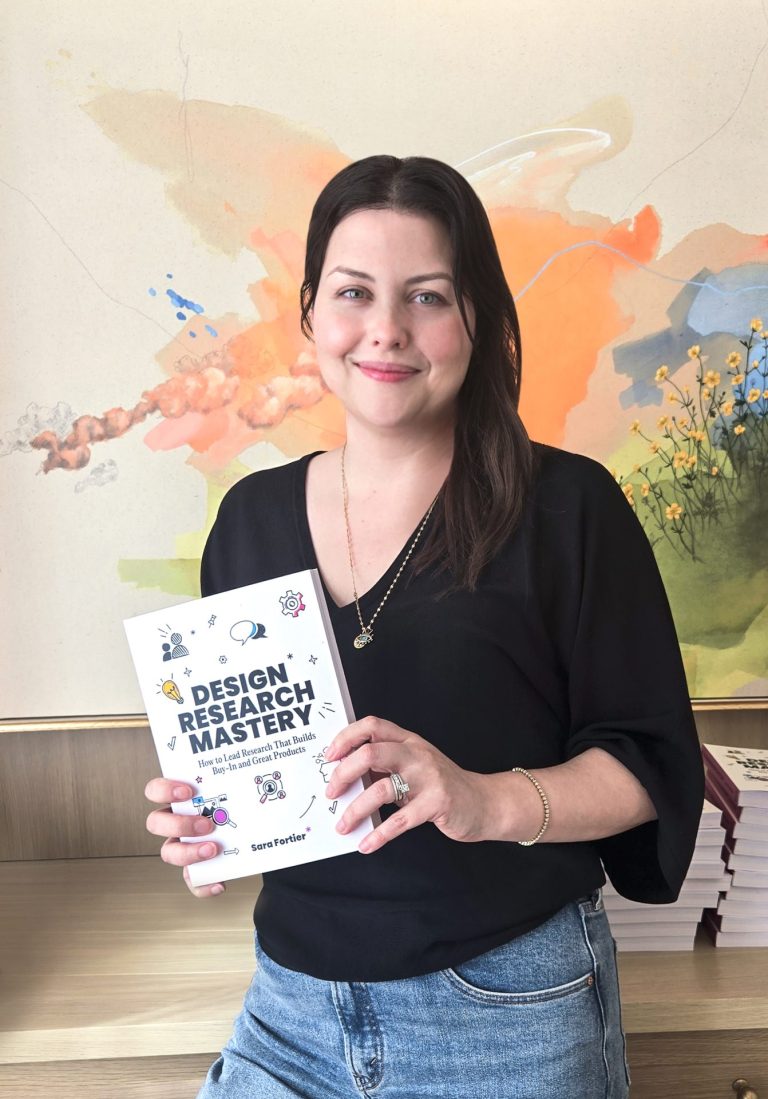
When Sara Fortier returns to Ottawa next month to launch her debut book, Design Research Mastery, she’ll do it at Bayview Yards, surrounded by the design community she helped build. It’s a long way from the one-bedroom Cooper Street apartment where she started her company Outwitly in 2016 with no business plan and a cat to keep her company. A decade later, the Carleton grad’s user experience (UX) design and research firm pulls in more than $12 million in annual revenue and her book arrives at a moment when the industry she’s built her career around is being reshaped by AI. Fortier thinks the human side of design is exactly what machines cannot replace. Outwitly now has 20 employees and 60 contractors working for clients across North America in both the private and public sectors. The book, which took two years to write and attracted interest from five publishers, is a practical guide to conducting design research and an argument for why that matters right now.“It does make me stress. I’m not gonna sit here and say, ‘Oh, I’m not worried about AI at all,” Fortier told OBJ in an interview. “But AI can’t replace a lot of the humanness that is about our day-to-day work.”Outwitly founder Sara Fortier with her debut book, Design Research Mastery. Photo supplied.A big part of that work, according to Fortier, is bringing stakeholders together, facilitating difficult conversations and aligning teams around shared goals. AI can speed up prototyping and handle repetitive tasks, but it can’t navigate the organizational politics that determine whether good research actually changes a product. “The things that we love, which is usually the strategic piece, that stuff can stay with the designers and researchers,” she said. “But the actual iterative prototyping, the grunt work, can be taken by AI.”The book also responds to a shift in the UX industry. The post-COVID digital transformation boom created a wave of specialist roles, she explained: UX designers, UX researchers, UX writers and others. But the economy has tightened and Fortier has noticed those roles are collapsing back into generalist positions. She said many of those specialized people now need to learn skills they hadn’t developed before. “They tend to talk in jargon and process and things that businesspeople don’t care about,” she said. “So it’s about training them how to speak the language of someone running a business.”She almost didn’t finish the book. Last summer, as AI tools advanced rapidly, she found herself questioning the entire project. “What is the point of even writing this book?” she recalled thinking. “Who will ever even continue to do research?”But now she believes the timing is perfect. Fortier grew up in Chelsea, Que., and completed both her undergraduate and a master’s degree in interdisciplinary design at Carleton University. Her early career included a stint at Macadamian, the Ottawa-based consulting firm, before moving to San Francisco and spending four years working in the grind of Silicon Valley. She described that experience as a culture shock. “Sometimes they would yell in meetings and they would all shake hands after, like it was not a big deal,” she said. “But for me, a girl from Ottawa, I was like, oh my god, are we okay?”She also found the social environment one-dimensional. “Everyone there is only there for work,” she said. “That’s all they talk about. That’s all they do, is work and work and work.”She moved back to Ottawa in 2016, partly to be closer to family and partly because she saw an opportunity. UX design wasn’t widely understood in Canada at the time and she wanted to bring what she’d learned back with her. “I’ve worked for other firms before and other companies and (I thought) all of you are not doing it in a good way and I can do this much better than all of you,” she said of her mindset at the time. “So I think, with that bravado, I just started my own firm.”Entrepreneurship wasn’t foreign to her. Her parents ran an acoustic consulting business in Ottawa, now taken over by her brother. “I grew up with them at the table talking about business and their clients,” she remembered.Still, the early days were lean. Fortier did everything herself: admin, marketing, client delivery. A turning point came when she noticed growing demand for staff augmentation, where Outwitly would place full-time designers and researchers within client organizations, instead of traditional consulting work. “My initial instinct was, well, that’s not really consulting, we don’t really do that, so I’m not going to do it,” she said. “But I instead dipped my toes in and was like … maybe I can do it differently than how other IT recruiting firms do it.”The pivot paid off. Staff augmentation is now the majority of Outwitly’s business. But growth wasn’t driven by sophisticated systems. “People ask me, how did you scale your business?” she said. “And I wish it was because I have amazing processes and systems. But, to be honest, it was just sheer hard work. I used to do 40 interviews a week.”Fortier moved to Winnipeg in 2018 with her husband, whom she met while working in Silicon Valley. She kept the company Ottawa-based, flew in for meetings and quietly pushed clients to take calls remotely, well before COVID made that normal. She didn’t even tell clients she had left the city. Her first hire came in 2019, when she was pregnant with her son. It was her best friend from Carleton, who took over communications and administration. The team started growing in earnest around 2021. The company recently moved its headquarters to Calgary from Ottawa for tax purposes, but Fortier said Ottawa remains her home. This is why she chose Ottawa over Toronto for her book launch. “I know and love Ottawa,” she said. “I feel like those people know and love me and that they would be good supporters. My family is there, my friends, my parents. Launching a book there feels like a big celebration.”She also says that Ottawa's UX landscape has changed significantly. While the concept was not widely understood in Canada in 2016, that has shifted, she said, in part because of companies like Shopify that built large UX teams and raised the profile of the discipline. She also pointed to a growing design community within the federal government and credited local post-secondary programs with feeding talent into both the private and public sectors. “People went to those programs and now are working in Ottawa at the tech companies and even within government," she said. "There's a huge design community within government there."Looking ahead, she’s focused on finding growth despite a turbulent economy and shifting geopolitics. “Where is the opportunity? Because there’s always opportunity. You just have to look in the right place. The money shifts, but it’s still there.”She also plans to travel more and reconnect with the broader Canadian design community in person, something that’s been hard with two young children. Her daughter just turned two.“I feel like they can stay with dad for a few days now,” Fortier said with a laugh.