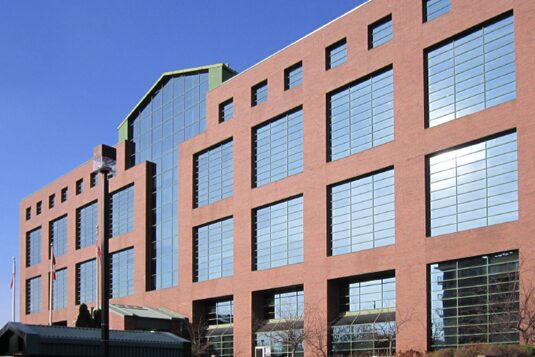
Ottawa property investment company Regional Group has submitted an application to the city to convert a Westboro office building into housing.
Already an Insider? Log in
Get Instant Access to This Article
Become an Ottawa Business Journal Insider and get immediate access to all of our Insider-only content and much more.
- Critical Ottawa business news and analysis updated daily.
- Immediate access to all Insider-only content on our website.
- 4 issues per year of the Ottawa Business Journal magazine.
- Special bonus issues like the Ottawa Book of Lists.
- Discounted registration for OBJ’s in-person events.
Ottawa property investment company Regional Group has submitted an application to the city to convert a Westboro office building into housing.
The application, which was submitted in late November, is a proposal to turn the seven-storey office building at 495 Richmond Rd., between Broadview and Golden avenues, into 143 residential units.
According to the application, the conversion wouldn’t require any changes to the existing footprint of the building.
The irregularly shaped property is about 7,530 square metres, with 16 metres of frontage on Richmond Road. The surrounding neighbourhood includes residential, from low- to highrise to the west and south, as well as a park, garden and restaurant on neighbouring sites. The Kichi Ziki Mikan Parkway is to the north.
The property also includes a surface parking lot of undisclosed size.
Built in 1983 and last renovated in 2012, the seven-storey Class-A building with 94,000 square feet of office space was previously occupied by the Canadian Institute for Health Information, which relocated to Constitution Square.
In 2019, Winnipeg-based Artis REIT announced that it would sell the building to an undisclosed owner for $39 million.
In October 2025, the building was put up for lease. According to a report from CBRE released this week, the property “came to market fully vacant in the previous quarter.”
The proposal is just one of a few potential office-to-residential conversions across the city. According to CBRE, a number of potential conversions remain in the planning process, including the Jackson Building at 122 Bank St., a federal government property that was included on the disposal list in 2023 and was mentioned by Prime Minister Mark Carney at a December event in Ottawa as having potential for conversion to affordable housing.
In the downtown, Ottawa engineering firm Novatech has submitted an application to convert a six-storey office building at 240 Bank St. into residential, with 45 units and 183 square metres of ground-floor retail.
Nearby at 396 Cooper St., Mortar Land Development Consultants has proposed converting a four-storey office building into 33 residential units, while retaining 300 square metres of existing ground-floor commercial space.
KTS Properties filed a plan last year to turn an eight-storey, 55,000-square-foot office building at the corner of Bronson and Carling avenues into a 70-unit rental complex with ground-floor retail space.
KTS is also in the process of converting another former office tower at 130 Slater St. into a 204-unit apartment building.
Other companies with conversion projects in the pipeline include CLV Group, which is gutting the Narono Building at 360 Laurier Ave. W. and creating 139 rental apartment units, and District Realty, which is redeveloping an 11-storey office building at 200 Elgin St. into a multi-residential complex.
East of Bank Street, District Realty is currently redeveloping an 11-storey office building at 200 Elgin St. into a multi-residential complex.
While conversions appear to be gaining momentum, some industry insiders caution they are not the solution to reducing Ottawa’s growing glut of lower-quality downtown commercial real estate.
Alan Doak, a principal at Proveras Commercial Realty who specializes in brokering office leases for tenants, told OBJ in October the costs associated with gutting aging office towers and rebuilding their interiors are a major roadblock for many developers.
“There isn’t a lot of demand for one-bedroom apartments that are north of $2,000 a month, and that is generally what these conversions are designed for,” Doak said, adding he thinks the city is nearing the “saturation point” for such projects.
With files from David Sali