The Jackson Building in Ottawa’s downtown core could be one federal property earmarked for conversion to affordable housing as the City of Ottawa and the federal government work to create more affordable and mixed-use housing in the nation’s capital. At a Mayor’s Breakfast event on Monday morning, Ottawa Mayor Mark Sutcliffe was joined by Prime […]
Already an Insider? Log in
Get Instant Access to This Article
Become an Ottawa Business Journal Insider and get immediate access to all of our Insider-only content and much more.
- Critical Ottawa business news and analysis updated daily.
- Immediate access to all Insider-only content on our website.
- 4 issues per year of the Ottawa Business Journal magazine.
- Special bonus issues like the Ottawa Book of Lists.
- Discounted registration for OBJ’s in-person events.
The Jackson Building in Ottawa’s downtown core could be one federal property earmarked for conversion to affordable housing as the City of Ottawa and the federal government work to create more affordable and mixed-use housing in the nation’s capital.
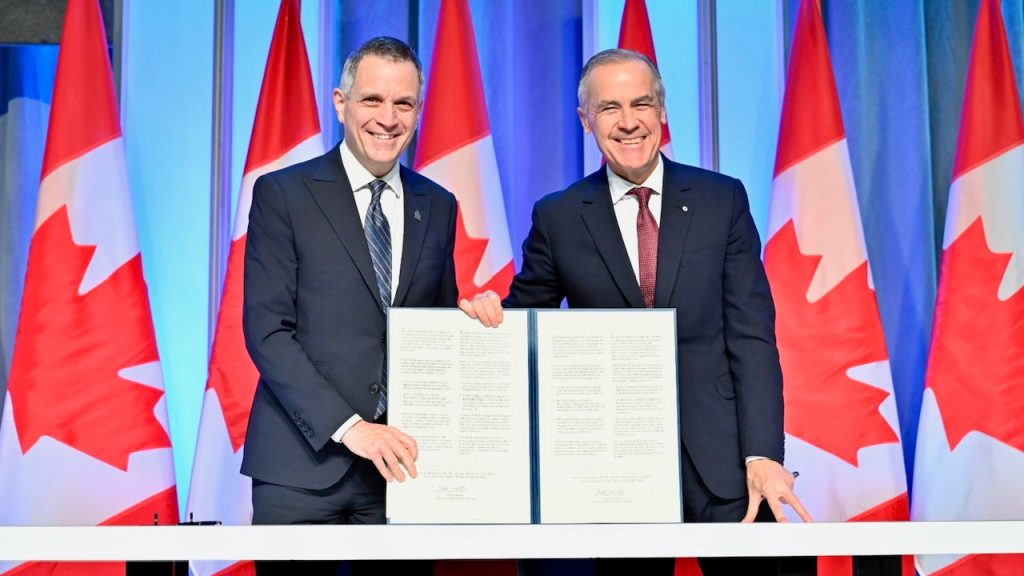
At a Mayor’s Breakfast event on Monday morning, Ottawa Mayor Mark Sutcliffe was joined by Prime Minister Mark Carney to speak to a business crowd of more than 1,000 people. One of the announceables was a new partnership between the municipal and federal governments, with a goal of building up to 3,000 mixed-income and affordable housing units beginning next year.
Subject to city council approval, a joint investment of $400 million would see the City of Ottawa fast-track the construction of 2,000 mixed-income and affordable housing units on federal lands, including by reducing or waiving development charges, permit fees and property taxes.
At the same time, the new agency announced by the federal government in September, Build Canada Homes, will deploy financing for 1,000 affordable housing units from the City of Ottawa's slate of housing projects.
Finally, the partnership, estimated to be worth $400 million, will streamline permitting and development timelines to build more homes, according to a news release.
Projects under the partnership would use modern construction methods and operate under the government's Buy Canadian Policy, which prioritizes Canadian lumber and other domestically sourced materials, the release said.
Ottawa is the first Canadian municipality to secure such an agreement with Build Canada Homes.
“Ottawa is leading the way on building more homes, and building them faster,” said Mayor Sutcliffe in a news release. “This agreement demonstrates our strong working relationship with the federal government, and our shared commitment to building more affordable homes. Thisrepresents hundreds of millions of dollars in new investment in housing in Ottawa.”
“By fast-tracking and streamlining the permitting and developing, building faster on federal and municipal lands, attracting private capital and building Canadian, this partnership between the (City of Ottawa) and Build Canada Homes is a model for how we need to build across this country,” said Carney in his remarks on Monday.
At the event, Carney cited the Jackson Building at 122 Bank St., which is currently on the federal government’s disposal list and listed in the Canada Public Land Bank alongside other properties in Ottawa such as L’Esplanade Laurier, as a possibility for conversion.
“Over the course of the new year, the federal government will transform the Jackson Building (with) the Canada Lands Company. We will be able to use this vacant space to build new affordable housing,” Carney said in French in his opening remarks.
“We’re going through all of our federal lands and looking for opportunities to make those lands available for affordable housing,” Carney said later at the event.
Speaking to the media after the event, Sutcliffe said more details about which buildings and federal lands will be chosen as well as the timeline and cost of the project will be included in a report to council early next year.
Shawn Hamilton, principal at Proveras Commercial Realty in Ottawa, told OBJ on Monday that the Jackson Building is a “strong candidate” for residential conversion.
“The naming of the Jackson Building makes sense to me. It’s well-positioned. It’s got a floorplate size that would lend itself to conversion,” he said, adding that the building’s proximity to transit and other amenities also makes it a good candidate.
Hamilton said the Jackson Building falls into the “sweet spot” of floorplate sizes for residential conversion.
“If the floorplates are too large, it becomes inefficient to subdivide the floorplates down into apartment-sized units, so they’re not like a bowling alley or inefficiently large … The City of Ottawa planning guidelines recommend a floorplate of 8,500 to 11,000 square feet. Anything larger than that becomes inefficient, and the Jackson Building falls into that sweet spot.”
While there are no further details from the federal government on what other buildings might be considered for residential conversion, Hamilton said buildings such as L’Esplanade Laurier, the Sir Charles Tupper Building on Riverside Drive and the Edward Drake Building on Bronson Avenue would not be good candidates for conversion.
“You’d make bowling alley-type environments so that everybody has access to a window and natural light. The distance from the elevator core to the perimeter of the building is too great,” he said of L’Esplanade Laurier. “If you’re making 3,000-square-foot units from that, (L’Esplanade) Laurier might work, but the market doesn’t look for 3,000-square-foot units.”
Hamilton said he was unclear on what next steps will look like.
“(The federal government) going on the record and saying that (the affordable housing project) will start in 2026 was positive. The question is, what is starting in 2026? Does that mean hammers start swinging in 2026? Does it mean there will be a public process to dispose of the building, or does this mean that the federal government will be undertaking the conversion?” he said.
He added that the private sector will be looking forward to knowing more details.
“The good news is that, if the private sector is to play a role in this, the faster they can have the details, the faster they can contribute to helping alleviate the pain of affordable housing … We’re all coiled like a spring on how we can help and those details will matter.”