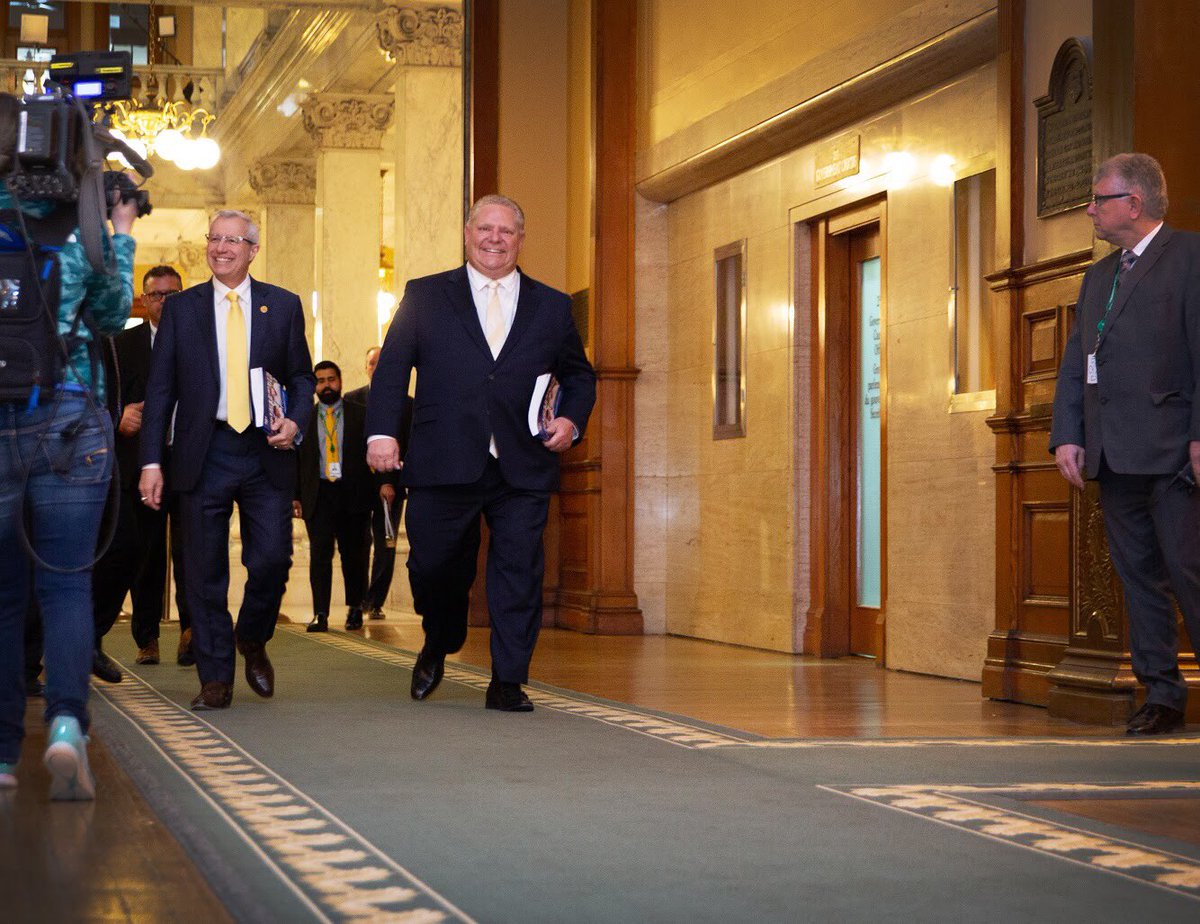

The Ontario Progressive Conservative government’s first budget contained a few items just for Ottawa, and several more that are bound to have an impact on local businesses.
Major project support
The biggest-ticket local item in the province’s 2019 fiscal blueprint is the previously announced $1.2 billion in funding for the second stage of Ottawa’s light-rail transit system. Premier Doug Ford was in Ottawa last month to reaffirm the province’s contributions to the $4.7-billion project, but stopped short of committing to future stages of LRT out to Kanata, Stittsville and Barrhaven.
In a statement Thursday evening responding to the budget announcement, Mayor Jim Watson said the $28.5 billion pledge to expand Toronto’s transit system is a promising indicator that Ontario might support further extensions to Ottawa’s LRT.
The budget also pledged support for the design and construction of a new Children’s Treatment Centre at the Children’s Hospital of Eastern Ontario as well as the new Civic Hospital, though specific dollar amounts were not included.

Making the grade
Ottawa’s universities and colleges will soon switch over to a new outcomes-based funding framework. The PC government said in its budget it will negotiate new agreements with 45 post-secondary institutions – including Carleton University, the University of Ottawa, Algonquin College and Collège La Cité – by the end of next March to make the province a “national leader” in outcomes-based funding.
The province said only a small proportion of funding has been linked to institutional performance in recent years – 1.4 per cent for universities and 1.2 per cent for colleges – but that will go up to 60 per cent in the next five years. The first year of the new agreements will tie 25 per cent of funding to outcomes, and that proportion will rise annually until 2024-25.
The government did not specify what criteria will be used to evaluate post-secondary performance, saying it will work with institutions to develop the metrics. Graduation and employment rates are already used to gauge performance.
Ottawa’s AV hub to get a boost
A section in the budget concerning Ontario’s automotive sector included a few notes to advance autonomous vehicle development in the province.
The document mentioned plans to “enhance” Ontario’s Autonomous Vehicle Innovation Network with the addition of a “wintertech” stream to test AV capabilities in the harshest winter conditions. Local autonomous vehicle developers have mentioned Ottawa’s four-season climate as a boon for testing self-driving and connected car systems.
The budget also included plans to increase funding for AVIN’s TalentEdge program, which supports internships and research on autonomous vehicles. Dollar amounts for the new and expanded initiatives were not specified.
Corporate tax rate remains at 11.5%
For businesses across the province, faster write-offs on capital investments are expected to provide $3.8 billion in corporate tax relief over six years. That allowance is instead of cutting the corporate tax rate from 11.5 per cent to 10.5 per cent, as the Tories had promised in the election. They say this move will benefit businesses more.
Ontario Chamber of Commerce president and CEO Rocco Rossi said if he had to choose between the two measures he prefers the capital allowance.
“We have been lagging significantly in terms of productivity measures vis-a-vis our global competitors – this is an important step,” he said. “We’d like to see, eventually, that corporate tax rate come down.”
– With files from Canadian Press