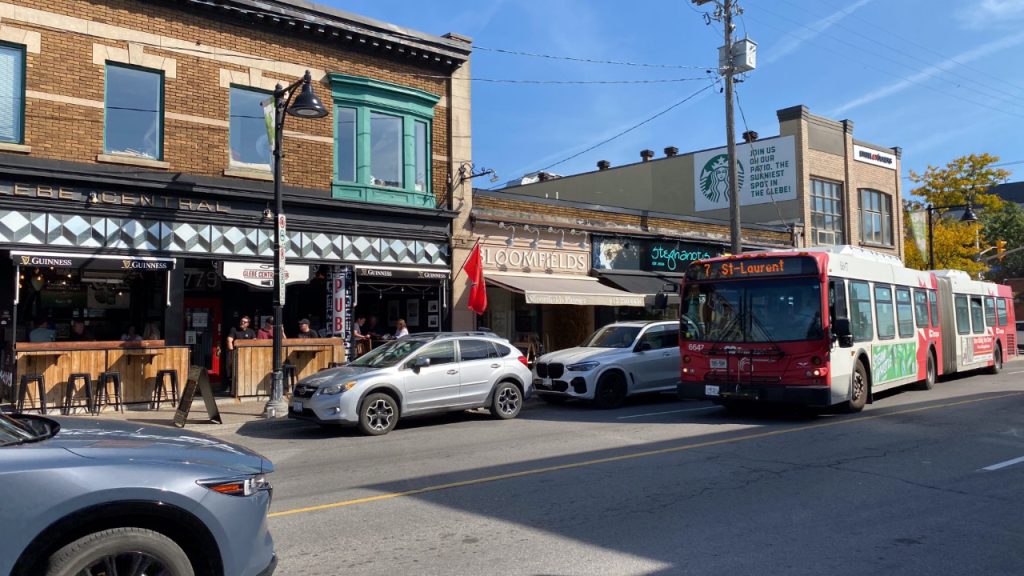
Reducing on-street parking in favour of more permanent bus lanes may lead to loss of customers and revenue for Glebe businesses, the local BIA executive director says.
On March 30, the city’s public works and infrastructure committee will decide whether a plan to install permanent and “time-of-day” bus lanes along parts of Bank Street between the Rideau Canal and Highway 417 will come into effect next year.
The 15-month pilot project, which would run from summer 2027 to the fourth quarter of 2028, would see 17 on-street parking spaces removed to make way for four permanent 24-hour bus lanes on Bank Street at Fourth Avenue, Fifth Avenue and near Lansdowne Park. The report to the committee also recommends further restricting segments of the street to buses-only during peak hours in the morning (7 a.m. to 10 a.m., northbound) and evening (3 p.m. to 6 p.m., southbound).

How Westboro’s female entrepreneurs are making it an attractive destination to live, work and play
When fitness guru Amber Stratton opened the first Pure Yoga studio in Ottawa in 2012, Westboro was her first choice. “The space we found was a really good starting point

How The Ottawa Hospital uses AI tools to boost health outcomes and streamline clinical efficiency
Dr. Douglas Manuel says it all began with the Ottawa Ankle Rules algorithm, a set of clinical guidelines developed in the early 1990s by The Ottawa Hospital’s Dr. Ian Stiell
The recommendations come as Ottawa residents call for better transit reliability and improved active transportation modes, but Darrell Cox, executive director of the Glebe BIA, told OBJ on Friday that the BIA and its members are concerned about what these changes might mean for Bank Street businesses.
“A lot of our members rely on those spaces close to their storefronts for short-term visits, deliveries and, especially now, UberEats,” Cox said of the plan to remove the 17 on-street parking spaces. “The other thing we need to consider is an ageing population. This is an accessible parking issue as well.”
The BIA has put out a petition against the changes that has already garnered 65 signatures, Cox said. “While we support any initiatives that are going to help improve public transportation and active transportation, it can’t be at the expense of the business community.”
Removing on-street parking could have a lasting impact on businesses, he added.
“By removing those spaces, you’re not just taking away 17 spots. What you have to take into account is that (those) 17 spaces are being used over the course of the day. So that could be a couple hundred customers. What’s the potential negative revenue loss from having fewer customers being able to park in the Glebe?”
Cox said the biggest impact will be felt by the businesses along the no-parking segments between Fourth and Fifth avenues and between Fifth Avenue and Regent Street, such as Mad Radish, Yolks, The Papery and Mickle Macks Haberdashery.
The Glebe already has a reputation as a hard-to-park area, Cox argued, and this plan would only exacerbate that problem.
“Businesses are very concerned about that. There’s always that fear, that concern, that people will just go, ‘Well, I’m going to Bayshore (Shopping Centre) or St. Laurent (Shopping Centre),’” he said, adding that Bank Street businesses are already feeling the sting from post-pandemic online shopping habits.
Cox said there is data to show that removing on-street parking spaces can hurt revenues, and added that he hasn’t seen positive data to back this plan.
“What I find rather confusing is that there’s no specific number in the staff report that says (this plan brings) a moderate decrease in travel time … So do we really need to be making all of these changes at the risk of revenue loss to our business community?”
The project comes with a price tag of more than $2.5 million. It is not a priority for the BIA, Cox said, adding that those city funds could be better used elsewhere.
“Ottawa Police Services has reached out to us about … how they can support us because we’re all seeing an increase in crime and theft. We’re seeing an increase in open drug use, now having to collect needles. We would like to see that money be directed to Ottawa Police Services so they can have more of a police presence in the neighbourhood.
“The mayor is committing to reduce youth homelessness by 2030 (and) $2.5 million can play a large role in contributing towards housing,” Cox said.