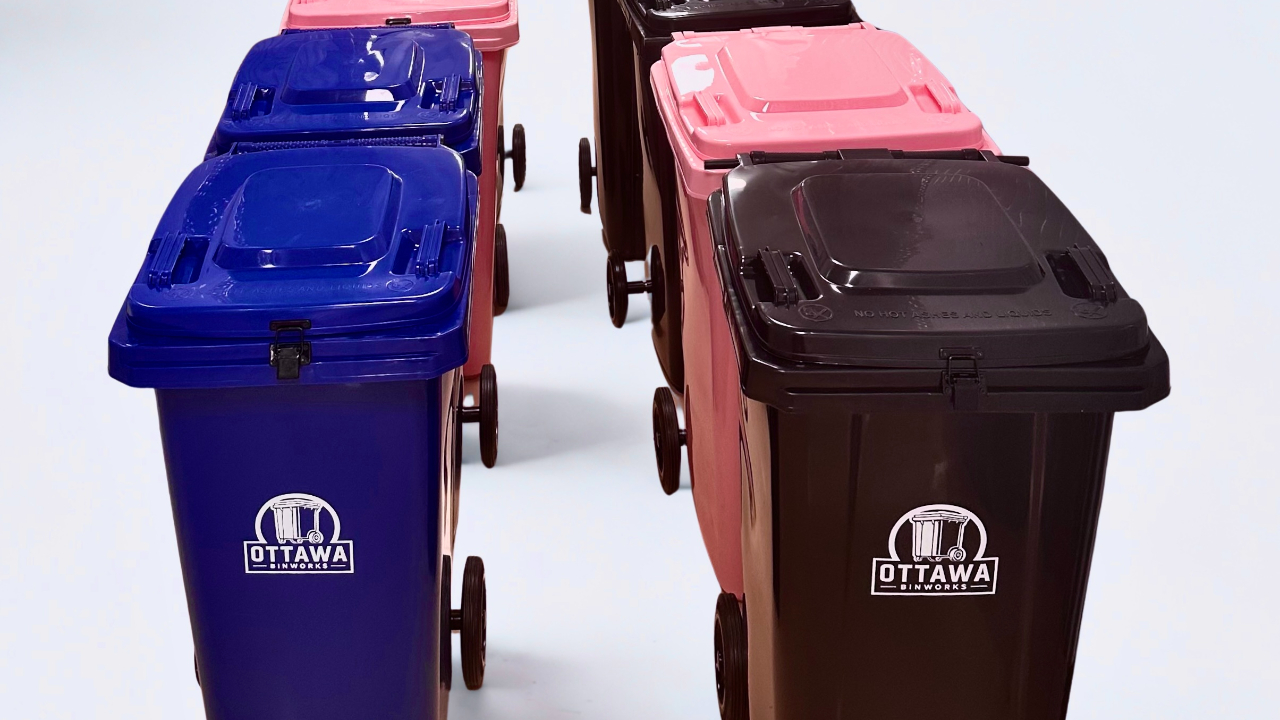

When Shelina Cocker looked online for city-compliant garbage bins last year, none could be found – at least, not for a reasonable price.
Cocker, who has worked at the Canadian Centre for Cybersecurity and internationally for companies such as Meta and LinkedIn, said she came back to Ottawa last year to be with family while she was between jobs.
Not long into her stay, the city introduced a new waste management bylaw, limiting households to three garbage items per curbside collection. One of the three items allowed was a 140-litre garbage bin, with the lid off when waste was collected.
The limit was intended to encourage households to rethink what they were throwing away as well as to extend the life of the Trail Road landfill while the city looks for other waste disposal options.
But for Cocker, when the garbage bin issue came to light, she saw it as a way to occupy her time while helping her community. And so she created Ottawa BinWorks, a company that sells garbage bins that are fully compliant with the city’s new rules.

In researching how to bring the product from idea to reality, Cocker said she first consulted the city on how such a product could follow all its guidelines.
“We wanted to really align with them prior to bringing out a product that would be completely shut down. We actually had a lot of back and forth. It was really amazing to work with the team there because it was a new subject for me, too,” she said. “I would send them photos and diagrams. I sent them the concept of what the hinge would look like and they were available to provide comments on what was working.”
The city told Cocker that compliant bins would need to have a removable lid, but Cocker said she wanted her product to be as accessible as possible.
“I wanted to create something that was super easy, regardless of technical aptitude. You would just be able to move the hinge in the mornings,” she said. Instead of having snap-on lids, Cocker engineered a removable rod at the hinge of the lid, while also adding a robust handle and wheels to allow for easy transportation to and from the curb.
It was no simple task bringing the idea to life, she said, as standard garbage bins in Canada were only made in 120-litre or 240-litre sizes.
“It was a huge challenge. What I learned was that there’s a mould that’s used to create these bins and (it’s) not available in all countries. Nobody has it in Canada and to create the mould it would cost something over $20,000 to $30,000,” she said, adding that she eventually found a manufacturer in China that was willing to partner with her to create the 140-litre bins.
Cocker said she bootstrapped the project. “I was laughing back then because I was like, ‘Oh gosh, I don’t have a job and here I am taking this crazy jump,’” she said. As she was gearing up for her second shipment of products, Cocker said she sought funding from the Women’s Enterprise Organizations of Canada.
In Ottawa BinWorks’s first year, all of the revenue was re-invested into the company to help it grow, but Cocker said that she expects to start seeing some profit as she enters the second year. Thousands of customers have supported Ottawa BinWorks since its launch, she said.
Ottawa BinWorks is a family affair, Cocker noted, with both her sons helping on sales and logistics, and she hopes to grow the team as the company scales.
“We will be looking to formalize the roles and responsibilities by the end of this year once we establish how we’re going to be expanding,” she said, adding that the company currently has seven employees in roles from delivery to sales contractors.
Having started with the standard black garbage bin, Cocker expanded her product line to include recycling bins. More recently, she added a pink garbage bin after a customer request. Cocker said she wanted to give back to the community and tying the pink bins to Breast Cancer Action Ottawa was a natural link.
“The pink bin has become a little symbol for us. It’s a very unique product and we’re getting a lot of positive (feedback) from our customers, which is twofold. People are using it as a novelty bin … but then we have a lot of customers that want to support a local group,” she said.
More colours will be added as the company grows, Cocker said, with a “ soft dove gray” bin being added this week.
In order to spread the word beyond the local community, Cocker has turned to social media.
“We were relying on Facebook when we started because we found that our demographic was local. On the back end, 50 per cent of our customers were coming from Facebook or Instagram, 40 per cent from Google and the last 10 per cent from other sources,” she said.
Earlier this year, Cocker secured partnerships with Rona and Home Hardware, supplying 10 stores across the nation’s capital.
“It was a lot of cold calls. I was taking the bin myself into the stores, demonstrating it for some of the business owners. It was a ground-up approach,” she said.
Now she’s working on partnerships to expand the Ottawa brand on a national scale and potentially to the United States if tariff issues dissipate. Interest in the products has already started, with a shipment being sent to Montreal recently.
“Our next phase will focus on expanding across Canada. That means that we have to bring in (an) extremely large inventory. We definitely want to start looking at investors or other types of resources that we can leverage,” Cocker said.